
Alexa for Shopping (formerly Rufus) is Amazon's conversational shopping assistant, and on 13 May 2026 it took the name it uses today. The system did not change with the name. It reads your title, item highlights, bullet points, A+ content, structured attributes, customer reviews and Q&A, then answers shopper questions in plain language. No listing rework was needed because of the rename.
What did change is the route to the buy button. A shopper can ask a question in their own words, get a short list of products, a comparison and a recommendation, and never scan a page of results in the old way. That rewards a different kind of listing from the one that keyword placement alone produces.
This guide covers what the assistant is, how it works, where it appears, and why listings built only for keywords are losing answers. The field-level method lives in a separate guide, linked below.
What is Alexa for Shopping?
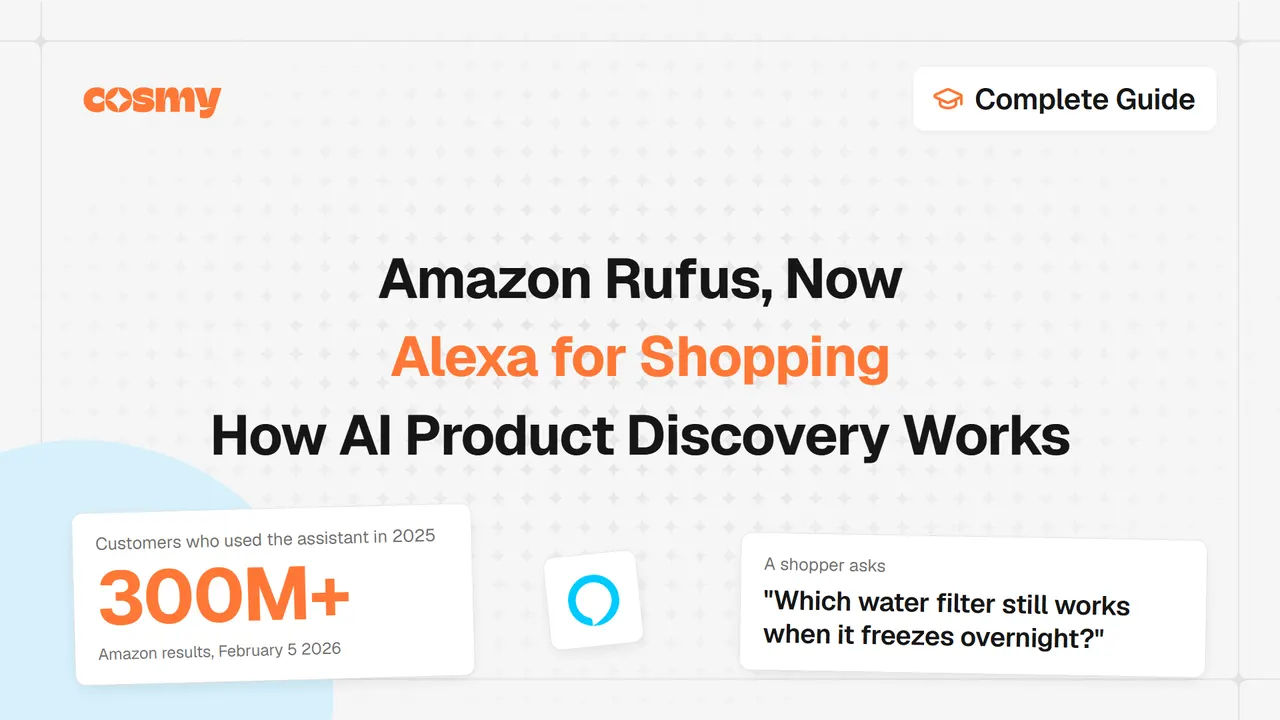
Alexa for Shopping is a generative AI assistant built into Amazon's app and desktop site. It sits in the main search bar and on product pages, and it answers buying questions in the shopper's language. Ask "what do I need for cold weather golf" or "which water filter still works when it freezes overnight" and you get a written answer with products attached, not a list of pages that happen to contain those words.
Amazon launched it as Rufus in February 2024, named after the corgi that spent time in Amazon's first warehouse. Over the following two years it expanded beyond the US and began answering questions typed straight into search. On 13 May 2026 Amazon folded the separate chatbot into its main assistant brand and renamed it Alexa for Shopping. The rename is the whole story: same system, same job, new label for your reports. If you need the short version for a client, what the rename did and did not change is worth keeping on hand.
How many people actually use it?
Amazon's own numbers are the only ones worth quoting. On the company's Q3 2025 earnings call, Andy Jassy said roughly 250 million customers had used the assistant, and that it was on track to drive more than $10 billion in incremental annualized sales. Those are Amazon's figures for 2025, stated while the assistant was still called Rufus. On 5 February 2026, Jassy put the 2025 figure at more than 300 million customers. Either way, they describe the size of the audience, not a result you can expect from one listing.
Why the assistant changes product discovery
Amazon search has always been a matching problem. You found the phrases shoppers typed, placed them in the title, bullets and backend search terms, and the listing appeared. That work still applies to the search results page. It does not answer a question.
A shopper asking whether a fishing reel handles saltwater is not looking for the words. They are looking for a fact. The assistant assembles that fact from whatever your listing, your reviews and your Q&A provide. Four consequences follow.
- Thin listings lose. A page with a keyword-heavy title and three generic bullets gives the assistant nothing to work with, so it recommends a product that does.
- Inconsistency costs answers. When a title says 30 oz and an attribute field says 32, the safest thing an assistant can do is not answer, or answer from someone else's listing.
- Reviews fill your gaps. When your listing leaves a question open, the assistant can answer from reviews, in your customers' phrasing rather than yours. You have not avoided the answer. You have handed it to someone else.
- Intent beats phrasing. A listing written for "camping gear" can surface for "what do I need for a weekend hiking trip" if it states the facts that make it suitable.
The unit of competition is no longer the phrase. It is the fact a shopper asked for, in a form the assistant can retrieve.
How it actually works
This is not a chat model plugged into a storefront. Amazon built a system for commerce, and the parts that matter to sellers are the training data, the retrieval layer and the feedback loop.
A model trained on shopping data
Amazon has described the assistant as running on Amazon Bedrock, with a custom model built for shopping and a router that selects the most suitable model for each question, balancing answer quality against latency. The training data is commerce data: the product catalog, customer reviews, community Q&A and a set of curated external sources. That is why it handles product relationships, categories and shopping language in a way a general model does not.
Retrieval that keeps answers current
Training data goes stale. The assistant handles that with retrieval, pulling fresh facts at the moment a question is asked. When a shopper asks whether a pan is dishwasher safe, the system:
- parses the question to work out the intent;
- identifies which sources could answer it: specifications, reviews that mention dishwashers, manufacturer answers;
- retrieves the relevant records from Amazon's own systems;
- writes a reply that combines what it was trained on with what it just found.
Retrieval is the reason your attribute fields matter. A fact the system can pull is a fact it can use. A fact that exists only inside a lifestyle photo may never reach it.
Where CoSMo fits
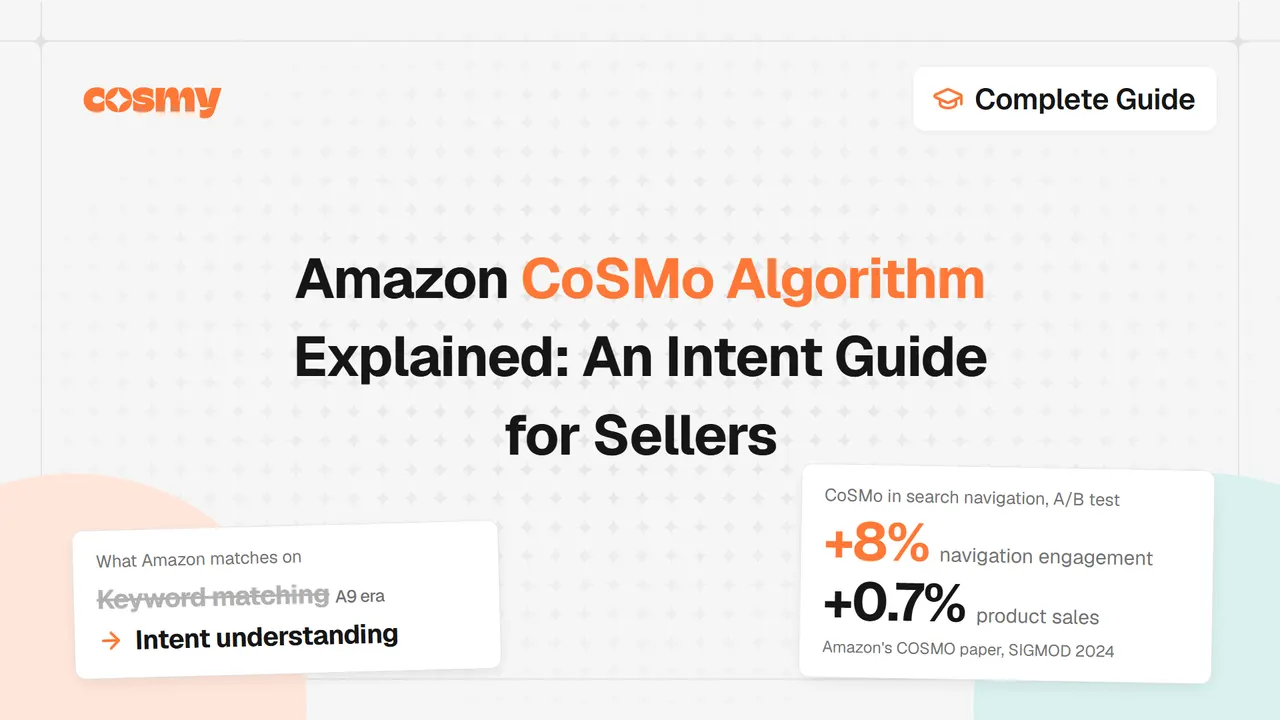
CoSMo is a different Amazon system, and mixing up the two wastes effort. Alexa for Shopping answers a shopper's question. CoSMo is Amazon's commonsense knowledge system, described in Amazon's SIGMOD 2024 paper COSMO: A large-scale e-commerce common sense knowledge generation and serving system at Amazon. It models relations between products and shopper intents, the kind captured by phrases such as used for, used by, used in and capable of. The two reward the same thing from different angles: a listing that states its audience, its use cases and its context in plain words gives the assistant facts to quote and CoSMo relations to match. How CoSMo works alongside the assistant is its own guide.
Learning from what shoppers do
Every interaction feeds the system. Explicit signals such as a thumbs up or thumbs down tell it which answers helped. Implicit ones, including which products a shopper opens after a question and whether the recommendation ends in a purchase or a return, refine future answers. The assistant gets better at connecting a question to the products that satisfy it, which raises the value of a listing that is clear about what it does.
Built to answer fast
Serving conversational answers to a very large audience takes infrastructure. Amazon runs the workload on its own AI chips and has described engineering work on streaming, so a shopper sees the beginning of an answer quickly instead of waiting for the full response. The technical detail changes often and is not worth planning around. The consequence for sellers is simple: the assistant answers from a fixed set of fields, at speed, with no human in the loop to ask what you meant.
The new rules of product discovery
Discovery now has more than one path. Alongside keyword search there is a conversational path where an assistant acts as a filter, a comparison engine and, increasingly, an agent that takes action.
The assistant can act, not just answer
Amazon has introduced features that let shoppers do things through the assistant: adding a set of items to the cart from a photo of a handwritten list, tracking a price and buying when it hits a target, and remembering shopping activity across Amazon services to personalize what it suggests. The practical label for this is agent-discoverable. If an assistant cannot tell what your product is, who it is for and when it applies, it will not choose it, however large the ad budget behind it.
Off-site signals can show up in search
Amazon has also tested modules, such as a "Researched by AI" section spotted on mobile search in November 2025, that cite editorial coverage from outside publications near standard results. If that continues, credibility earned off Amazon could shape what shoppers see on Amazon. Amazon has not documented how much weight this carries, so treat it as a reason to earn genuine coverage, not as a lever you can pull on demand.
Ads do not always sit on top
Sponsored Products prompts and Sponsored Brands prompts became generally available in the US on 25 March 2026, billed per click like any other sponsored placement, so paid answers exist inside the assistant. What Amazon has not published is how paid and organic recommendations are blended in a generated answer. That shifts where your effort pays off:
- Content quality is the equalizer. A smaller brand with complete, factual listings can be chosen over a larger brand with vague ones.
- Ad spend does not fix a thin listing. If the page cannot answer the question, a bigger budget buys more people for an answer that goes nowhere.
- Content compounds. Ads stop the moment you stop paying. Facts in your listing keep working.
How to optimize your listing for Alexa for Shopping
The rules moved, and they moved toward clarity. Here is the short version. The full method, field by field, is in Optimizing Amazon Listings for Alexa for Shopping.
- Write the title as brand, product type and the one fact most likely to decide the purchase. Titles are capped at 75 characters including spaces since 27 July 2026, in every category except media. The 75-character title cap broke a decade of keyword-packing convention, so pick what survives.
- Move the rest into item highlights, which allow 125 characters. Materials, size and use cases belong there now, not in the title.
- Answer the questions Amazon already shows on your product page. Open your own listing, read the suggested questions, and make sure a sentence in your copy answers each with a number or a fact.
- Fill every structured attribute. Material, dimensions, capacity, compatibility and intended use are retrieved directly. Empty fields are answers you have left to chance.
- Stop leaning on reviews and Q&A to do your work. Ask buyers for specific reviews, seed honest Q&A entries on common questions, and fix anything the reviews repeatedly contradict.
- Treat A+ content as a data source. Put facts in text modules rather than in images, and mirror any claim that appears only in a graphic into a bullet or an attribute.
- Keep every field consistent. One capacity, one set of dimensions, one story across the page.
- Measure mention rate rather than rank. Ask a fixed set of buyer questions on a fixed schedule and count how often you are named. AI shopping visibility explains why no position exists to track.
None of this is keyword stuffing with extra steps. It is writing down what your product is, in the fields Amazon reads.
What comes next
Three things are worth watching, and none of them should change your plan this quarter.
International coverage. Amazon has described the rename as a US launch. Amazon has not published a market-by-market schedule beyond that, and any timeline you read elsewhere is an estimate.
Outside AI agents. Amazon's leadership has said the company will look for ways to work with external AI assistants, so that a shopper using a different assistant could still be routed to Amazon products. No integration has been announced. Treat it as a direction of travel, not a channel to plan around yet.
Model updates. Amazon keeps revising the models behind the assistant and has not published a roadmap. The safe assumption is that the bar for explicit, factual content rises rather than falls, because that is what every version of the system has needed.
Where to focus
Most of what decides whether the assistant names your product is unglamorous: a title inside the cap, highlights that state hard facts, attributes filled in, and questions answered in your own copy. Sellers who do that work get quoted. Sellers who leave it to their reviews get represented by a stranger's sentence, if they get represented at all.
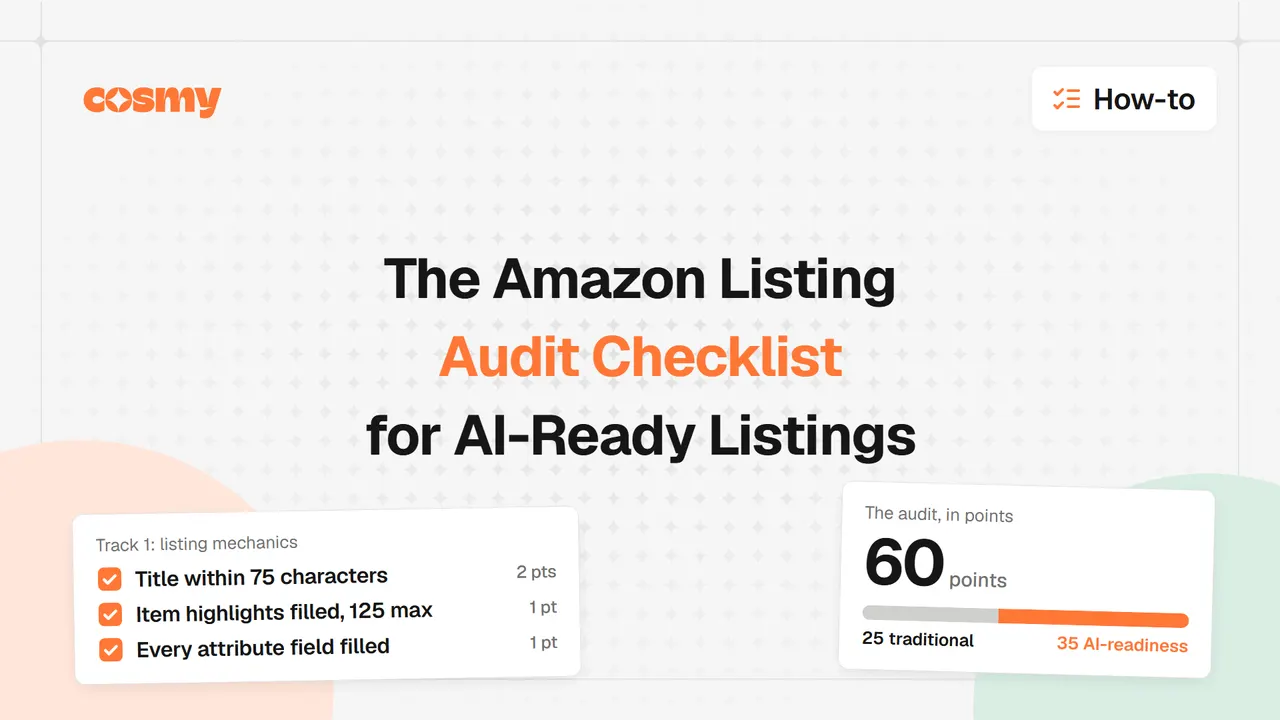
Start with an audit rather than a rewrite. Work through the listing against the questions buyers actually ask, using the listing audit checklist, then fix the fields that fail.
If you want to see those gaps on your own product, Cosmy's Amazon listing quality checker is free. Enter an ASIN and it shows the shopper questions your listing cannot answer, which is where the work starts.