
Amazon already summarizes your reviews for shoppers, so the fastest check is a diff. Put the "Customers say" summary on your product page next to your listing, and list what shoppers say that your listing never states. Alexa for Shopping (formerly Rufus) answers from listing details, customer reviews and community Q&As, so a gap you can see in the summary is a gap the assistant can see too. Then add the facts that are true of your product to the right field, in your own words. Never paste review text into a listing.
Why this matters
Amazon says review highlights receive hundreds of millions of impressions weekly, and that the number of customers who engage with them grew 100% year over year. Amazon's Q4 2025 results said more than 300 million customers used Rufus, now Alexa for Shopping, in 2025. Your listing has to agree with the summary shoppers see.
Where does Amazon already summarize your reviews?
Review highlights sit directly above the reviews on product pages. Amazon describes them as a short summary of customer sentiment based solely on the content from customer reviews, updated as new feedback arrives. Click an aspect, such as durability, and the page shows how many customers mention it, split into positive and negative.
Two rules from Amazon's explainer matter here:
→ Highlights use text reviews from Verified Purchases only.
→ Multiple customers must share an opinion. Amazon publishes no threshold number.
Shoppers can also ask the assistant "What do customers say?" So the summary is not a side feature. It is one of the ways the assistant talks about your product.
How do you compare the summary with your listing?
Copy three things from the page: the summary paragraph, the aspect tags, and the mention counts. Then check each theme against your title, bullets and A+ content.
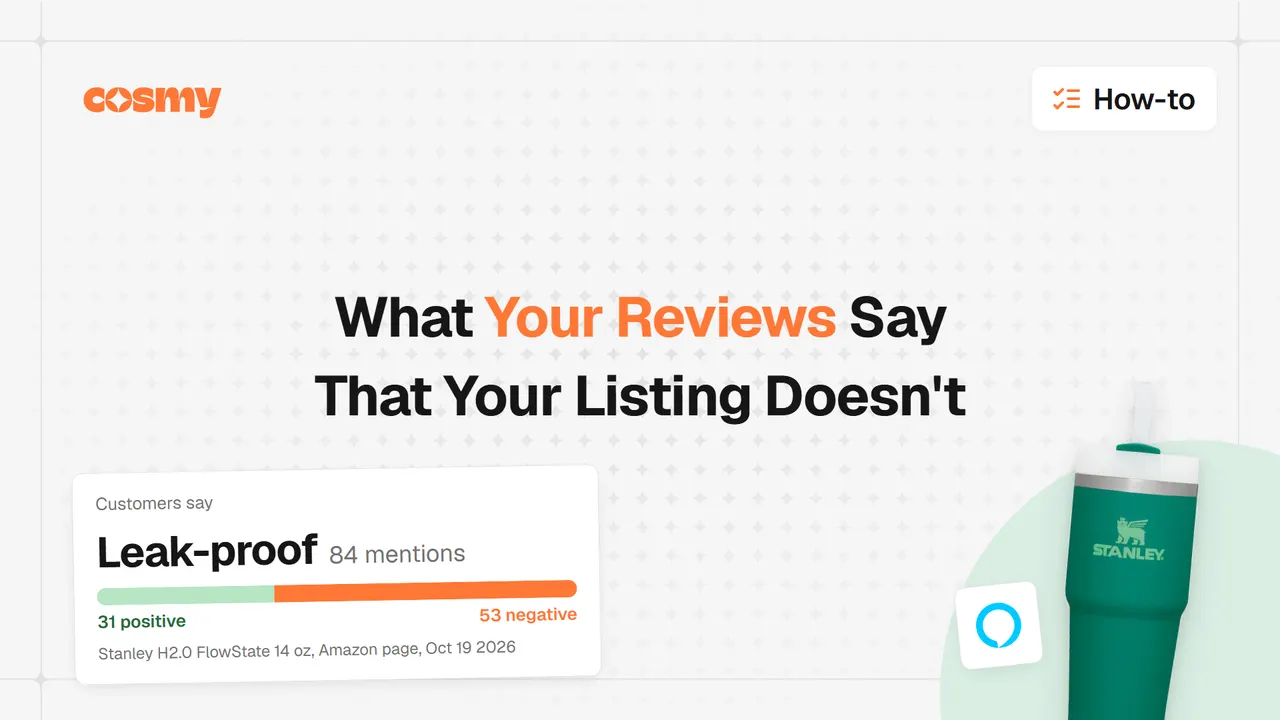
Here is a worked example. On 19 October 2026 we read the live amazon.com page for the Stanley Quencher H2.0 FlowState tumbler, listing B0D674YVLS, shown as the 14 oz Alpine variant (ASIN B0C448DCKZ). The review summary there describes temperature retention and durability as strengths and the leak-proof feature as mixed.
| Theme in highlights | Mentions (positive / negative) | Does the listing state it? |
|---|---|---|
| Temperature retention | 171 (155 / 16) | Yes. Double wall vacuum insulation, drinks stay cold, iced or hot "for hours". No duration tested or stated. |
| Durability | 63 (53 / 10) | Yes. Recycled stainless steel built for "a lifetime of use". |
| Leak-proof | 84 (31 / 53) | Yes, as a claim. The lid copy says the full-cover position adds leak resistance and prevents spills. Most reviewers who mention it disagree. |
Temperature retention and durability agree with the copy. Leak-proof does not: more reviewers mention it negatively than positively. That is the gap that matters most, and it is a mismatch, not a missing fact.
This is our reading of one page on one day. It is not a verdict on the product.
What about the questions, not only the praise?
Praise tells you what to keep saying. Complaints and questions tell you what the listing leaves open.
Sort each gap into one of three bins:
→ True and unstated. Add it. If reviewers keep naming a use, a user or a fit your copy never mentions, that is a fact the assistant can only get from reviews. Check that several reviewers say it before acting: one review is a lead, not a pattern.
→ Contradicted by reviews. Fix the claim or set expectations. For the lid, say what each of the three positions does and does not do.
→ Not a listing problem. The summary also notes tumblers arriving dented and dirty. No bullet fixes that. It is a packaging and fulfillment problem.
If your product is in a regulated category, add a gap only if you can substantiate it.
How do you rewrite a gap without copying a review?
Amazon prohibits quoting reviews verbatim in listings. It is also weaker copy. Here is an illustration for a generic small tumbler, not Stanley's copy:
→ Bad: "Great for my toddler, keeps drinks cold all day! Five stars." (a pasted review)
→ Rewrite: "14 oz size built for smaller hands and backpack side pockets. Narrow base fits standard car cup holders. Rotate the lid to the full-cover position when carrying: the straw opening can leak if the cup tips."
The assistant already holds the review. A pasted quote adds nothing it cannot read, and it is one person's opinion. The rewrite adds listing-level facts it can cite, and it agrees with what the highlights say. Only write what is true of your product.
What do reviews not feed?
Amazon describes reviews as feeding highlights and assistant answers. It describes CoSMo differently: Amazon's SIGMOD 2024 paper, covered in our CoSMo guide, builds its 15 relations from search and co-purchase behavior. Treat reviews as evidence for the first job, and do not assume they move the second. Any CoSMo score is a tool's own measure of your content, not a number Amazon shows.
What to do next
- Open the product page. Copy the "Customers say" paragraph, the aspect tags and the mention counts.
- Build a three-column table: theme, does the listing state it, in which field.
- Fill the true gaps. Add each fact to the right field (title, bullet or A+ module) in your own words. Do not quote reviewers.
- Handle the real complaints. Fix the product or set expectations in the listing. Do not hide them.
- Re-run the check when highlights change. They update as new reviews arrive.
Where to start
Doing this by hand works for one ASIN. A free account at cosmy.ai runs review analysis on an ASIN you add, returning themes, shopper language and unmet needs that inform your wording and never replace it.