
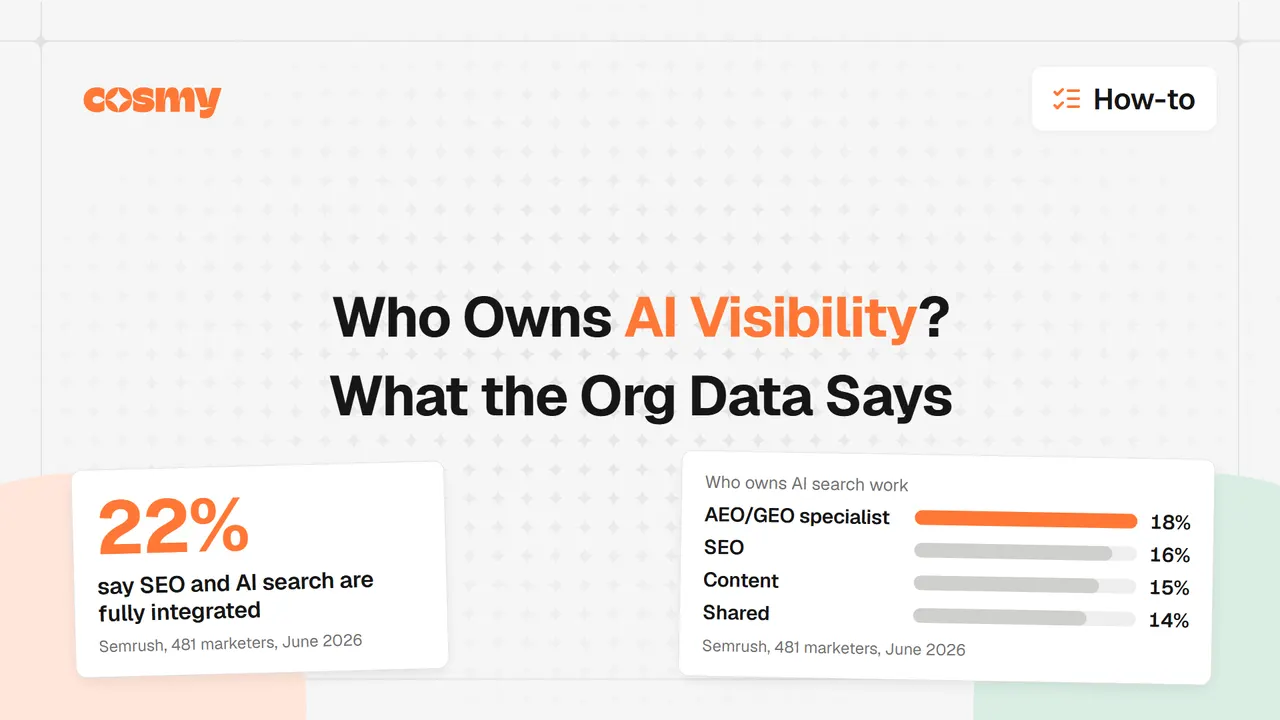
Name one accountable owner for AI visibility, and give every team that touches it the same scorecard. Split ownership is the norm, so do not start by building a new department. In a Semrush survey of 481 marketers (3 June 2026), only 22% said SEO and AI search are fully integrated, and no single role owned AI search in more than 18% of teams. For a marketplace seller, we recommend the owner be whoever controls the listing fields, with ecommerce ops feeding the same number from the product feeds.
Why this matters
Nobody is in charge by default. Semrush found that one in ten teams has no clear owner at all, and that ownership of AI search was scattered across seven functions. This article is a recommended model, not a measured one, and the last section says what the data cannot prove.
How do you find out who owns AI visibility today?
Ask one question: who can change the thing the AI reads, and who reports on whether it worked?
On Amazon, the AI reads the listing. That means the title, bullets, A+ content, images, and the review and Q&A layer. Off Amazon, it reads product feeds and structured data. These usually sit with different people.
Write down every name that touches each of these:
→ Title, bullets and description
→ A+ content and images
→ Review and Q&A response
→ Product feeds and structured data
→ The report that says whether AI visibility moved
Expect more than one name. That matches the survey. In the Semrush data, no function won the ownership question: an AEO/GEO specialist or team lead 18%, SEO 16%, content 15%, shared ownership 14%.
Why name one accountable owner?
Because "shared" is how a number ends up with no name on it. Shared ownership was the answer for 14% of teams in the survey. It is also the arrangement that leaves "who is responsible when it drops?" hardest to answer.
The test is simple. When the number drops, whose name is on the question? If the answer is two names or a team, you do not have an owner yet.
The owner does not do all the work. The owner answers for the number, decides what gets fixed first, and calls the monthly review.
Here is the difference, illustrative and not a real team.
Before: "Marketplace and ecommerce ops share AI visibility."
After: "The marketplace ops lead owns the AI visibility number. Ecommerce ops owns the feeds that feed it."
The first line has no name in it. The second can be asked a question.
For a marketplace seller, we recommend the owner sits with marketplace ops. They control the fields the AI reads most directly. A search or content lead who cannot edit the listing can advise, but cannot fix.
How do you map each task to the team that controls the field?
Put every field in one table: where it lives, which team can change it, and who owns the number. This is the table we recommend as a starting point. It is illustrative, so rename the teams to match yours.
| Task | Where it lives | Team that controls it | Who owns the number |
|---|---|---|---|
| Title and bullets | Amazon listing | Marketplace ops | Marketplace ops lead |
| A+ content and images | Amazon listing | Marketplace ops | Marketplace ops lead |
| Review and Q&A response | Amazon listing | Marketplace ops | Marketplace ops lead |
| Product feeds and structured data | Feeds sent to other AI surfaces | Ecommerce ops | Marketplace ops lead (ecommerce ops feeds the number) |
| Monthly scorecard | Shared sheet | Both | Marketplace ops lead |
The last column is the point. Many teams do the tasks. One name sits in the last column.
We recommend marketplace ops as that name because most of the rows are theirs. The rule is that the owner follows the fields.
How do you build one shared scorecard?
Both teams read the same numbers. No second dashboard.
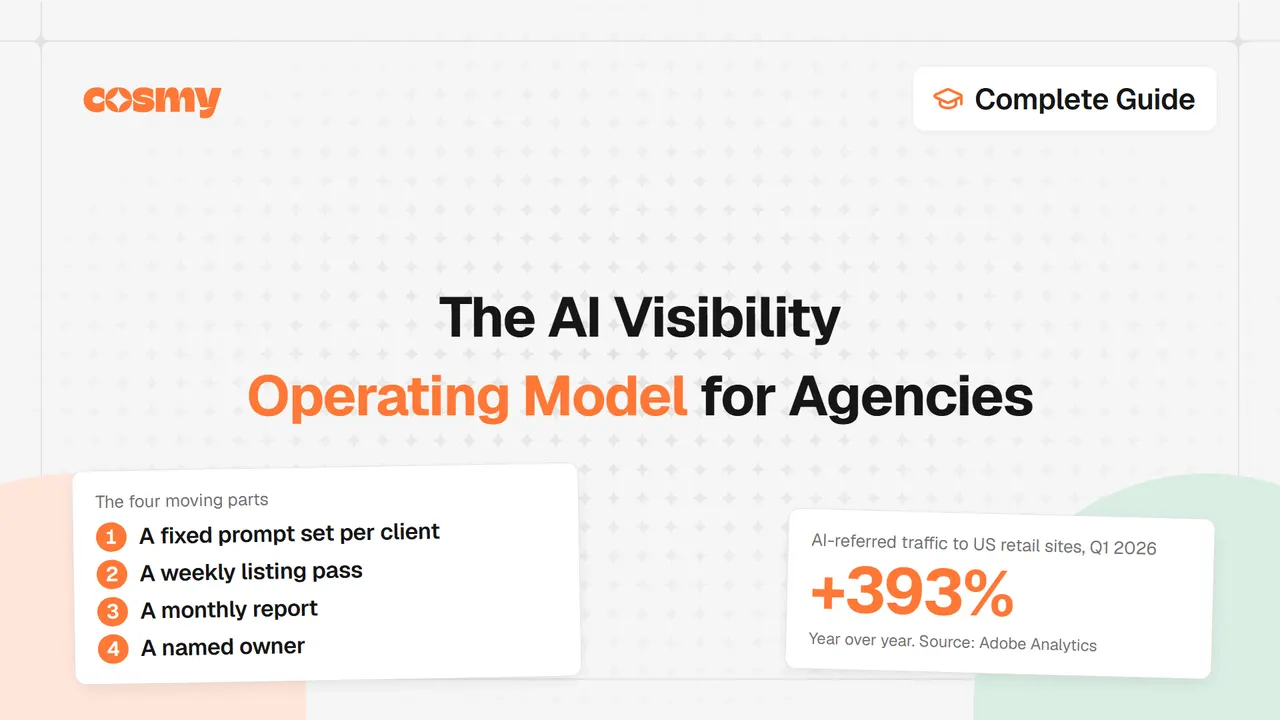
Do not invent a new measurement method. Use the one in How to measure AI shopping visibility: a fixed set of buyer prompts, run on the same date each month, recorded the same way. Two reasons.
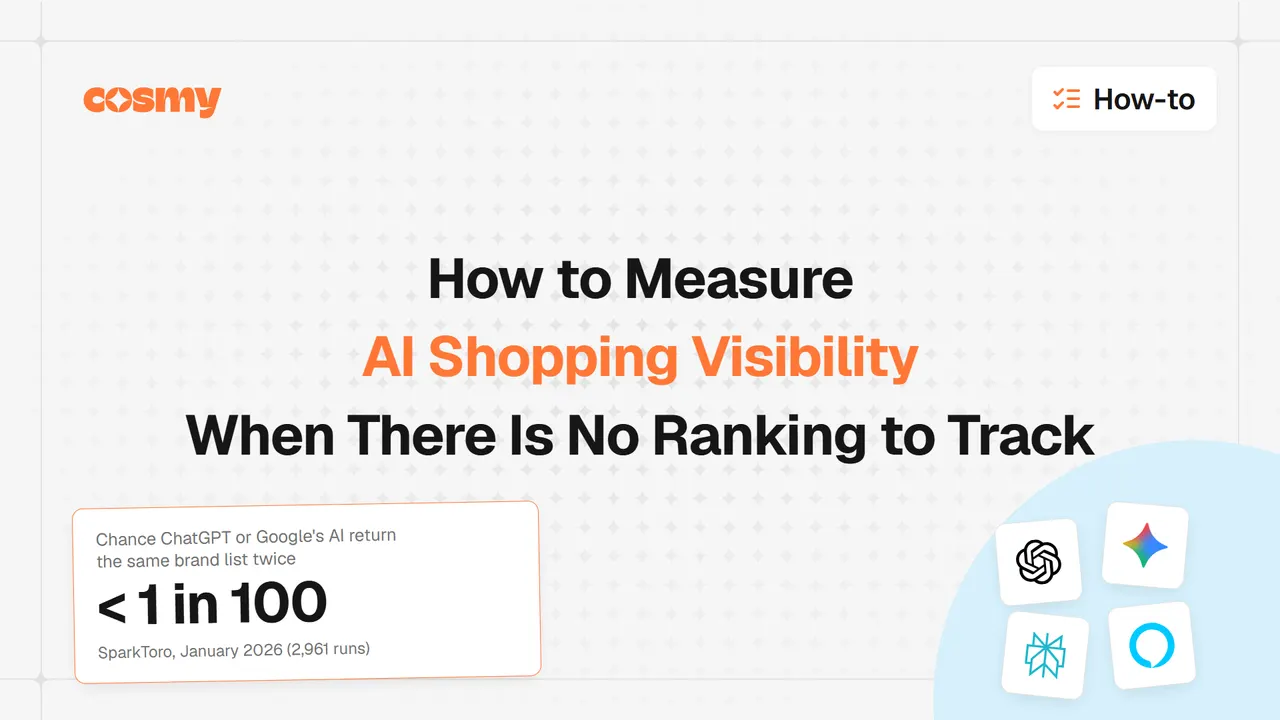
→ AI answers vary between runs. SparkToro found less than a 1 in 100 chance that ChatGPT or Google's AI return the same brand list in two responses (600 volunteers, 2,961 runs, 28 January 2026). A scorecard needs one fixed method, or the owners argue about noise.
→ If each team measures differently, the owner cannot tell whether a change helped.
Keep it to three lines per surface: share of prompts where you are cited, which products appear, which competitor domains keep showing up.
What does the monthly review look like?
Both teams in the room, same date every month. Walk the scorecard in order. First, did the number move? Second, which task row explains it? Third, who is fixing what before the next review?
If there is no movement and nobody can say why, that is the signal to re-nominate the owner. The weekly and monthly cadence behind this is in the AI visibility operating model.
What can the survey not tell you?
Read it with these limits.
→ Semrush is a vendor. The sample is marketers, SEO professionals and business owners. It is not a sample of marketplace sellers or agencies.
→ It is self-reported. People described their own teams. Nobody audited the org charts.
→ It is correlation, not causation. Semrush found that only 3% of teams seeing results from AI search report having no clear owner, against 22% of teams not seeing results. That is a link. It does not show that naming an owner produces results.
→ Our model is a recommendation. We have not measured that one-owner teams outperform others on a marketplace. We recommend it because it is easy to check: a name, a table, a scorecard.
What should you do next?
- Write down who touches AI visibility today (listing, A+ content, reviews, Q&A, feeds) and who reports on it. Expect more than one name.
- Pick one accountable owner. Test: when the number drops, whose name is on the question?
- Put every field in one table: field, team, owner of the number.
- Agree one scorecard both teams read, using the same fixed prompts each month.
- Review it monthly with both teams. Re-nominate the owner if there is no movement and no explanation.
Where to start
Pick one ASIN, name its owner, and run a free analysis of that listing at cosmy.ai to see what the AI needs that the listing does not say.