Five surfaces decide whether an AI recommends your product: Amazon's Alexa for Shopping (formerly Rufus), Walmart's Sparky, ChatGPT, Google's AI Mode and Gemini, and Perplexity. They do not read the same inputs. Amazon and Walmart read the listing you maintain in their own seller tools. ChatGPT, Google and Perplexity read product feeds, plus whatever else they can retrieve. All five reward the same thing: complete, explicit, non-contradictory product facts. What does not transfer is the field mechanics, because every platform publishes its own schema, limits and onboarding.
Why does this matter now?
Adobe Analytics reported that traffic from AI sources to US retail sites grew 393% year over year in the first quarter of 2026. In March 2026, that traffic converted 42% better than non-AI traffic, a new high. A year earlier it converted worse. Shoppers who arrive from an AI answer are already further along. The question is which surfaces can find your product in the first place.
Which five surfaces pick products?
A surface is any place where an AI system chooses which products to show or name. Each one is run by a different company with a different data pipeline.
| Surface | Run by | Where you feed it | What the owner documents |
|---|---|---|---|
| Alexa for Shopping | Amazon | Your Amazon product detail page | Detail page and attribute guides in Seller Central |
| Sparky | Walmart | Your Walmart Marketplace item setup | Item Spec and product details policy |
| ChatGPT shopping | OpenAI | A product feed, through the Agentic Commerce Protocol (ACP) | Product feed spec |
| AI Mode and Gemini | Merchant Center product data | Product data specification, Universal Commerce Protocol (UCP) | |
| Perplexity shopping | Perplexity | Its merchant program | Merchant Program terms |
This guide maps what each owner says in its own documentation. It does not rank the surfaces or claim to know their ranking logic. None of them publishes that.
What does each surface say it reads?
Alexa for Shopping on Amazon
Amazon announced Alexa for Shopping as the combination of Rufus's product expertise with Alexa+. Customers can ask it questions in the main Amazon search bar and compare products from search results. Amazon retired the Rufus name on 13 May 2026. The full story is in our Alexa for Shopping optimization guide.
What it reads, per Amazon's own Seller Central help: for specific questions such as "What are the dimensions?" or "Is this machine washable?", Alexa for Shopping uses information from the product's detail page. Amazon's attributes guide adds that complete and accurate attributes help the assistant give more accurate product information. Amazon also says the detail page is a shared space: Amazon chooses what to show based on manufacturer and seller contributions.
Behind the assistant sits a research system. Amazon Science published COSMO at SIGMOD 2024. It builds a commonsense knowledge graph from shopper behavior, expanded to 18 major categories, and the paper says it has been deployed in search applications such as search navigation. The paper does not say how any single listing is scored.
Sparky on Walmart
Walmart introduced Sparky on 6 June 2025. The announcement says it can synthesize reviews, answer product questions and compare items. It does not list the data fields Sparky reads. Anything more specific than reviews and product information would be a guess.
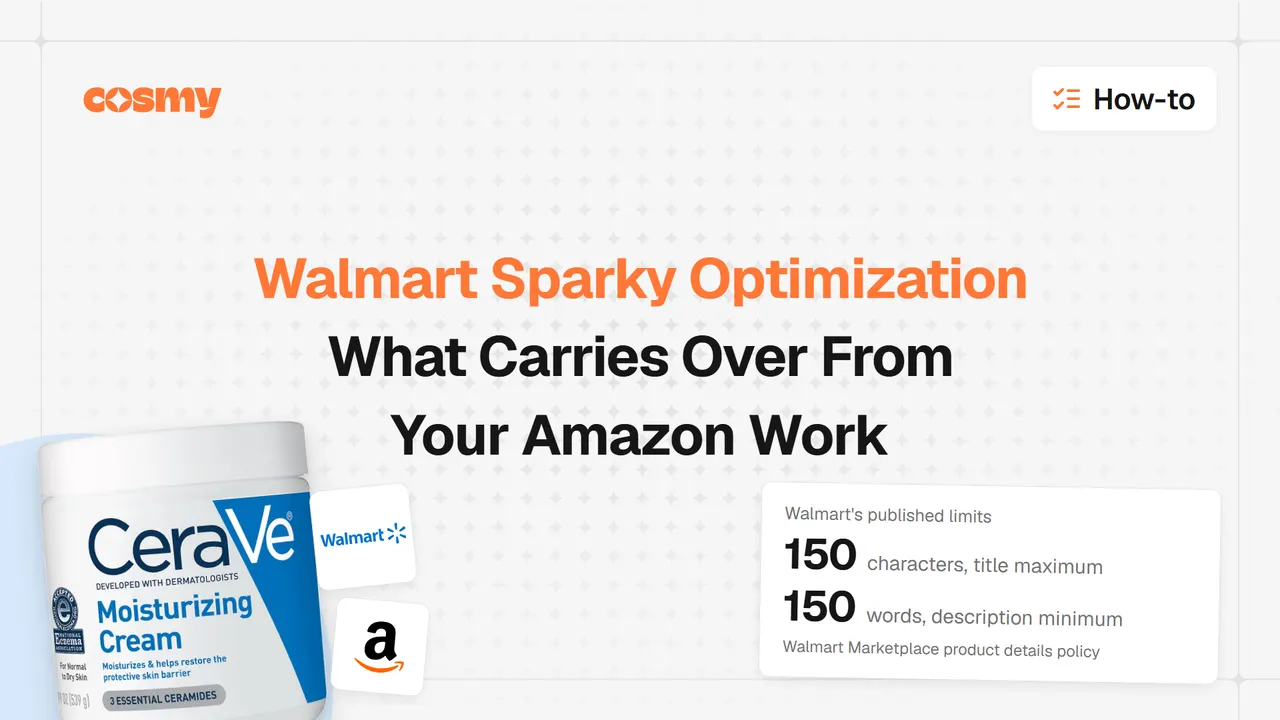
What Walmart does document is the content that feeds its catalog. Its product details policy says title, description, key features, images and additional attributes help determine how items appear in search and browse results. Item Spec 5.0 moved more attributes to structured text, so listings land in the correct shelves and navigation paths on Walmart.com. The detail is in Walmart Sparky optimization.
ChatGPT shopping
OpenAI's route in is the product feed. Its product feed specification asks for one row per purchasable item or variant, with nine required fields: item_id, title, description, url, brand, seller_name, image_url, availability and price. It recommends titles of at most 150 characters and descriptions of at most 5,000. Optional fields cover variants, product attributes, shipping and returns.
OpenAI's key concepts guide says required fields ensure correct display of price and availability, while recommended attributes such as rich media, reviews and performance signals improve ranking, relevance and user trust. Feeds are refreshed with daily snapshots. OpenAI's Get Started page describes feed onboarding as limited to approved partners, so check current access before planning around it.
ACP is the protocol behind this. We compare it with Google's in ACP vs UCP explained.
AI Mode and Gemini on Google
Google's inputs are the Merchant Center feed you may already maintain. Its product data specification says Google uses this data to match your products to the right queries. Required attributes include ID, title, description, link, image link, availability and price, with brand required for most new products. GTIN is strongly recommended when available.
Google's UCP FAQ says Merchant Center remains central: you must keep product feeds, brand assets and return policies complete and up to date there. It also says UCP is designed for AI Mode in Google Search and the Gemini app, and covers discovery and consideration, powered by the Shopping Graph.
Perplexity shopping
Perplexity's route is its Merchant Program, announced in November 2024 as a free program for large retailers to share product specs. Perplexity says products in its index have better chances of appearing as a recommended product. The program terms define product data broadly: title, price, description, brand, availability, shipping, images, returns and more, delivered as CSV or XML.
Perplexity publishes less detail than the other four, and the program is aimed at large retailers. Read the program page yourself before relying on any detail.
What transfers between surfaces?
Facts transfer. Formats do not. Four kinds of work carry across all five.
→ Complete attributes. Amazon says complete attributes help its assistant answer. Walmart says to fill in as many attributes as accurate information allows. OpenAI and Google list required fields and treat extra attributes as optional upside. Every owner asks for the same underlying thing.
→ One true version of each fact. If your Amazon title says 16 oz and your Walmart attribute says 12 oz, every surface that reads either one sees a contradiction. Pick one source of truth for each spec.
→ Answers to the questions shoppers ask. Amazon's own examples are dimensions and machine washability. These are plain facts that should exist in a field, not buried in a paragraph.
→ Reviews and ratings. Walmart's announcement says Sparky synthesizes reviews. OpenAI lists reviews as a recommended attribute. Amazon's announcement says Alexa for Shopping compares features, prices and reviews. Review quality is not something a feed fixes, but all three treat it as an input.
Here is one illustrative product, not a real ASIN, to show how a single fact moves across fields.
| Where | Before | After |
|---|---|---|
| Amazon bullet | Easy to clean | Machine washable at 30 degrees, no dry cleaning needed |
| Walmart key feature | Easy to clean | Machine washable, no dry cleaning |
| OpenAI feed description | Easy to clean | Plain-text sentence stating the same wash instruction |
| Merchant Center description | Easy to clean | Same sentence, same wording |
The before column fails every surface. "Easy to clean" cannot answer "Is this machine washable?" The after column is one fact, written once, placed in four different fields. That is the transferable work.
What does not transfer, and why?
Everything mechanical. Each owner has its own caps and its own schema.
| Item | What the owner documents |
|---|---|
| Walmart title | Not exceeding 150 characters |
| Walmart description | One paragraph, a minimum of 150 words, varying by category |
| Walmart key features | Three to 10, each within 80 characters |
| OpenAI title and description | At most 150 and 5,000 characters, as recommended |
| OpenAI required fields | Nine, including seller_name and item_id |
| Google required attributes | ID, title, description, link, image link, availability, price, and brand for most new products |
Amazon's own title cap is a separate case: 75 characters from 27 July 2026, covered in our title cap article. A title written to Amazon's cap is a poor Walmart title and a poor feed title, and the reverse is also true.
Three more things do not move between surfaces.
→ Attribute vocabularies. Amazon attributes vary by product type. Walmart's Item Spec has its own structured attributes. Google and OpenAI have their own field names. Mapping is manual or tool-assisted.
→ Access. A listing on Amazon or Walmart is yours by default. A ChatGPT or UCP integration is not: OpenAI describes feed onboarding as limited to approved partners, and Google says UCP checkout is available to select merchants. Perplexity routes merchants through a sign-up.
→ Checkout. Under UCP, Google's FAQ says you remain the merchant of record. Amazon and Walmart sell on their own stores. The protocol differences are the subject of ACP vs UCP explained.
What do you control on each surface, and what do you not?
| Surface | You control | You do not control |
|---|---|---|
| Amazon | Title, bullets, description, attributes, A+ content, images | What Amazon shows on a shared detail page, how the assistant ranks answers |
| Walmart | Item content and attributes against Item Spec | What Sparky reads from them, since Walmart does not say |
| ChatGPT | The feed: fields, freshness, completeness | Whether you are accepted into onboarding, and ranking |
| Merchant Center feed and brand assets | Eligibility for UCP checkout, and ranking | |
| Perplexity | Product data you submit through its program | Whether and when it recommends you |
The pattern is the same everywhere. You control the data. The platform controls selection. No owner publishes a ranking formula, so any guide that promises one is guessing.
Product schema on your own website is a fourth input that sits outside every platform program. We cover what is worth implementing in product schema for AI.
Where should you start, by where you sell?
Match the first move to where your revenue already is.
→ Amazon only. Start there. Complete the required, recommended and all-attribute views in Seller Central, then tighten bullets so each answers a shopper question. Everything else is optional.
→ Amazon and Walmart. Keep one master sheet of product facts. Fill both sets of attributes from it. Then rewrite titles to each platform's own limit.
→ Your own site on Shopify, or a Merchant Center account. You may be closer to Google and ChatGPT than you think. Google works from the Merchant Center feed you already maintain. Check whether your platform or feed provider already supports these feeds before building your own.
→ Brands selling everywhere. Start with the master sheet, then check each surface's access rules before building anything. For most sellers it is three surfaces, not five.
The hub for this pillar maps the territory. The depth lives in the spokes: Walmart Sparky optimization, product schema for AI and ACP vs UCP explained.
How do you measure visibility across all five?
None of the five gives you a shared dashboard. Measure the same way on each, with your own repeatable check.
→ Pick 10 to 20 buyer questions for one product. Use the wording real shoppers use.
→ Ask each surface the same question on the same day each month.
→ Record whether your product appears, what the answer says about it, and whether the facts match your listing.
→ Mark every answer that is thinner than your data deserves. That is a data gap on your side, not a platform quirk.
→ Re-check after any content change, not before.
Adobe's numbers show why this is worth doing. AI-referred visits to US retail sites grew 393% year over year in Q1 2026. Without your own check, you will not know which of your products those visits can find. For the category view, read the AI shopping visibility guide.
What to do next
- List the surfaces that matter for your category. For most marketplace sellers it is three.
- Build one master sheet of product facts: dimensions, materials, care, compatibility, pack size. One value per fact.
- Fix attributes first on the platform where you sell most. Complete the required, recommended and optional fields.
- Check access for each feed-based surface before you build: OpenAI onboarding, Google UCP, Perplexity's program.
- Run the same 10 to 20 buyer questions every month, same wording, same day, and log the answers.