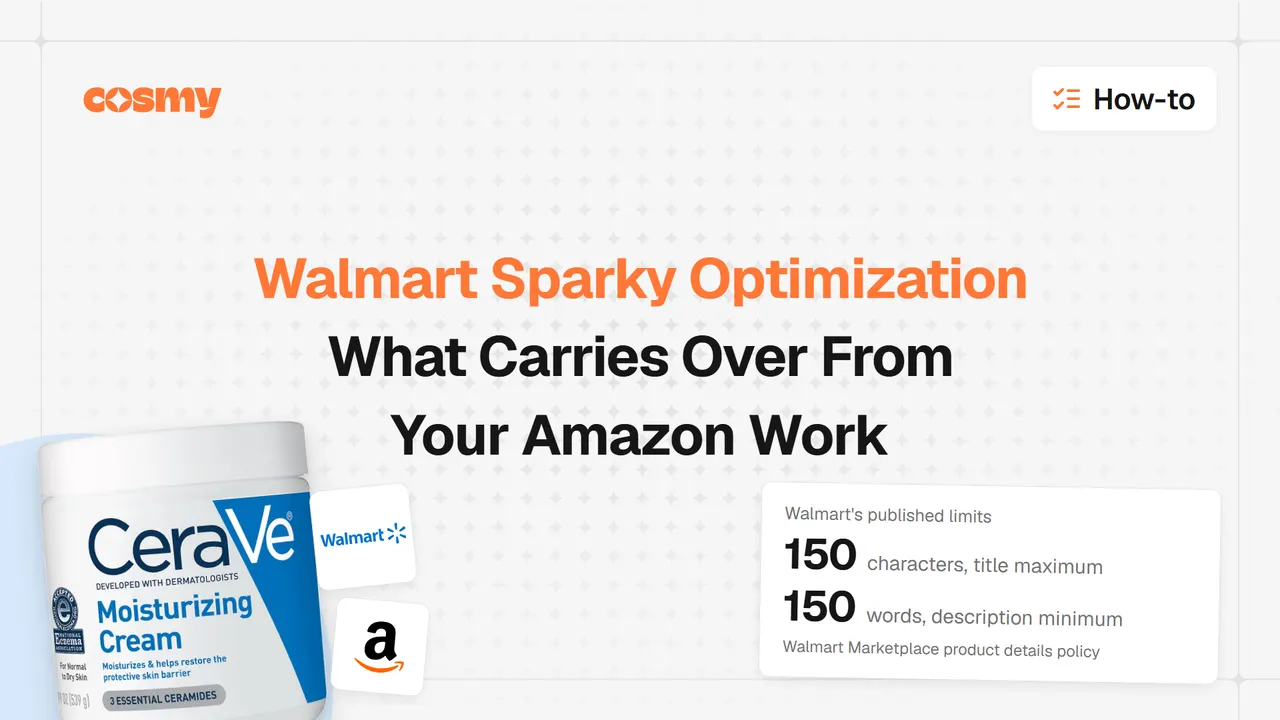
Most of it carries over. Sparky is Walmart's AI shopping assistant, and Walmart says it works from reviews and product data. So the habits you built for Alexa for Shopping (formerly Rufus) still apply: complete attributes, plain answers, strong reviews. What changes is the rulebook. Walmart publishes hard limits on titles, descriptions and key features, and it scores your listing in Seller Center. Check those first, then fix attributes.
Why this matters
Walmart's leadership put a number on Sparky on the fiscal 2026 Q4 earnings call, held on 19 February 2026. Customers who use Sparky have an average order value "about 35% higher than non-Sparky customers." That compares two groups of shoppers. It does not say optimized listings cause bigger baskets. On the same call, Walmart executives said roughly half of Walmart app users have used Sparky.
What is Sparky, and when did it arrive?
Walmart announced Sparky in a newsroom post dated 6 June 2025. Customers reach it through the "Ask Sparky" button in the Walmart app, across all categories. Walmart describes it as helping customers search, synthesize reviews and compare options.
One limit on everything below. We found nothing in Walmart's seller documentation that explains how Sparky ranks or reads a listing. So this guide sticks to what Walmart does publish: its content rules and its listing score. Treat anything beyond that as a guess, including ours.
Step 1: Check your title, description and key features against Walmart's limits
Walmart's product details policy sets numbers. Amazon habits break some of them.
| Field | What Walmart publishes | Carries over from Amazon? |
|---|---|---|
| Title | Brief titles, not exceeding 150 characters. No all caps, no special characters such as ~ ! * $, no promotional claims. | Partly. Clear, descriptive titles transfer. Keyword stacking does not. |
| Description | One paragraph, minimum 150 words. Word counts vary by category. No bullets, no numbered lists. | No. A short or bulleted description fails the rule. |
| Key features | Three to 10 features, 80 characters or fewer each, spaces included. | Partly. The idea matches your bullets. The 80-character cap is a rewrite. |
| Attributes | Fill in as many as possible, with values that match each attribute's unit of measure. | Yes. Same discipline, different field names. |
| AI-written copy | Must be truthful and accurate. You must review and substantiate it before publishing. | Yes. Same rule of care. |
| Competitor claims | "Amazon exclusive" and similar claims are prohibited in the description. | No. Strip them out before you reuse Amazon copy. |
Here is why the title rule matters. An invented example, to show the pattern:
→ Before: AMAZING!!! Yoga Mat Non Slip Yoga Mat Thick Exercise Mat Workout Mat Best Yoga Mat For Women Men
→ After: Non-Slip Yoga Mat, 6 mm Thick, 72 x 24 in, Blue
The first breaks three of Walmart's published rules: capitals, special characters and repeated keywords. The second states the product, then key attribute values, as Walmart's policy asks. A model that reads titles also gets a clean noun phrase to work with. That last point is our reasoning, not Walmart's claim.
Step 2: Rewrite the description as one paragraph
Take the Amazon description, remove lists, remove "Amazon exclusive" style claims, and write one paragraph of at least 150 words. Name the product, the brand and the related words a shopper would use. Answer the questions your buyers ask, in full sentences.
Step 3: Cut your bullets down to 80 characters
Take your five Amazon bullets. Rewrite each as a short phrase under 80 characters, spaces included. Put the most important feature first. Walmart allows three to 10, so you can split one long bullet into two.
Step 4: Fill every attribute
Walmart's item attribution guide says attributes are "required for every item sold on Walmart.com." It also says better attributes can improve discoverability "not only on Walmart.com but on other search engines as well."
Attributes depend on your product type. Walmart sorts items into a category, a product type group and a product type, and the product type decides which attributes you get. Its documentation says choosing the correct product type "can impact everything from shelving to sales." Check yours first. If Walmart placed an item in the wrong type, its seller training says you can report it from the Listing Quality Actions page.
Step 5: Use Walmart's keyword rules, not Amazon's
The keyword guide differs from Amazon habits in two ways.
→ Pick one or two primary keywords and use each once across title, description and key features.
→ Use words that are unique to Walmart.com where you can, not wording copied from other retailers.
It also lists titles over 200 characters as not recommended, so a long Amazon title needs trimming twice: once to the 150-character policy, once for clarity.
Step 6: Work the Listing Quality score
Walmart's Listing Quality score has five components:
| Component | What Walmart says it measures |
|---|---|
| Content quality | The efficacy of item name, description, key features and images |
| Price competitiveness | Your price against similar products on external marketplaces |
| Shipping | Promised delivery speed across ZIP codes |
| Published & in stock | How often the item is available, over the last seven days |
| Ratings & reviews | Number of reviews and average rating |
Only the first is copy. The other four are price, speed, stock and reviews. This is the real difference from your Alexa for Shopping work: on Walmart, the score Walmart shows you mixes content with offer quality. We do not know whether Sparky uses this score. Walmart does not say. It is still the best published view of what Walmart itself counts as a good listing.
Walmart also offers AI suggestions in Seller Center. Its update guide says the tool shows how much your content quality score would improve. Read every suggestion before you submit. You carry the accuracy duty, not the tool.
Step 7: Check who controls the content
On Amazon you may be used to editing your own detail page. Walmart says it picks the best content for each attribute and gives priority to brand owners and their authorized resellers. If you are not one, you cannot edit some fields, including blank ones. Multiple sellers can also supply content for the same item. Register as brand owner where you qualify, or the work above may not reach the page.
What to do next
- Pick one product that sells on both marketplaces and open its Walmart listing next to its Amazon listing.
- Check the title against the 150-character policy and the description against the 150-word minimum.
- Rewrite your bullets as key features of 80 characters or fewer.
- Fill every attribute your product type offers, in the right unit of measure.
- Open the Listing Quality dashboard and fix the lowest component first.