
Master Amazon Bestseller Rankings: Strategies for 2026


You’ve just finished a promotion. Orders picked up. Your ad report looks healthier than it did last week. Then you check the product page and the BSR either barely moved or slipped. That’s usually the moment brand managers start treating Amazon bestseller rankings like a black box.
The confusion is understandable. BSR looks simple because it’s only one number, but it compresses a lot of activity into a fast-moving signal. It doesn’t tell you whether your listing is good, whether your margins are healthy, or whether your brand is building durable demand. It tells you something narrower and more useful: how much sales momentum Amazon thinks you have right now.
That difference matters. Teams waste time chasing the number itself instead of fixing the inputs behind it. They react to one-day rank swings, force aggressive discounts, and misread category wins that don’t translate into profitable growth. In an environment where Amazon’s search is increasingly shaped by AI systems that interpret shopper intent, that old habit gets expensive.
A better approach is to treat BSR as an outcome metric. Use it to read market response, not to guess blindly. If you want a grounded view of how Amazon search behaviour is changing more broadly, this piece on search on Amazon is a useful companion.
Introduction Why Your Amazon Rank Seems So Unpredictable
BSR feels unpredictable because it moves faster than most brand reporting. Many teams review performance weekly. Amazon updates BSR far more frequently, so by the time you look, the number may reflect a sales burst, a competitor’s discount, a category shift, or the simple fade that follows a promotion.
That creates a common mistake. People assume BSR is a quality score, or a verdict on the listing as a whole. It isn’t. A product can have a strong BSR for a short period because sales accelerated recently, even if the listing still has major conversion problems.
Why short-term wins can look strange
A launch push often creates a quick jump, then a sharp wobble. That doesn’t mean the push failed. It usually means Amazon is weighting fresh sales heavily and re-ranking products against the rest of the category in near real time.
The practical question isn’t “Why didn’t my rank stay perfect?” It’s “Did this activity build a stronger sales base than before?”
BSR rewards momentum. It doesn’t reward effort, page traffic, or how much work your team put into the listing.
What matters to a brand manager
Most of the value in amazon bestseller rankings comes from interpretation. You want to know:
Whether demand is accelerating: Is the product gaining sales momentum relative to peers?
Whether your category choice is helping: Are you competing in a realistic shelf, or an overcrowded one?
Whether your growth tactics are durable: Did the rank improve because demand strengthened, or because price was cut too much?
Whether AI-era content is doing its job: Is your page answering the questions that drive purchase intent?
Used properly, BSR becomes a useful signal. Used lazily, it becomes noise.
What Amazon Bestseller Rank Really Measures
A better way to read BSR is as a live measure of category sales momentum. It shows how quickly a product is selling relative to other products in the same shelf, with recent sales weighted more heavily than older ones. Amazon updates that signal frequently, and sales velocity does the heavy lifting, as outlined in this sales ranking breakdown.
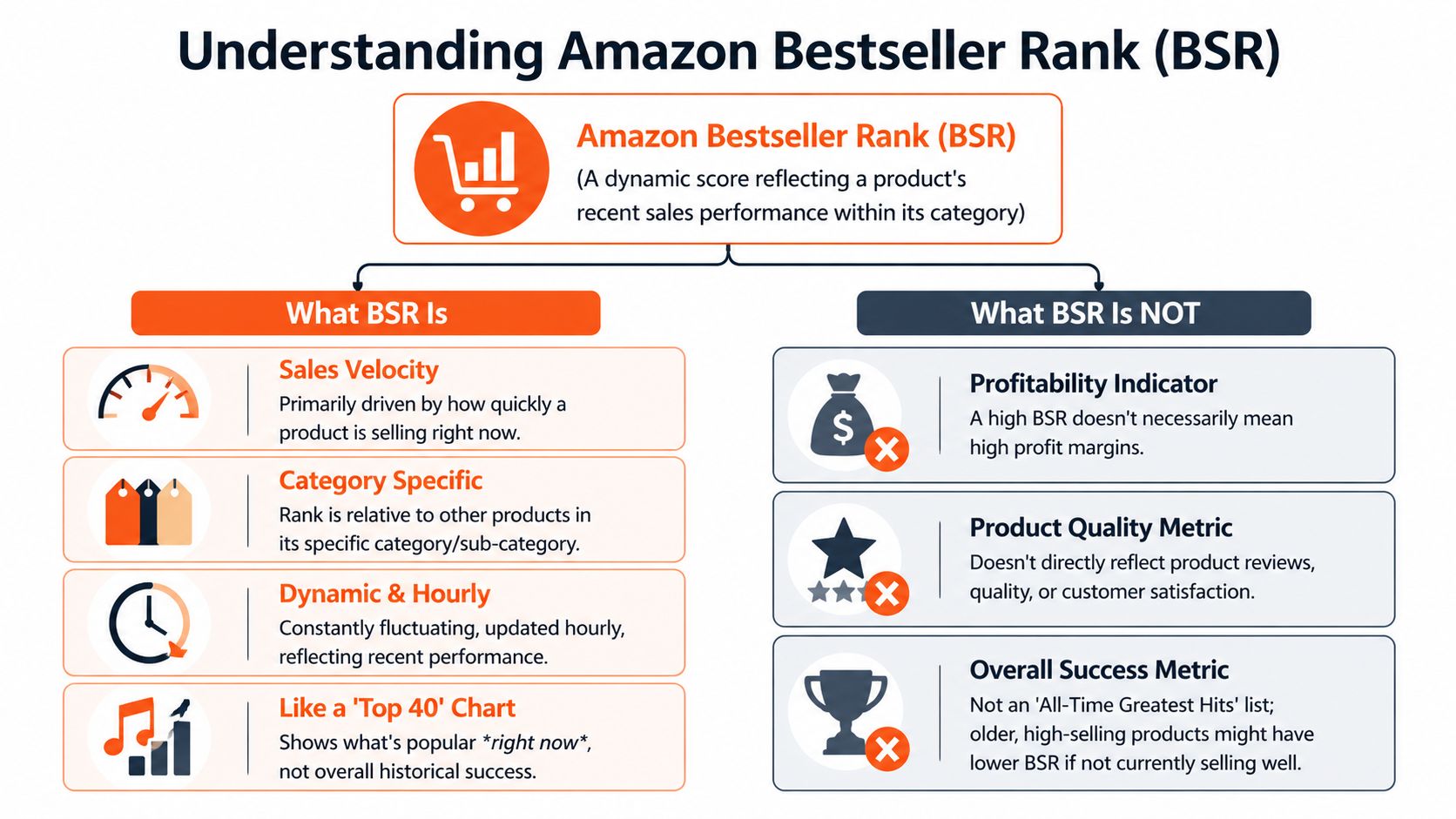
That distinction matters because teams often read BSR as a summary of listing quality. It is not. A weak page can post a strong rank for a period if demand spikes. A polished page can hold a mediocre rank if traffic is broad, unqualified, or poorly converted. BSR reacts to transactions first.
What the number is reacting to
At its core, BSR responds to order pace inside a category. The exact sales volume behind a given rank varies by category, season, and competitive set, but the pattern stays consistent. Faster recent sales usually improve rank. Slower recent sales usually weaken it. Older sales still matter, just less than fresh ones.
That is why BSR often moves before a team has fully explained what happened. A coupon, a retail event, a pricing test, a creator mention, or a surge in high-intent traffic can shift the rank quickly. The algorithm is not asking whether the listing looks better. It is measuring whether shoppers are buying now.
Category context changes the meaning of the number
BSR is always relative to a category, not to Amazon as a whole. A product can be a bestseller in a narrow subcategory and still look ordinary in marketplace-wide terms. That does not make the rank meaningless. It changes how you should use it.
For a brand manager, niche category strength can be commercially useful if the category matches actual shopper intent. It can improve visibility in a more relevant shelf, create social proof, and give the product room to build sales history before competing in broader, harsher categories.
A short launch burst may get a product into a visible range. Holding that position takes repeatable demand.
Practical rule: Read BSR as a category performance signal, then ask whether the category itself is strategically worth winning.
BSR versus other Amazon signals
BSR gets mixed up with search placement because both can move at the same time. They are connected, but they are not measuring the same thing. BSR reflects category sales momentum. Organic rank reflects how well a product matches a query and converts for that query. In the AI search era, that gap matters more, because Rufus and CoSMo are trying to interpret intent, product fit, and content quality, not just count recent orders.
Metric | What It Measures | Primary Driver | What It’s For |
|---|---|---|---|
BSR | Relative sales momentum inside a category | Recent sales velocity with more weight on fresh purchases | Judging category demand strength |
Organic rank | Position in search results for a specific query | Relevance, conversion, shopper intent, content quality | Winning visibility for target searches |
Amazon’s Choice | A badge shown for selected query-product combinations | Amazon’s merchandising logic | Helping shoppers choose quickly |
Many teams miss the connection. Better content does not improve BSR directly. Better content improves discovery and conversion, especially as Amazon’s AI systems get better at matching shopper questions to product pages. If that content produces more qualified sales, BSR improves as a downstream result.
If your team is trying to connect rank movement to commercial outcomes, this guide to optimizing Amazon sales for growth gives useful context for reading sales data alongside platform metrics.
What BSR does not measure
BSR does not measure margin quality. A product can climb the rankings on aggressive discounts and still damage contribution profit.
It does not measure listing quality on its own. Reviews, images, A plus content, and answer coverage matter because they influence conversion. BSR only reflects the sales outcome.
It also does not give a full health check on the ASIN. I have seen products post a strong BSR during a promotion while inventory risk, weak retention, and fragile economics were getting worse in the background. Read BSR as an output. Then trace it back to the inputs that created it.
The Core Drivers That Control Your BSR
If BSR is the output, these are the levers behind it. Some are obvious. Some are easy to ignore until they hurt you.

Sales velocity beats almost everything else
The biggest driver is sustained order volume over time. Not traffic. Not impressions. Not how attractive the listing looks in isolation. If your product is selling faster than comparable products in the same category, your BSR usually improves.
A short spike can help, but it often fades quickly. I’ve seen brands run a sharp discount, celebrate the rank jump, then get frustrated when BSR softens a day later. That’s normal. Amazon responds strongly to fresh sales activity, then recalibrates as the sales pace normalises.
What works better is a more organised push:
Steady ad support: Keep conversion-ready traffic flowing instead of relying on one burst.
Price discipline: Use offers to accelerate demand, not to train the market to wait for discounts.
Calendar alignment: Stack promotions, inventory, and content updates so they reinforce each other.
Category choice shapes the game you’re playing
A lot of BSR frustration starts with poor category placement. Two products with similar demand can look very different if one sits in a broad, crowded category and the other is placed in a more relevant subcategory.
Many teams go wrong. They choose the broadest possible category because it feels important. In practice, that can bury the product among stronger incumbents and make every BSR target harder to reach.
A better question is whether the category is both accurate and strategically useful. If shoppers would reasonably expect to find the product there, and the competitive set is more realistic, that’s often the better home.
Category selection doesn’t create demand. It changes the frame Amazon uses to compare your demand against other products.
Promotions and external traffic can move rank, but they don’t fix weak listings
Lightning deals, temporary price drops, influencer pushes, email traffic, and paid social can all improve BSR if they convert into orders. The key phrase is “if they convert”.
A weak product page will absorb traffic and waste it. A stronger page converts that traffic into the sales velocity BSR rewards. That’s why promotions often produce very different results for two products with similar budgets.
Use promotions for one of two jobs:
Create an initial sales burst for a new or newly optimised listing.
Support an already-converting product to compound demand.
Don’t use them as a substitute for fixing the detail page.
Returns and post-purchase friction damage the base
Teams often focus only on the front end. BSR is more forgiving of short-term noise than people think, but a weak post-purchase experience creates drag. If the product disappoints buyers, if sizing is confusing, or if the imagery overpromises, your sales base gets less stable.
Returns matter because they usually signal a mismatch between shopper expectation and product reality. That mismatch also shows up in softer conversion over time and weaker repeat demand.
The practical fix isn’t mysterious:
Tighten images: Show what the product is and isn’t.
Reduce ambiguity in bullets: Spell out size, fit, compatibility, or included components.
Read reviews for friction themes: If buyers keep raising the same confusion, rewrite the listing.
If your team needs a better process for turning customer feedback into listing changes, this article on reviews on Amazon is worth reading.
Stability matters more than heroic days
Many brand managers overvalue the standout day and undervalue the consistent week. The products that hold rank usually have fewer operational surprises. They stay in stock, keep converting, and avoid wild swings in offer quality.
That sounds less exciting than a dramatic launch push. It’s also what tends to hold BSR after the campaign team moves on.
The New AI Layer Influencing Amazon Rankings
Your BSR can hold steady while your visibility weakens underneath it.

That happens when a product still benefits from brand demand, ads, or strong placement in a familiar category, but the listing does a poor job answering the kinds of questions Amazon now tries to resolve through AI-assisted discovery. BSR still reacts to sales. The difference is that sales are now shaped by systems that assess relevance with more context than a keyword match.
Rufus and related recommendation models push Amazon closer to intent-led discovery. A shopper may not search the exact phrase in your title. They may ask for a product for a specific use case, customer type, problem, or constraint. If your page does not clearly explain those things, you can lose exposure before the shopper ever compares offers.
Relevance now depends on answer quality
The old habit was simple. Add the main keywords, cover a few variants, and trust traffic to find the page.
That approach leaves money on the table now.
Amazon’s AI layer needs enough structured, consistent information to infer what the product is for, who should buy it, and what could stop a purchase. In practice, that means relevance is no longer just term presence. It is whether your listing helps Amazon confidently match the product to a specific buying situation.
Teams that treat AI search as a separate channel usually miss the main opportunity. The same content improvements that help Rufus understand a product also improve conversion once the shopper lands on the page.
What strong AI-era listings do differently
A listing that performs well in this environment usually answers five questions with very little ambiguity:
What problem does this product solve
Who is it for
What makes it the right choice for a specific use case
What limitations or compatibility details matter before purchase
What objections should be resolved on the page instead of left to reviews or Q&A
This changes how titles, bullets, images, and A+ Content should be written. The goal is not to stuff more terms into the page. The goal is to give Amazon enough clean signals to place the product in the right conversations, then give shoppers enough clarity to convert.
Strong content does not raise BSR by itself. It improves the discovery and conversion conditions that produce the sales BSR responds to.
The trade-off brand teams need to understand
Highly polished brand copy often underperforms on Amazon if it stays abstract. AI systems and shoppers both respond better to specifics.
“Premium everyday comfort” sounds good in a creative review. “Soft cotton crew socks with arch support for men who stand all day” is far more useful. One line signals brand tone. The other helps Amazon understand intent and helps a shopper decide.
The trade-off is not brand versus performance. It is vague branding versus usable detail.
Where AI and retail readiness meet
This is also why content quality and operational quality are now tied more closely together. If Amazon surfaces your product for a high-intent query and the page feels incomplete, pricing looks out of step, or stock is unstable, that session is wasted. You do not just lose one sale. You lose momentum on the signals that help sustain ranking.
Watch these areas closely:
Inventory health: In-stock products preserve demand capture and learning.
Offer clarity: Price, fulfilment promise, and variation setup need to make sense immediately.
Content completeness: Missing dimensions, materials, compatibility notes, or use cases reduce match confidence.
Objection handling: The page should answer common pre-purchase concerns before the shopper leaves.
Here’s a useful visual overview of the broader AI influence on Amazon search and content workflows:
How to respond without guessing at the algorithm
Do not chase AI ranking myths. Audit the page like Amazon is trying to classify it and a shopper is trying to reject it.
Check whether the listing clearly states use case, audience, compatibility, material, dimensions, outcome, and limits. Compare that language to how customers phrase questions in reviews, Q&A, support tickets, and ad search term reports. If those inputs describe the product more clearly than the listing does, the page is under-informing both Amazon and the buyer.
The working rule is simple. Build pages that are specific enough for AI systems to interpret and clear enough for buyers to trust. In the current Amazon search environment, those are increasingly the same job.
How to Audit and Monitor Your BSR Performance
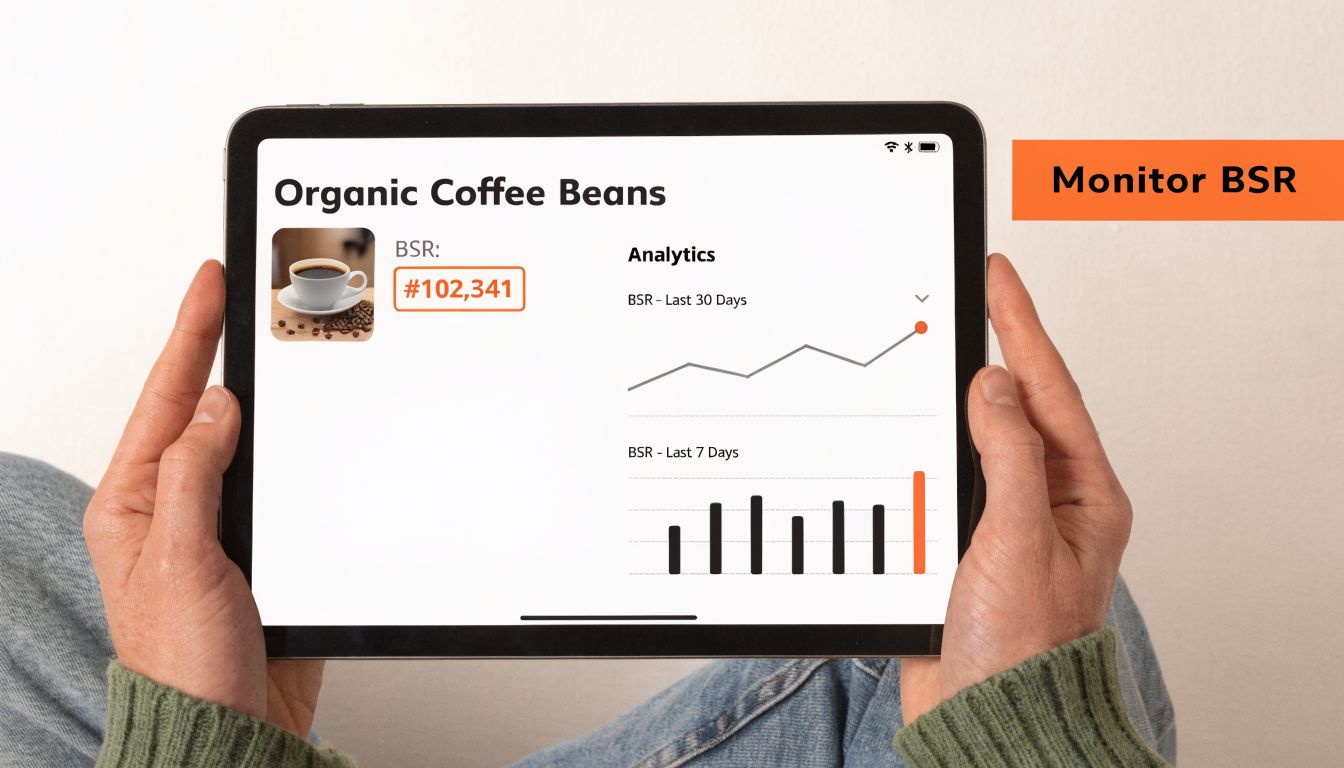
You launch a price change on Monday, increase ad spend on Tuesday, and by Thursday your BSR moves in the wrong direction. The rank looks unstable, but the problem is usually the tracking model, not the number itself. BSR becomes much more useful once the team reviews it against the actions that changed demand, conversion, or availability.
Start with a change log, not a dashboard
The product detail page gives you the current BSR and category placement. That is useful for spot checks. It is not enough for diagnosis.
Keep a running log of every event that could shift sales velocity or reduce conversion quality:
Promotions launched
Ad budget changes
Price changes
Inventory dips
Content updates
Competitor events you can visibly spot
For a small catalogue, a spreadsheet works. For a larger one, use a tool that stores historical snapshots and lets you line up rank movement with sessions, conversion rate, ad activity, and retail events. The goal is not prettier reporting. The goal is to explain why rank changed.
Read BSR in context
BSR is relative. A weaker rank can reflect your own slowdown, a competitor spike, or a category that got more active that week. A flat rank can also hide progress if the market became more competitive while your units grew.
Add short written commentary to the log. One sentence is enough if it is specific: “BSR softened after stock coverage tightened,” or “rank improved after coupon launch and image update.” That habit gives brand managers something they can act on. A screenshot alone does not.
If the team cannot explain the move, treat BSR as a symptom and inspect the inputs before changing strategy.
Separate marketplace benchmarks before you judge performance
A common reporting mistake is using one benchmark across every locale. That creates bad calls on inventory, ad efficiency, and growth potential because the same BSR can represent very different sales volumes by marketplace.
Review performance market by market. Compare local category depth, local competition, and local demand patterns before deciding whether a rank is strong, average, or weak. This matters even more now because Amazon’s AI-driven discovery systems can surface products differently by query and market. A listing that gains traction in one country may need different content coverage, different traffic support, or a different benchmark in another.
Build a monitoring routine that connects rank to causation
The teams that use BSR well follow a simple operating cadence.
Daily checks for hero ASINs
Review BSR, stock position, price, buy box status, and any visible offer issues.Weekly diagnosis
Compare BSR trends with sessions, conversion rate, ad spend, promotions, and listing changes. Check whether rank movement followed traffic growth, better conversion, or a retail problem.Monthly category review
Confirm the ASIN is still indexed and placed where it should compete. Review the leading products in the category and note what changed in price, review profile, bundles, or merchandising.Quarterly search and content review
Audit whether the listing still matches how shoppers search and how Amazon interprets the product. In the Rufus and CoSMo era, that means checking not just rank movement but whether your content covers the use cases, attributes, and comparisons that influence discovery and conversion.
If your team needs cleaner inputs before running that analysis, this guide on how to request Amazon data is a practical starting point. If you also want to track how products appear in newer search experiences, tools that help Optimize visibility using AI search add a useful layer that standard BSR reporting misses.
What good monitoring looks like
Good monitoring is disciplined and slightly boring. The team records changes consistently, checks rank at a consistent cadence, and avoids reacting to one bad day.
That consistency is what turns BSR from a noisy scoreboard into an operating signal.
A Prioritised Framework for Improving Your BSR
Most BSR advice is too broad to act on. “Sell more” is true and not very helpful. A better framework is to fix the factors in the order they influence the outcome.
Tier one fixes the foundation
Start with category placement and inventory health.
If the product sits in the wrong category, your BSR target is distorted from the beginning. If inventory runs out, no amount of optimisation matters because the sales momentum stops. These are not advanced tactics. They are the conditions that make every other tactic worth doing.
Check the basics with discipline:
Category accuracy: Make sure the product is competing in the most relevant shelf available.
In-stock reliability: Protect hero SKUs from avoidable stock interruptions.
Offer cleanliness: Keep the listing free of avoidable friction around fulfilment, variants, and product facts.
A surprising amount of BSR underperformance starts here. Teams jump to ad changes and content rewrites before fixing the basic retail conditions.
Tier two creates and sustains velocity
Once the foundation is stable, focus on demand generation that can hold. At this stage, many brands either overspend or under-coordinate.
Use a mix of tactics that support each other:
Advertising: Paid traffic is most effective when it supports listings that already convert.
Promotions: Use deals to create momentum, not to cover for weak retail fundamentals.
External traffic: Email, creators, and social can work well when the landing page is already tight.
The true test is what happens after the push. If rank improves only during discount windows, you don’t have a BSR strategy yet. You have a temporary sales subsidy.
Tier three improves conversion and AI relevance
This is the long game. Refine the product detail page so it does two jobs at once. It should help a human shopper decide quickly, and it should give Amazon’s AI systems enough structured, specific information to understand when to recommend the product.
That usually means improving:
Titles: Clear, readable, and descriptive without turning into a keyword pile.
Bullet points: Focused on decision-making facts, not generic brand language.
Images: Demonstrate use, scale, compatibility, and included components.
A+ Content: Reinforce trust and answer objections that block conversion.
The strongest BSR gains usually come after the listing becomes easier to buy from, not after it becomes louder.
What to do first if resources are tight
If you can only do a few things this month, do them in this order:
Priority | Action | Why it comes first |
|---|---|---|
1 | Fix stock and retail readiness | No sales momentum survives stock issues |
2 | Confirm category placement | Rank only makes sense in the right shelf |
3 | Tighten title, bullets, and images | Better content improves conversion efficiency |
4 | Layer in promotions and ads | Traffic works better after the page is ready |
5 | Review and iterate | BSR improves through compounding, not one-off changes |
This framework keeps teams from wasting time on cosmetic optimisation while deeper blockers remain untouched.
Conclusion Making BSR Work For You
The most useful way to think about amazon bestseller rankings is as a lagging indicator of sales momentum. It matters. It can reveal useful shifts in demand. But it’s not the thing you should optimise in isolation.
Strong BSR usually follows strong inputs. The product is in the right category. It stays in stock. The offer is competitive. The page answers real purchase questions. Promotions create momentum instead of masking weakness. Search visibility comes from relevance and conversion, not from stuffing more terms into the title.
That’s even more important as Amazon’s platform becomes more AI-driven. Search systems are getting better at interpreting intent and less forgiving of vague, thin, or outdated content. Brands that adapt will have a clearer path to sustained discoverability. Brands that cling to old ranking habits will keep seeing BSR as mysterious when it’s often reflecting deeper operational and content issues.
If your team is trying to make that shift, it helps to scale your e-commerce CRO strategy alongside your marketplace work. Better conversion systems make BSR improvement more durable because they improve the inputs that drive it.
A healthy Amazon business is the goal. BSR is the readout.
If you want to understand how Amazon’s AI layer is interpreting your listings, Cosmy is built for that job. It helps brands audit how products are perceived in Amazon’s emerging AI search environment, map shopper questions to content gaps, and prioritise fixes that support visibility, conversion, and ranking.


