
AI Search & Discovery for eCommerce Amazon


Most advice about eCommerce Amazon still tells brands to chase search volume, squeeze more keywords into titles, and keep tweaking backend terms. That advice is late.
If your Amazon sales are flat even though you're “doing the SEO stuff”, the problem usually isn't effort. It's that you're still optimising for a simpler search system than the one shoppers now use. On Amazon Italy, where the platform accounts for over 40% of total retail eCommerce sales in 2024 according to eMarketer's analysis of Amazon's marketplace position, small content weaknesses get amplified fast because Amazon controls so much of product discovery.
The practical shift is this. Amazon no longer rewards listings just for containing the right words. It increasingly rewards listings that are easy for AI systems to interpret, compare, trust, and recommend. That changes how you write titles, how you structure bullets, how you fill attributes, and how you decide which ASINs need work first.
Why Your Amazon SEO Strategy No Longer Works
Our work with Italian brand teams shows a repeated pattern. Sales stall on Amazon even after the team has updated titles, added backend terms, and refreshed bullets, because the listing was built for keyword coverage rather than machine understanding.
That gap shows up faster in Italy than in looser markets. Amazon.it accounts for over 40% of total retail eCommerce sales in 2024 in Italy, based on eMarketer's market analysis. When one platform controls that much discovery, small content weaknesses stop being minor merchandising issues and become ranking constraints.
The old Amazon SEO playbook assumed a simpler system. Put the target phrase in the title, repeat variants in bullets, fill search terms, and let relevance do the rest. That logic breaks once Amazon's internal models start interpreting shopper intent, product relationships, and listing quality at a deeper level. In practice, Alexa for Shopping and models such as CoSMo push Amazon to evaluate whether your content is understandable and trustworthy enough to surface in more contextual shopping moments, not just whether it contains the right phrase.
Three failure points come up again and again.
Overwritten titles weaken product interpretation. Repeating near-identical terms may help with coverage, but it often hides the core product type, primary use case, or key differentiator.
Generic bullets reduce confidence. Claims like “premium quality” or “excellent design” do little if the listing skips material, dimensions, compatibility, certifications, care instructions, or who the product is intended for.
Category pages are no longer the only battleground. Shoppers use longer, more specific queries, compare substitutes, and rely on recommendation surfaces where thin content loses to clearer listings.
A flat sales curve often means Amazon only partially understands the ASIN. The product is indexed. It may even rank for a few head terms. But the system lacks enough structured meaning to place it confidently in broader discovery paths, assistant-led prompts, or comparison-heavy searches.
That is the practical change brand managers need to accept. Amazon SEO is now tied to how well Amazon's AI can classify, connect, and trust your listing.
For a broader view of how search systems are shifting in this direction, Surnex's 2026 SEO guide is a useful reference because it explains why clear intent coverage now beats mechanical term repetition.
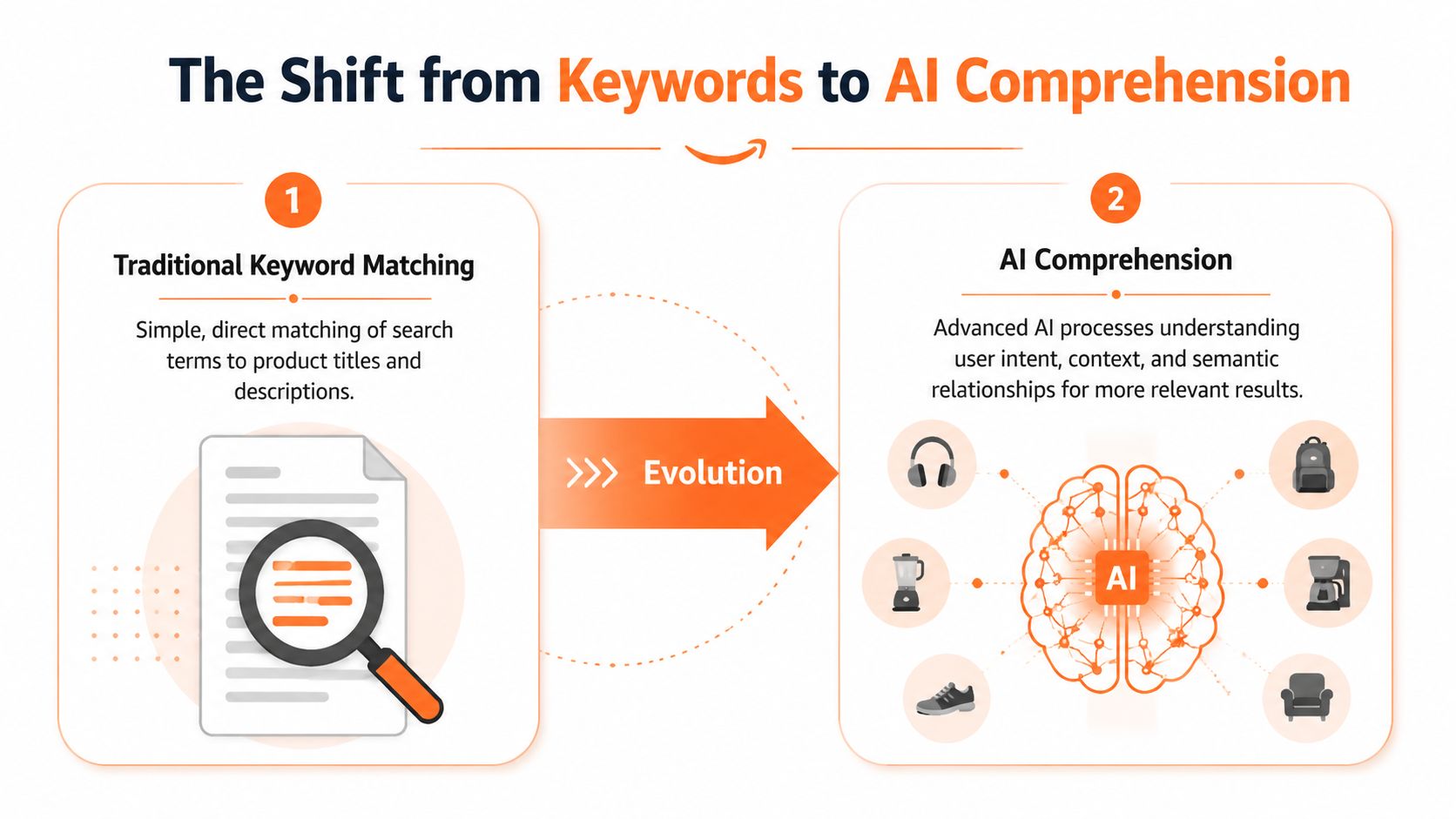
The Shift from Keywords to AI Comprehension
Amazon's search used to feel more like a card catalogue. If you knew the right phrase and placed it in the right fields, you had a fair shot. Today it works more like a skilled shop assistant. The system tries to understand what the shopper means, what kind of product would satisfy that need, and which listings look complete enough to trust.
Amazon's scale makes this shift impossible to ignore. Amazon was founded in 1994, launched its online bookstore in 1995, and by 2024 reported global revenue of $630 billion, according to the documented history and financial milestones of Amazon. At that scale, even small optimisation gaps matter because millions of listings compete inside the same discovery system.
What AI comprehension means in plain English
AI comprehension isn't about magic. It's about whether the marketplace can read your listing and understand:
What the product is
Who it is for
Which attributes matter
Which problems it solves
How it differs from nearby alternatives
That's a very different standard from “does the title contain the keyword”.
A shampoo bar listing, for example, shouldn't just repeat “solid shampoo” in title and bullets. It should make clear whether it's vegan, suitable for fine hair, fragrance profile, format, benefits, ingredient positioning, and practical usage cues. That helps both humans and machine interpretation.
This isn't only an Amazon issue
Amazon is the clearest example, but the shift is broader. Major marketplaces are rebuilding discovery around AI. Amazon uses shopping assistants and internal quality models. Walmart is also pushing AI-led shopping experiences, including Sparky. Other retail platforms are moving the same way, even if they use different names and interfaces.
Better marketplace content now behaves like structured product knowledge, not ad copy with extra keywords.
That's the key change for brand managers. Your listing is no longer just a search entry point. It's a data asset that feeds multiple systems, including search, recommendations, filters, comparison modules, shopping assistants, and mobile shopping flows.
The practical consequence
If your team still asks, “Which keyword should we add?” start asking, “What would the system still fail to understand about this product?” That question leads to stronger fixes.
Teams that make this shift usually stop chasing isolated term placement and start improving the product record itself. That's what lifts discoverability across modern marketplace surfaces.
Understanding Amazon's AI Search and Quality Models
Two parts of Amazon's ecosystem matter most for discoverability today. One helps interpret what the shopper is asking. The other helps judge whether your listing is complete and reliable enough to show.
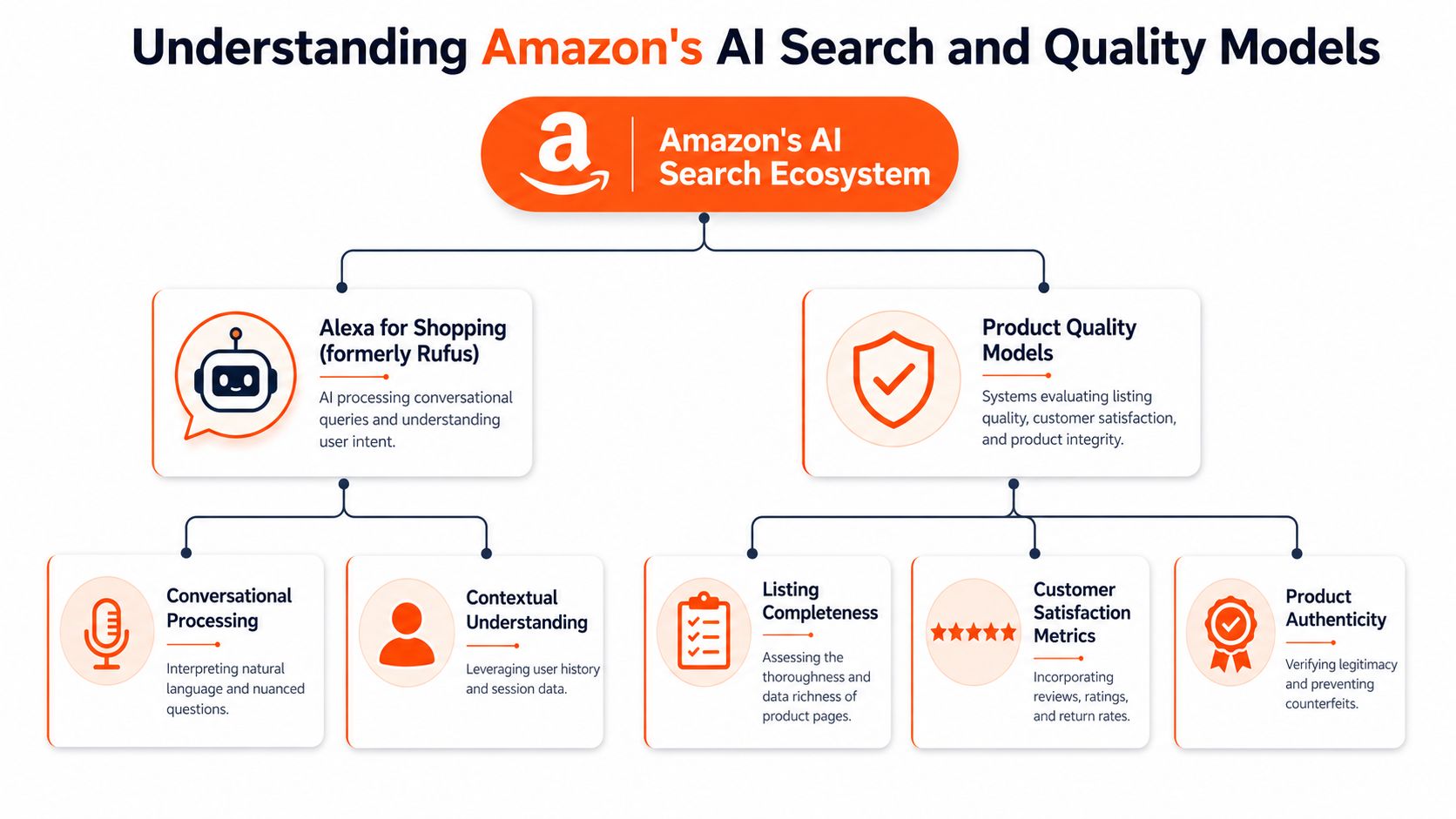
Alexa for Shopping reads intent, not just terms
Alexa for Shopping matters because it pushes Amazon further towards conversational product discovery. Instead of a shopper typing a short phrase, they might ask for something specific, comparative, or use-case based.
For Italian brands, that matters even more because Italian-language marketplace research shows higher search query length and more conversational phrasing, as discussed in Analyzer's review of unserved demand and search behaviour on Amazon. If shoppers ask fuller questions, listings need fuller answers.
A weak listing forces the system to guess. A strong listing makes the answer obvious.
CoSMo-style quality scoring judges listing integrity
The other layer is content quality. Amazon's internal quality model is often discussed through the lens of CoSMo. You don't need to know the internal code to understand the practical effect. The model favours listings that are clear, complete, specific, and consistent.
Independent research on European marketplaces found that listings with at least 12 to 15 distinct facets per product achieve significantly higher click-through and conversion outcomes, and that incomplete or ambiguous records are penalised by AI-driven systems, according to the underlying e commerce research on product data completeness and semantic signal coverage.
What CoSMo-style evaluation usually rewards
A brand manager can think about it like this:
Listing area | Weak signal | Strong signal |
|---|---|---|
Title | Repeated head terms | Clear product identity plus differentiating attributes |
Bullets | Generic claims | Specific features, use cases, materials, compatibility |
Attributes | Missing or inconsistent values | Normalised, complete, category-relevant data |
Description | Fluffy brand copy | Readable explanation that answers likely buyer questions |
Mobile readability | Dense blocks | Scannable structure and clean phrasing |
If a listing is hard for a tired shopper to scan on a phone, it's often hard for Amazon's systems to interpret cleanly as well.
Where teams usually go wrong
Most brands don't fail because they ignore SEO. They fail because they separate “SEO” from “content quality”. On Amazon, those are now tightly linked.
A common example is electronics accessories. The listing has the right category phrase, but it doesn't clearly state device compatibility, connector type, cable length, charging standard, finish, or pack size in a structured way. That weakens search relevance and buyer confidence at the same time.
The same pattern appears in beauty, home, supplements, and pet care. The words are present. The meaning isn't complete.
How to Optimise Product Listings for AI Discoverability
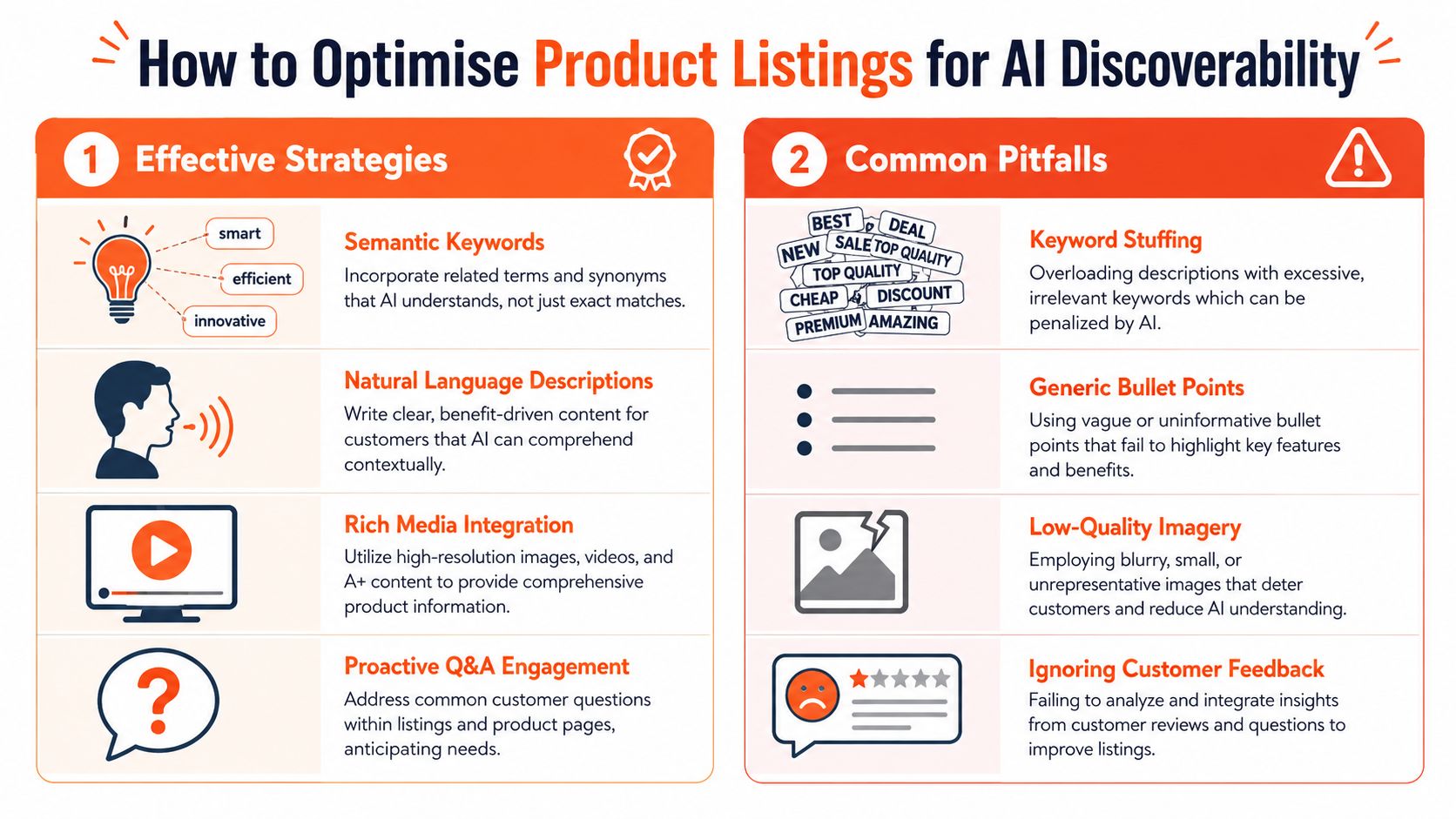
Once you accept that Amazon is reading for meaning, the rewrite process gets clearer. The goal isn't to sound clever. The goal is to make the product easy to understand, easy to compare, and easy to trust.
Start with how Italian shoppers actually ask
Italian marketplace behaviour matters here. As covered in the research above, Italian queries tend to be longer and more conversational, which means your listing should help Amazon answer natural-language shopping requests, not just short category searches.
A shopper may not search “shampoo solido”. They may ask where to find a vegan shampoo bar for fine hair, or which one works for frequent use. Your content should anticipate that.
Before and after example
Here's a simplified rewrite pattern.
Before title
“Shampoo Solido Shampoo Solido Vegano Capelli Fini Naturale Donna Eco Bio”
After title
“Solid shampoo bar for fine hair, vegan formula, gentle daily wash, plastic-free format, suitable for travel”
The second version gives Amazon clearer product identity and use context. It also reads like something a person would trust.
Bullet points that help AI and shoppers
Weak bullets
High quality product
Natural ingredients
Great for hair
Eco friendly
Best solid shampoo
Stronger bullets
Hair type fit. Designed for fine hair and daily washing where heavy formulas can weigh hair down.
Formula clarity. Vegan shampoo bar with a gentle cleansing profile and no plastic bottle format.
Practical use. Compact solid format is easy to store, carry, and use while travelling.
Sensory expectation. Clear description of scent, texture, and how the bar behaves when wet.
Routine relevance. Explains who it suits, how often to use it, and what result the buyer should expect.
The stronger set covers intent, expectations, and product facts. That helps recommendation logic and reduces ambiguity.
A useful companion tactic is better imagery. If your catalogue relies on flat, repetitive packshots, structured visual improvement can support comprehension too. For teams exploring this, PhotoMaxi's guide on boost creativity with AI product photos is a practical look at how to create clearer supporting visuals without turning the listing into fantasy branding.
This short walkthrough shows the broader mindset in action:
Description writing that actually works
Descriptions should answer the questions a shopper would ask if they picked up the product in a shop.
What is it really for
Who should use it
What makes it different
What should I expect when I open it
What detail might stop me returning it later
That means fewer slogans and more specifics.
Working rule: Every paragraph in the description should remove one uncertainty.
A practical rewrite order
If you only have an hour to fix one ASIN, work in this order:
Rewrite the title so the product type and key differentiators are obvious.
Replace generic bullets with feature-plus-benefit statements tied to buyer use cases.
Fill missing attributes in Seller Central before polishing prose.
Review images to check whether they explain the product, not just display it.
Use customer questions and reviews to identify wording gaps.
For sellers rewriting at scale, this breakdown of Amazon listing rewrite benefits for sellers is helpful because it frames rewrites as a discoverability and clarity exercise, not just a copy refresh.
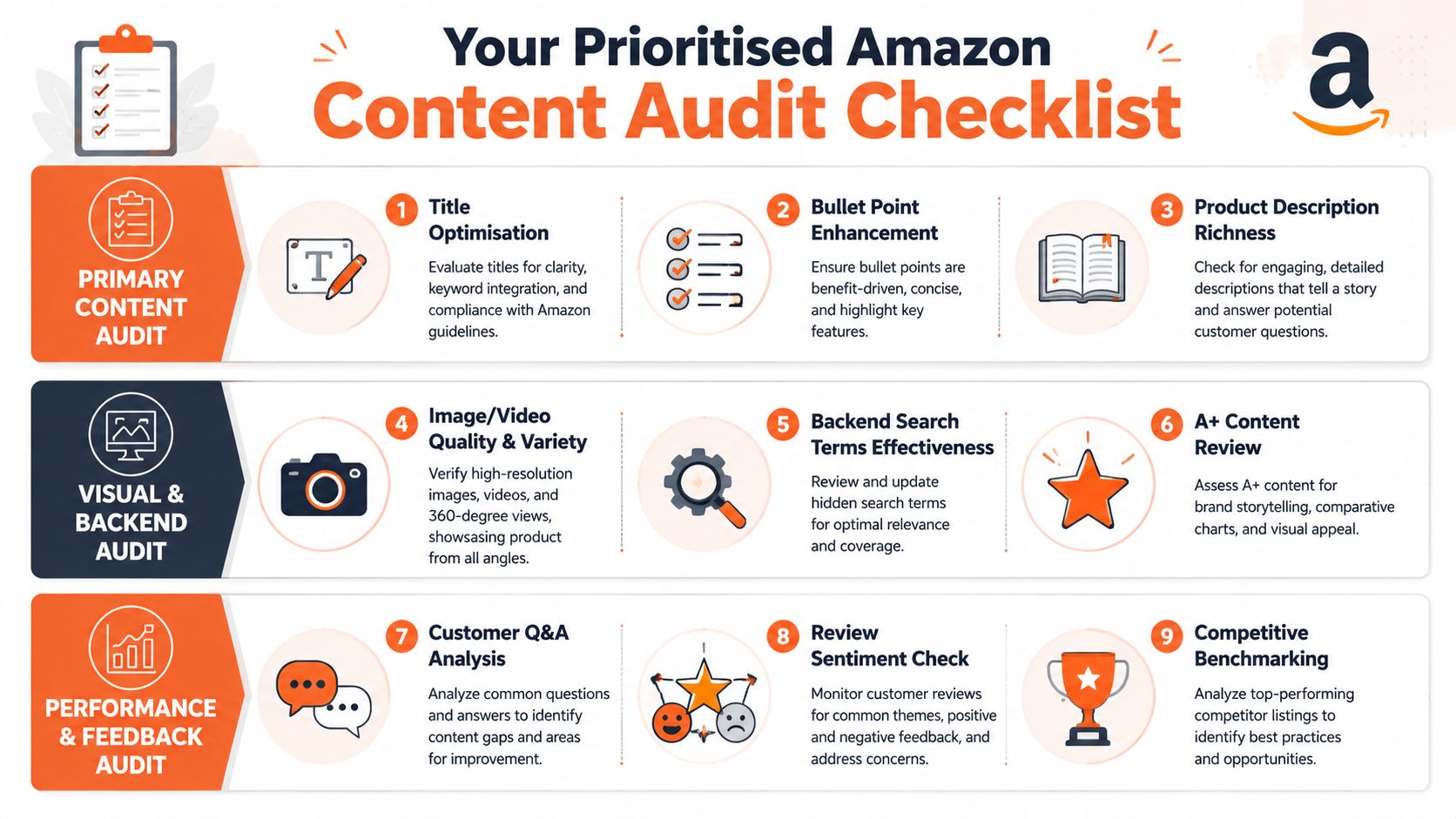
Your Prioritised Amazon Content Audit Checklist
Most catalogues don't need a dramatic rewrite everywhere. They need a disciplined audit that fixes the highest-friction issues first.
Italian sellers have a real guidance gap here. There's still limited Italy-specific material on how to measure listing quality systematically, and brands that treat CoSMo-style content quality as a strategic KPI rather than a one-off tweak are more likely to dominate shelf share, as discussed in Jungle Scout's resource on identifying opportunity and content quality gaps.
Tier one fixes you should do first
These are usually the fastest wins.
Title clarity. Check whether the title identifies the product cleanly and includes real differentiators instead of repeated category terms.
Bullet usefulness. Remove empty claims like “premium” or “top quality” unless you immediately explain what that means in product terms.
Attribute completion. Fill every relevant field you can. Missing material, size, compatibility, colour, model, or compliance details create avoidable ambiguity.
Main image accuracy. Make sure the hero image represents the actual item and pack format clearly.
Tier two fixes that improve interpretation
These take a bit longer but often lead to stronger discoverability.
Audit focus | What to check | Why it matters |
|---|---|---|
Secondary images | Demonstration, scale, use case, detail | Visuals often answer questions text missed |
Description | Readability on mobile, practical detail | Helps trust and clarifies buyer fit |
A+ Content | Consistency with core listing claims | Mixed messages weaken confidence |
Review themes | Recurring confusion or praise | Shows where the listing should be clearer |
Tier three work for catalogue discipline
At this stage, brands stop acting reactively.
Build content standards by category. A coffee machine shouldn't follow the same content template as a face serum.
Create a recurring audit cycle. Review content quality on a schedule rather than only after sales dip.
Use performance and content signals together. Poor sales alone doesn't tell you whether the issue is traffic, price, assortment, or listing clarity.
Track recurring gaps. If multiple ASINs are missing the same fields, fix the process, not just the pages.
Brands lose time when every content issue becomes a one-off firefight inside Seller Central.
A useful internal benchmark for teams building that process is this guide to improving e commerce content ROI, which connects content quality work to operational priorities across a catalogue.
How Cosmy Automates AI-Powered Listing Optimisation
The hard part isn't knowing what good content looks like. The hard part is applying that standard across dozens, hundreds, or thousands of ASINs without creating a slow manual workflow.

A manual process usually breaks in predictable ways. One person rewrites titles. Another updates bullets later. Attributes stay inconsistent. Review mining never happens because it takes too long. Agencies end up auditing only the products that are already causing pain.
What an AI-assisted workflow should actually do
For this kind of work, a useful tool needs to do more than generate copy. It should:
Audit existing listings against AI-search and content-quality principles
Flag missing or weak product signals that reduce discoverability
Pull voice-of-customer insights from reviews and questions
Produce publish-ready content rather than abstract recommendations
Support catalogue-level consistency so teams don't rewrite each page from scratch
Cosmy fits that operational gap. It analyses listings through the lens of Alexa for Shopping and CoSMo-style quality scoring, then generates revised titles, bullet points, and descriptions for Amazon listings. For teams comparing workflow options, the Cosmy tools overview shows the practical scope of that process.
Where this saves real effort
The value isn't “AI writes faster”. Plenty of tools can produce text quickly. The value is that the workflow starts from discoverability gaps, not from a blank page.
That matters because most listing rewrites fail for one of two reasons. Either they preserve weak source material and paraphrase it, or they produce polished copy that still ignores missing attributes and buyer questions.
A better system works backwards from what the marketplace needs to understand. Then it rewrites around that.
Adapting to the Future of Amazon eCommerce
The brands that win on Amazon over the next few years won't be the ones with the most aggressively optimised keyword lists. They'll be the ones whose product content is easiest for AI systems to interpret and easiest for shoppers to trust.
That's especially true in Italy, where Amazon already controls so much of digital retail attention and where shopper phrasing tends to be more conversational. If your listing content still reflects an older SEO mindset, you're not just slightly behind. You're feeding weak signals into the system that now decides what gets seen.
The same direction is showing up across marketplaces. Amazon, Walmart, and other retail platforms are all moving discovery towards AI-assisted interpretation. The exact interfaces will differ. The underlying requirement won't. Product data needs to be complete. Copy needs to be clear. Content needs to answer real buying questions.
If you want a broader view of that strategic shift beyond Amazon alone, Stimulead's piece on optimizing for AI search is a useful companion read.
The practical next move is simple. Pick a small set of underperforming ASINs. Audit them for clarity, attribute completeness, conversational relevance, and mobile readability. Then rewrite them for comprehension, not just indexing. That's how you stop fighting the last version of marketplace search.
If your team needs a faster way to audit, score, and rewrite Amazon listings for the AI search era, Cosmy gives you a structured workflow built around discoverability, content quality, and publish-ready output.