Cyber Monday and Black Friday: Amazon Seller Playbook 2026


You're probably already seeing the same pattern that catches Amazon teams every year. The calendar says Black Friday and Cyber Monday, but the actual work starts much earlier, the buying window lasts longer, and the pressure isn't limited to discounts. It hits content, stock, ads, fulfilment, and now product discoverability inside Amazon's AI-led shopping experience.
That shift matters because the old BFCM playbook was built around rank for keywords, cut price, raise bids, hope inventory holds. That still produces activity. It doesn't reliably produce efficient sales. If your listing doesn't answer real shopper questions, if your offer starts too late, or if your replenishment plan assumes demand peaks on one single day, you're giving away margin before the event even starts.
The New BFCM Reality for Amazon Sellers
Black Friday and Cyber Monday still matter because they anchor the modern holiday shopping season. Black Friday became mainstream in the U.S. in the 1960s, Cyber Monday followed later as the online counterpart, and Cyber Monday was first officially recognised in 2005. Britannica also notes that Black Friday is routinely the busiest shopping day of the year in the United States by number of shoppers, which is why the period still shapes retail planning far beyond those two labels alone (Britannica on Black Friday and Cyber Monday history).
For Amazon sellers, though, the useful way to look at cyber Monday and Black Friday has changed. The event is no longer a neat split between in-store Friday and online Monday. Buyers browse earlier, compare harder, and often see the same item discounted over several days across marketplaces, brand sites, and retail media placements.
The pressure has moved upstream
Teams typically don't lose BFCM because they forgot to switch campaigns on. They lose because the groundwork was thin.
A weak title gets less relevant traffic. Thin bullets fail to answer shopper objections. A storefront looks dated. Inventory arrives late. Deal timing clashes with replenishment. The result is familiar: impressions rise, but conversion quality lags.
Amazon's own platform changes add another layer. Search is moving beyond exact keyword matching toward intent matching and AI-assisted recommendations. If a shopper asks a more detailed question, the listing that wins won't just be the one with the shortest head term. It'll be the one that best explains fit, use case, limitations, and product context.
Practical rule: Treat BFCM as a system, not a sale. Content, offer design, media, and fulfilment all need to support the same buying journey.
That's why a modern seller playbook needs five things working together:
A clear timeline: Decisions made late are almost always expensive.
AI-aligned listing content: Your page needs to answer nuanced shopping questions.
Structured promotions: Don't rely on one blanket discount.
Operational discipline: Stockouts and late deliveries erase good marketing.
A proper debrief: The teams that improve fastest are the ones that document what happened.
If you also sell beyond Amazon, it helps to study how other channels plan peak trading windows. This guide on how to maximize Shopify Black Friday revenue is useful because it shows the same broader truth: the winning work happens before the rush, not during it.
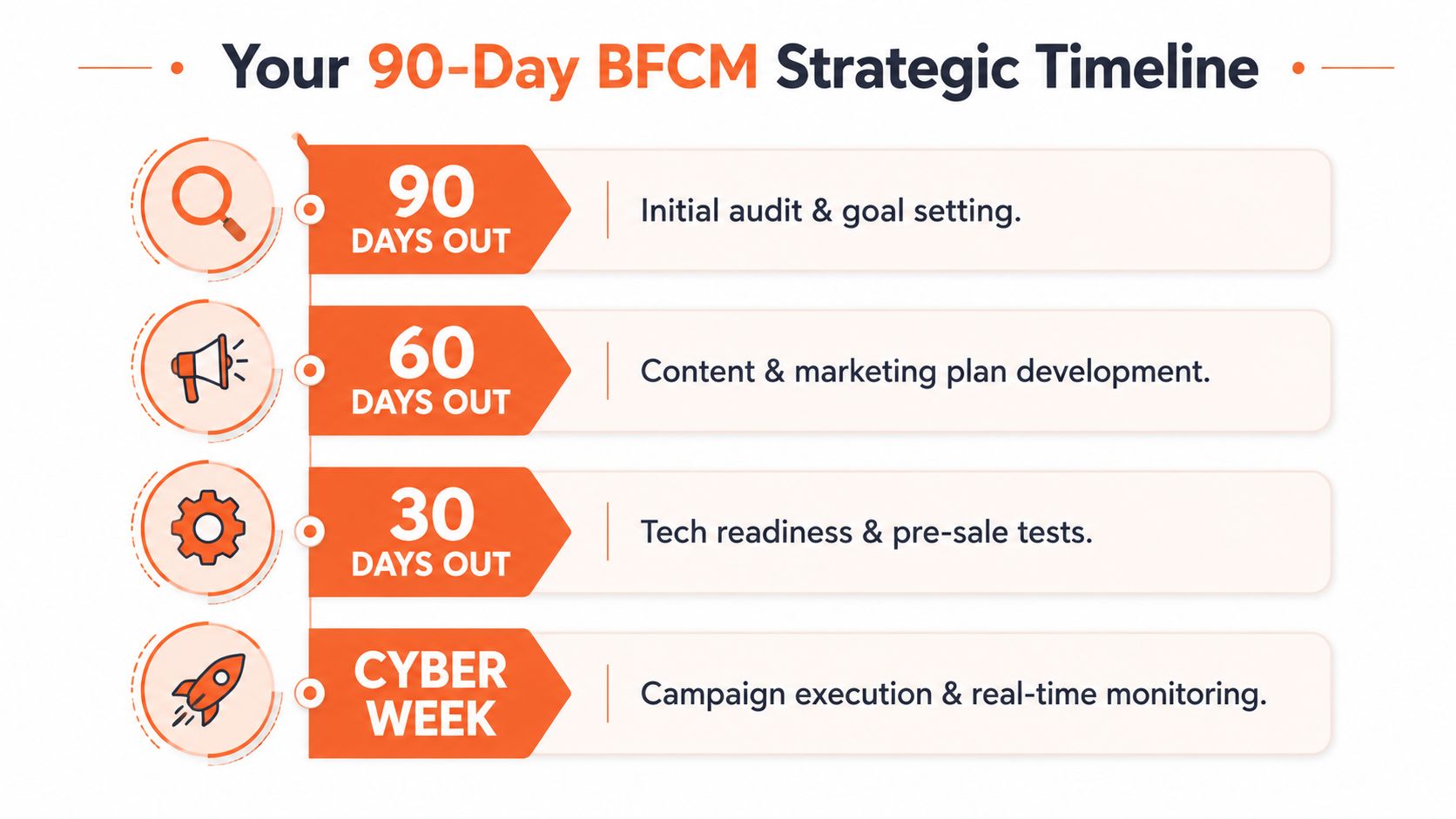
Your 90-Day BFCM Strategic Timeline
The easiest way to wreck BFCM is to treat it like a launch-week task list. It isn't. By the time Cyber Week arrives, your options are narrower. Your best move is to build the event in phases, with each phase solving a different problem.
Recent coverage shows that Black Friday and Cyber Monday have largely converged into a five-day promotional window, with many retailers running similar deals across the weekend and into Cyber Week. Business Insider notes that by 2025 the distinction had largely blurred, which means your planning should focus less on “which day matters more” and more on timing, inventory and channel execution (Business Insider on Black Friday vs Cyber Monday deal convergence).
Ninety to sixty days out
At this stage, don't obsess over ad copy. Fix the commercial foundations first.
Start with a SKU audit. Pull your top seasonal products, top margin products, giftable products, and any ASINs that historically convert well when traffic rises. Then separate them into roles. Some products should drive volume. Others should protect margin. A smaller group can act as hero items for visibility.
Use this period to make calls on:
Inventory depth: Decide which ASINs deserve the safest stock cover.
Offer eligibility: Work out which products can sustain a discount without damaging contribution.
Content priorities: Identify listings that need urgent rewriting before traffic scales.
Creative gaps: Check whether your Store, A+ Content, and image stack reflect holiday purchase intent.
If you're working with a catalogue that includes variants, review whether shoppers can understand the differences between them. During peak periods, confusion kills conversion faster than high price.
Sixty to thirty days out
This phase is where good teams create sales efficiency.
Rewrite product titles and bullets for clarity, not just keyword density. Tighten the first image set. Improve A+ Content so it answers practical buying questions such as fit, compatibility, material, routine of use, and who the product is for. If you sell supplements, home storage, kitchenware, pet products, or beauty tools, these details matter because shoppers compare several near-identical alternatives fast.
Build your campaign map at the same time. Don't wait until the last fortnight to decide how sponsored traffic should flow.
A simple structure works well:
Campaign layer | Job during BFCM | Common mistake |
|---|---|---|
Brand defence | Protect branded searches and bestsellers | Letting competitors sit on your own traffic |
Category capture | Win high-intent generic traffic | Sending traffic to weak listings |
Retargeting | Recover shoppers who clicked but didn't buy | Starting too late to build enough audience |
Competitor conquest | Pick selective openings | Burning budget on broad, low-fit terms |
If your listing still reads like it was written for a keyword tool, it'll struggle when shoppers ask more specific questions and compare more carefully.
Thirty to seven days out
This is execution territory. Most strategic decisions should already be locked.
Finalise deal submissions, coupon timings, ad budgets, creative assets, and your fallback plan if one hero SKU starts running hot. Review retail readiness page by page on mobile, because that's where many shoppers will make the final decision. Check image order, bullet readability, review quality, and variant selection.
Use this window for controlled testing, not reinvention.
Check price presentation: Make sure strike-through pricing, coupons, or deal badges display as expected.
Review traffic routing: Send ads to the best-converting variation, not the one with the weakest reviews.
Prepare escalation rules: Know when to cut bids, raise bids, pause low-margin terms, or switch budget to branded defence.
Confirm operational backups: If an ASIN goes out of stock at Amazon, know what happens next.
Cyber Week itself
During cyber Monday and Black Friday week, your real job is monitoring and reallocating. Don't spend the whole period admiring revenue. Watch contribution by SKU, stock cover, ad efficiency, and conversion by placement.
The teams that stay calm tend to do three things well: they launch on time, they don't overreact to the first few hours, and they shift spend toward listings that are already converting cleanly.
Win Discoverability by Optimising for AI Search
Amazon search used to reward listings that covered the main query set well enough. That still matters, but it's no longer enough on its own. AI-assisted discovery changes what “relevance” looks like, because shoppers can express intent in a fuller, more conversational way.
If someone searches for “water bottle”, standard keyword coverage might still get you into the auction. If they ask which bottle is best for commuting, fits a car cup holder, doesn't leak in a backpack, and is easy to clean, a shallow listing starts to fail. It may be indexed. It won't be persuasive.
Old Amazon SEO misses the point
A lot of marketplace content still follows an outdated formula. Cram the title. Repeat root keywords. Add generic bullets. Hope ad spend carries the rest. That approach leaves obvious gaps once AI systems start interpreting product fit at a deeper level.
The better approach is to write listings that answer likely shopping questions directly.
For example, don't stop at:
waterproof running shoes
trail trainers
winter grip
Push the content further:
suitable for wet trail conditions
better for runners who want grip on uneven terrain
lining and upper material details that help explain weather use
fit notes for thicker winter socks
whether the shoe is better for short daily runs or long-distance trail sessions
That isn't fluff. It's sales copy with retrieval value.
Where to place the signals
Different parts of the listing do different jobs. Use them deliberately.
Title: Cover product identity, main use case, and the clearest differentiator.
Bullets: Answer objections and buying criteria. Think durability, fit, compatibility, routine of use, cleaning, storage, or gifting.
Description and A+ Content: Add context that helps with comparison. Explain who the product is not for as well as who it is for.
Images: Support claims visually. Show scale, use environment, contents, steps, and outcomes.
A helpful way to think about it is simple. If a shopper asked a question out loud, could your listing answer it without forcing them into the reviews?
For teams trying to sharpen that skill, this piece on mastering AI search visibility is worth reading because it breaks down how content needs to adapt when discovery shifts from keyword matching to answer-based retrieval.
One useful lens is to review your page the way an AI system would review completeness. This article on AI in SEO for modern search workflows is a good prompt for that mindset.
Build content around intent clusters
Don't write one master listing and assume it works for every traffic source. Build around intent clusters instead.
Shopper intent | Content signal to strengthen |
|---|---|
Gift purchase | Packaging, recipient type, ease of choice |
Problem solving | Clear before-and-after use case |
Comparison shopping | Material, dimensions, compatibility, limitations |
Repeat purchase | Refill logic, durability, routine benefits |
Here's a practical walkthrough of why this matters in modern search behaviour:
A listing that only names the product competes on traffic. A listing that answers the shopper's real question competes on conversion.
During cyber Monday and Black Friday, this gap widens. Traffic gets noisier, comparison gets faster, and generic listings are easier to skip. The sellers who win discoverability aren't just optimising for rank. They're making it easier for Amazon to understand when their product is the right recommendation.
Architecting a Profitable Promotion Strategy
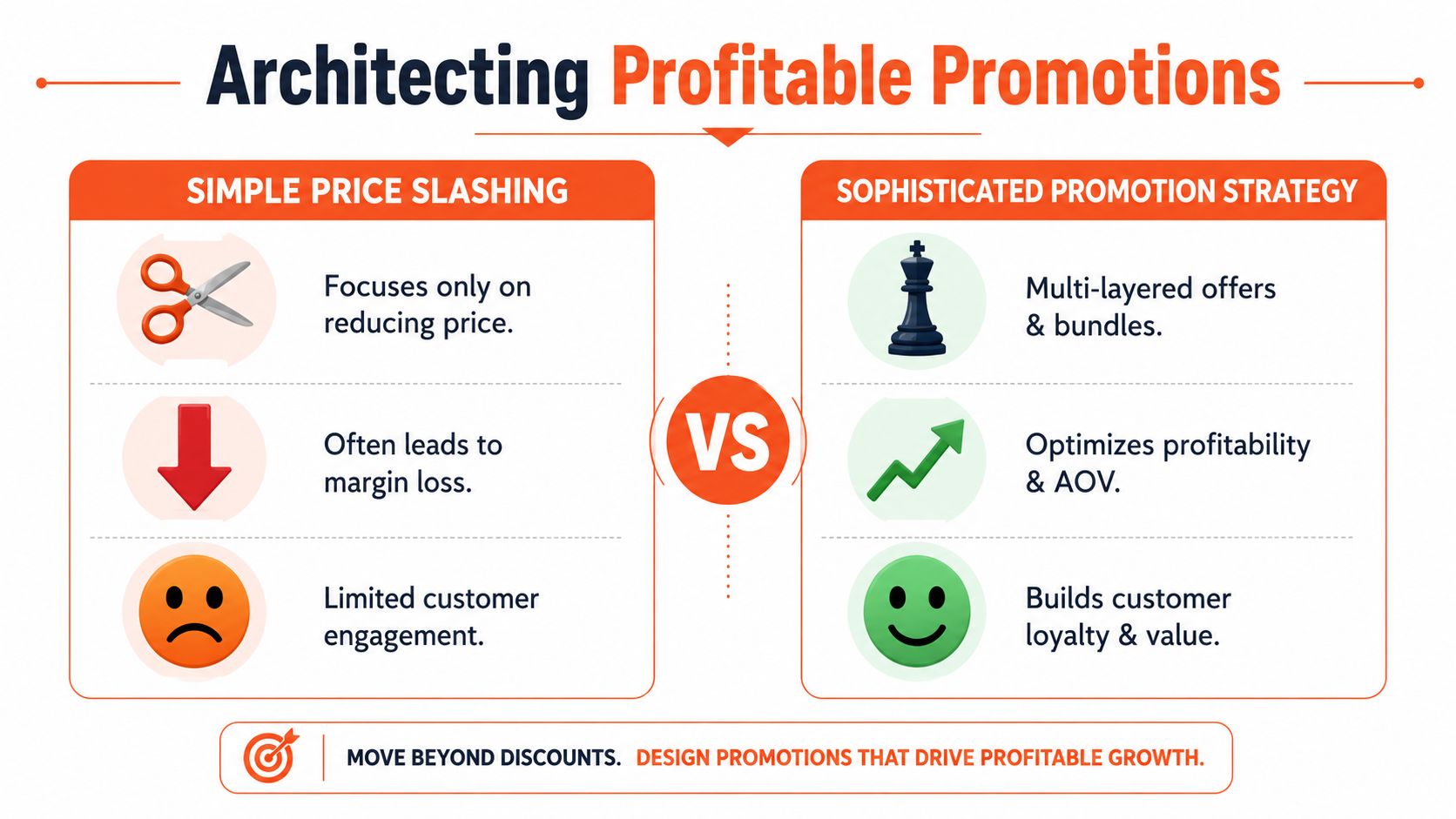
The blunt version of BFCM promotion strategy is easy. Drop price across the board and hope volume makes up for margin loss. Most of the time, it doesn't.
A better promotion plan treats each offer type as a tool with a specific job. Some offers should widen reach. Others should help close the sale once intent is already high. The mistake is running every promotion at once and flattening your pricing story.
Adobe reported that Cyber Monday online spending reached $14.25 billion, with peak online spending concentrated between 8 and 10 p.m. ET. The same reporting also noted that Black Friday growth outpaced Cyber Monday growth for the second year in a row, which is a useful reminder not to hold all your best offers for one final push (ABC News on Cyber Monday spending and timing).
Match the offer to the product role
Not every ASIN deserves the same treatment.
A hero SKU with strong review velocity and broad relevance might justify a sharper event discount because it can pull in new buyers and support halo sales across the range. A niche accessory with lower traffic may perform better with a coupon or a bundle rather than a headline price cut.
Use a simple decision frame:
Traffic driver products: Strong deal, strong ad support, clean listing.
Margin protectors: Light promotion, stronger cross-sell, tighter bid control.
Basket builders: Bundle logic, multi-buy angle, or adjacent accessory support.
High-consideration products: Stronger content, stronger review proof, timed push when buying intent peaks.
If your paid traffic strategy still treats all ASINs the same, fix that before the event. This guide to Amazon PPC ads and campaign structure is a practical reference for tightening that side of the plan.
Sequence matters more than drama
Think in waves, not one explosion.
Early in the window, broader offers can capture buyers who are already researching and comparing. Mid-window, use your most convincing combinations of price, badge and ad placement on products that are easiest to understand quickly. Later in the event, reserve extra pressure for items that need a final decision nudge, especially products where reviews, feature clarity and trust signals are already doing most of the selling.
A simple comparison helps:
Approach | What happens | Commercial result |
|---|---|---|
One flat discount everywhere | Visibility rises, margin falls, learning is poor | Hard to see what actually worked |
Sequenced offers by SKU role | You control timing and intent | Better read on profitable demand |
What usually works and what usually fails
What works: one or two hero products with obvious value, supported by clean retail pages and disciplined advertising.
What fails is familiar. Tiny discounts on undifferentiated products. Big discounts on ASINs with weak reviews. Heavy ad spend on listings that still leave basic shopper questions unanswered.
For cyber Monday and Black Friday, the strongest promotion architecture is rarely the loudest one. It's the one that makes buyers feel the offer is clear, timely and worth acting on, while still leaving the seller room to earn.
Nailing Inventory and Fulfillment Readiness
Marketing can create the spike. Operations decides whether you keep the sale.
That's especially true now because pre-event demand often arrives earlier than teams expect. Voyado reports that the Monday to Wednesday before Black Friday delivered the highest growth in its retail data set, at +13% to +20%, while Black Friday itself grew by only +0.15%. The practical read is simple: demand is being pulled forward, so sellers need to prepare for traffic and order flow before the headline day arrives (Voyado on pre-Black Friday growth and operational readiness).

Build for the surge before the surge
A common mistake is planning stock around Black Friday only, then acting surprised when inventory starts draining earlier in the week. On Amazon, that usually means one of two bad outcomes. Either your hero SKU goes out of stock during the most profitable stretch, or you suppress ads to protect remaining units and lose ranking momentum.
Your readiness checklist should include:
Primary FBA coverage: Make sure your priority ASINs are positioned early enough to survive intake delays.
FBM fallback: If Amazon availability tightens, know which products you can ship yourself without hurting buyer experience.
Variant balancing: Don't let one popular size or colour collapse the whole listing.
Mobile purchase flow review: If traffic rises sharply, friction on mobile hurts faster.
For teams managing stock across several channels or store groups, tools that centralise control can reduce avoidable mistakes. This breakdown of Spot Inventory Sync features is useful if your BFCM problem includes overselling risk, not just Amazon replenishment.
Practical fulfilment decisions that protect revenue
You don't need a fancy operations model. You need clear thresholds.
Decide in advance when to slow ad spend on low-cover ASINs. Decide which products can switch to merchant fulfilment without damaging customer trust. Decide whether a bundle should be paused if one component starts running short. Those decisions are much easier before the event than during it.
A second area sellers often ignore is listing-level fulfilment communication. If delivery timing changes, make sure your offer and campaign pacing still make sense. Overpromising late in the week creates cancellations, poor experience, and wasted media.
For a practical overview of the mechanics behind Amazon fulfilment models, this guide to Fulfil by Amazon and operational trade-offs is a helpful refresher.
Your ad budget can recover from a bad morning. A stockout on your best ASIN during peak demand is harder to repair.
For cyber Monday and Black Friday, the fulfilment winners aren't always the sellers with the biggest stock position. They're often the ones with the clearest backup plan.
Post-Event Analysis and Planning for 2027
Once the event ends, revenue is typically the initial and sole focus. That leaves too much money on the table. A proper BFCM debrief should tell you which actions created profitable demand, which ones only bought temporary volume, and where the listing or inventory plan broke under pressure.
The long-term backdrop is clear. Cyber Monday sales reached nearly $500 million in 2005, exceeded $2 billion in 2013, climbed to $6.5 billion in 2017, and more recent reporting in 2024 estimated that revenue passed the $13 billion mark (EBSCO research summary on Cyber Monday growth). That growth raises the bar. It also makes bad analysis more expensive.
What to review first
Start with a short commercial scorecard by ASIN, not just one total account view.
Look at:
TACoS movement: Did extra spend create incremental sales, or did it subsidise demand you would have won anyway?
Conversion by traffic source: Which campaigns sent buyers that purchased?
Price-to-conversion relationship: Which discounts moved volume, and which only reduced margin?
Stock impact: Which products ran too lean, too deep, or exactly right?
Then compare your hero ASINs against your support ASINs. A hero product that carried traffic but damaged profitability might need a different role next year. A quieter product with stable conversion and better margin may deserve more visibility in the next cycle.
Capture the lessons while they're still fresh
The useful debrief isn't a deck full of charts. It's a record of decisions and consequences.
Create a working document with three columns:
Area | What happened | Decision for next year |
|---|---|---|
Content | Which listings handled high-intent traffic well | Rewrite weak pages earlier |
Promotions | Which offers created efficient demand | Reduce blunt discounts |
Fulfilment | Where stock or timing failed | Adjust inbound and backup plans |
Add your observations on AI-aligned content as well. Did listings with clearer use-case language convert better under heavier comparison traffic? Did pages with better images and stronger bullets hold performance when ad costs rose? Those are the insights worth carrying into 2027.
The best BFCM post-mortem answers one question clearly: what should we repeat, stop, and change next year?
Don't wait until late summer to revisit your notes. By then, half the context is gone and the same mistakes start to look new again.
If your team wants a faster way to understand how Amazon's AI shopping layer interprets your listings before the next BFCM cycle, Cosmy is built for that job. It helps eCommerce brands audit Amazon product pages through the lens of AI-driven discoverability, so you can spot content gaps, strengthen shopper-answer coverage, and make sharper optimisation decisions before peak season arrives.