
An AI-Proof Amazon Content Strategy for 2026


Most Amazon advice is still stuck in a simpler era. It treats listings like old-school SEO pages: add more keywords, repeat the main phrase in the title, fill the bullets, and wait for rank to improve.
That playbook is incomplete now. Amazon product content has to do two jobs at once. It has to help a shopper decide, and it has to give Amazon's AI-driven systems enough clarity to understand when your product is relevant, what questions it answers, and why it deserves to be shown.
That's the core shift behind a modern Amazon content strategy. Better content doesn't just make a page look polished. It improves discoverability, supports conversion, and feeds the sales momentum that strengthens visibility over time.
Why Your Old Amazon SEO Playbook Is Broken
The common assumption is that Amazon ranking still comes down to keyword coverage first and everything else second. That was never fully true, and it's much less true now.
Amazon's own ecommerce guidance reflects a move from keyword-only optimisation toward AI-assisted and query-intent optimisation. Winning content now depends on answering shopper questions, improving visuals, and increasing conversion rather than merely repeating keywords. That matters because Amazon's merchandising environment is no longer just a static catalogue search system. It's an AI-mediated environment where content must satisfy both the shopper and the system evaluating relevance, as noted in Amazon's ecommerce content guidance.
A simple example shows the gap.
One coffee maker listing uses the old approach. The title is packed with variations of “espresso machine”, the bullets repeat specs, and the images show the product from a few angles. Another listing covers the same product type but answers actual buying questions: is it suitable for small kitchens, does it froth milk well, is it easy to clean, who is it for, and what trade-offs come with the machine's size and controls. The second listing gives Amazon's AI more context to work with, and it gives the shopper fewer reasons to hesitate.
What AI search changes in practice
AI-driven discovery changes what “optimised” looks like:
Keyword matching isn't enough: A listing can include the right terms and still fail if it doesn't explain use cases, constraints, or fit.
Visuals carry more weight: If your images don't clarify size, features, and usage, your copy has to work too hard.
Conversion signals matter earlier: Content that gets clicks but doesn't convert won't help for long.
Practical rule: If your listing only names the product, but doesn't explain when it's a good choice and when it isn't, it's underprepared for AI search.
This is why teams are starting to track AI-era visibility separately from traditional rank reports. If you want a useful primer on how brands monitor whether they're being surfaced in large-language-model interfaces, Algomizer for LLM brand visibility is worth reading. The same visibility problem is now showing up inside retail platforms.
For a broader look at how AI is changing search behaviour beyond Amazon, this piece on AI in SEO is a helpful parallel.
Perform a Retail Readiness Content Audit
Before rewriting titles or briefing a designer on A+ Content, check whether the product is worth optimising right now.
A lot of content projects fail for a simple reason. The listing wasn't retail-ready in the first place. If the product has weak reviews, patchy availability, or basic content gaps, polished copy won't rescue it.
A useful benchmark is to prioritise products only when they have clear content, at least 15 customer reviews, an average rating of 3.5/5 or higher, and stable in-stock availability, based on Artefact's Amazon media strategy guidance. That benchmark is practical because those signals materially affect performance.

Check what blocks performance first
Run the audit in this order.
Content clarity
Start with the basics. Is the title understandable without sounding stuffed? Do the bullets explain benefits, not just specs? Does the image set show the product in use, scale, and context?Review depth and rating quality
A listing with very few reviews is hard to scale, even with strong copy. Review count and average rating affect both shopper trust and how confidently teams can push traffic.Availability stability
Don't optimise a product that keeps going out of stock. In-stock consistency affects what happens after the click, and it changes whether your optimisation work can compound.Retail conditions around the listing
Price, buy box consistency, and basic shelf quality matter. If those variables are unstable, it becomes harder to judge whether content changes worked.
Use a simple scorecard
This is the table I'd use in a working session with a brand team.
Metric | Minimum Threshold | Your Product's Score | Ready? |
|---|---|---|---|
Content clarity | Clear content | ||
Customer reviews | 15 customer reviews | ||
Average rating | 3.5/5 or higher | ||
In-stock availability | Stable in-stock availability |
Add notes next to the table if needed, especially for image quality, video presence, and obvious review complaints.
A product with strong retail readiness is a better optimisation candidate than a product with bigger keyword demand but weaker fundamentals.
Build your priority list
Once the audit is done, sort ASINs into three groups:
Optimise now: Meets the readiness threshold and already has enough market traction to justify work.
Fix retail blockers first: Needs review, stock, or basic merchandising improvement before content investment.
Hold back: Not ready, or too volatile to measure properly.
If your team needs a useful outside reference on listing structure and merchandising basics, this guide to Amazon listing optimization for DTC gives a clear operational view.
The point of the audit isn't to slow content work down. It's to stop wasting effort on ASINs that can't convert the gains.
An AI-Centric Product Content Optimisation Framework
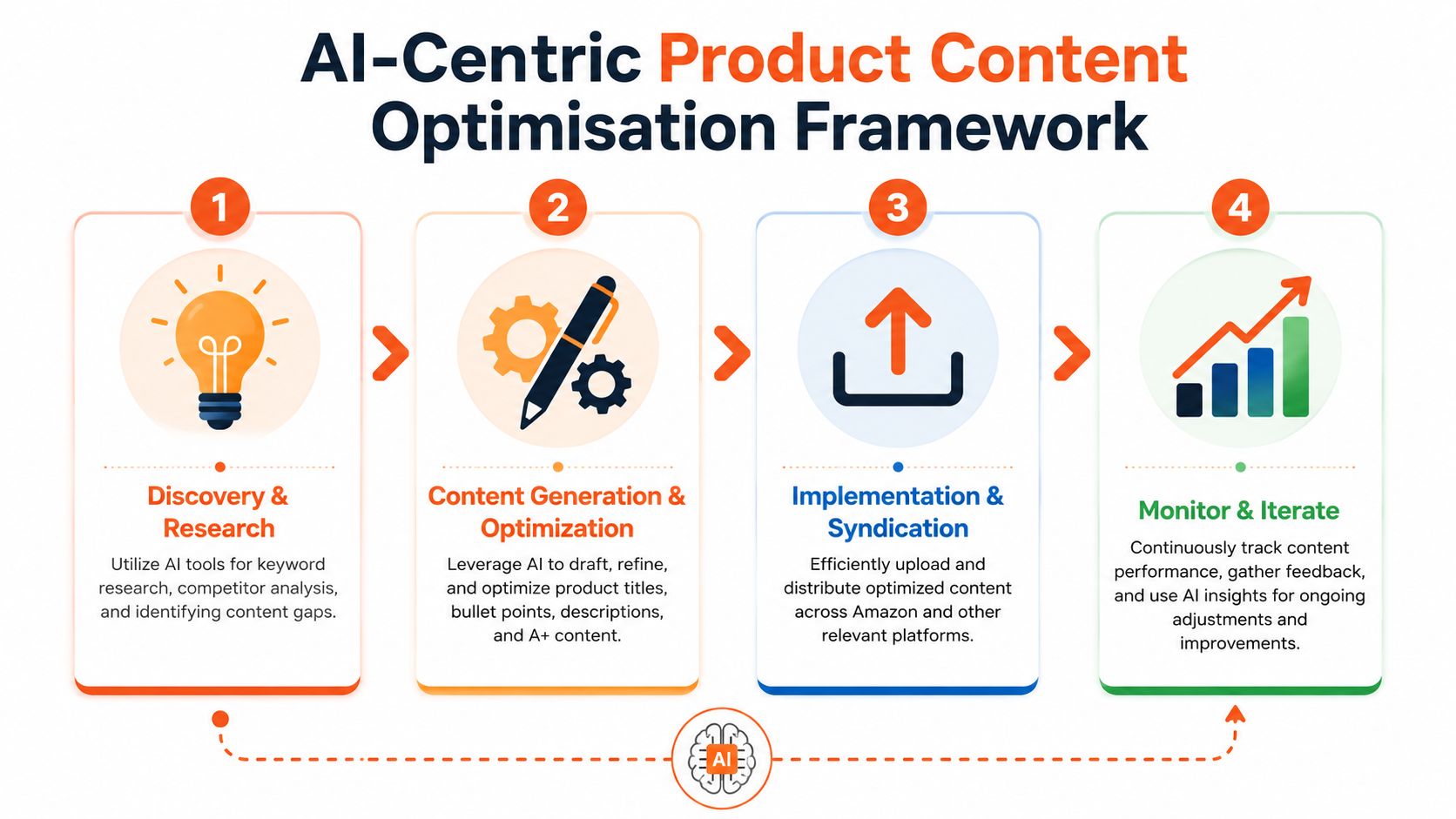
Once a product is retail-ready, then it makes sense to optimise aggressively. The cleanest workflow I've seen follows four phases: keyword and question research, listing optimisation, strike zone targeting of keywords already ranking on pages 2–3, and continuous improvement using search-query performance, as outlined in My Amazon Guy's framework.
Used properly, that workflow is built to move keywords toward page one and then improve click share and conversion.
Phase 1: Research questions, not just terms
Start with a product and list the questions a shopper would naturally ask before buying.
Take a premium coffee maker. Old research would focus on phrases like “bean to cup coffee machine” or “espresso machine with milk frother”. That still matters, but it's not enough. You also need to know the intent behind the search:
Is the buyer short on counter space?
Do they want café-style milk drinks or black coffee only?
Are they replacing pods and trying to cut waste?
Do they care more about speed, cleaning, or custom settings?
Here, AI-oriented research changes the brief. You're not just collecting search terms. You're collecting decision questions.
If your team is still building content around isolated head terms, it's worth reviewing this short guide on product keywords, especially the difference between broad relevance and buying intent.
Phase 2: Rewrite the listing around decision-making
Here's where many teams get too timid. They tweak a few bullets and call it optimisation. That usually isn't enough.
For the coffee maker example, a weak title might read like this:
Premium Coffee Maker, Espresso Machine, Bean to Cup Machine, Milk Frother, Stainless Steel
It contains terms, but it doesn't communicate much.
A stronger version would still include the core product language, but it would also make the use case and key feature easier to grasp. The bullets should then do distinct jobs:
One bullet explains flavour control and drink options.
Another addresses cleaning and maintenance.
A third clarifies who the machine suits.
Another gives practical context on size or kitchen fit.
The last handles a likely objection, such as learning curve or milk setup.
That structure helps both the shopper and the AI layer interpret the product more accurately.
Phase 3: Work the strike zone
This is the stage teams often skip because it looks less exciting than launching new content.
If a keyword is already sitting on pages 2–3, it's in the strike zone. That means the listing is close enough to relevance that focused action can move it. This usually involves a mix of PPC support and copy adjustment. The paid traffic helps test click potential, and the content update improves the product's chance of converting the interest once it arrives.
Don't spread budget across every target phrase. Push hardest where the product is already close to earning stronger visibility.
A good strike-zone update might include:
tightening the title so the main use case appears earlier
replacing vague bullets with clearer shopper-facing benefits
updating the image stack to answer obvious objections
aligning the first secondary image with the query theme you want to win
Later in the workflow, video can help reinforce that positioning. This walkthrough is a useful companion:
Phase 4: Refine with search-query behaviour
Once the listing is live, the job changes. You stop debating hypotheticals and start reading behaviour.
Look at which queries bring traffic, which ones drive clicks but weak conversion, and where shoppers may be misunderstanding the offer. Then adjust the listing to remove friction. Sometimes the fix is copy. Sometimes it's the hero image, feature callouts, or packaging badge visibility.
This last phase is where AI-era Amazon content strategy becomes less about “writing” and more about interpreting signals. The strongest teams don't ask whether the listing is finished. They ask what the current search and conversion pattern says the listing is still failing to communicate.
Measuring Content Performance and ROI
A content strategy that can't be measured gets cut the moment budgets tighten.
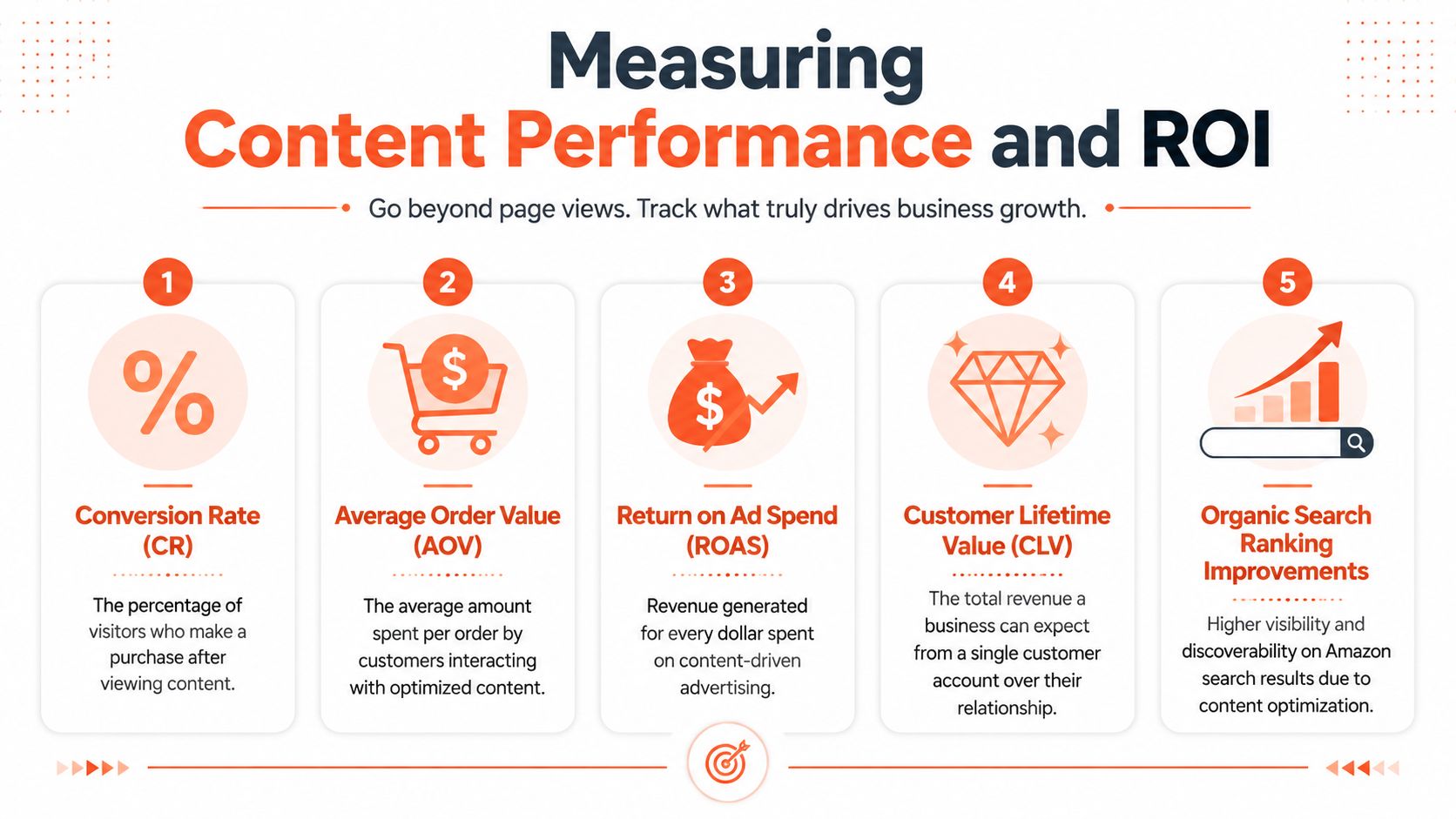
Amazon's own flywheel logic is the right way to think about this. Content is part of the mechanism that converts traffic into sales velocity, and stronger sales velocity can improve organic visibility. Brands should track organic traffic growth, time on page, click-through behaviour, conversions, and revenue attributed to content marketing, according to Amazon content strategy analysis.
That changes how you judge success. Page views alone don't tell you enough. A listing can attract traffic and still fail the business if it doesn't convert.
The metrics that actually matter
Use a measurement stack that links content changes to commercial outcomes.
Organic traffic growth: More relevant discovery is a sign that the listing is being matched more effectively.
Click-through behaviour to product pages: If impressions rise but clicks stay weak, your title, image, or value proposition may still be off.
Conversions: Content proves its worth. If traffic improves but conversion stalls, the listing is attracting the wrong audience or answering the wrong questions.
Revenue attributed to content marketing: This helps defend budget decisions with leadership.
Time on page: Useful as a diagnostic, especially when paired with conversion trends.
Read metrics together, not in isolation
One of the biggest mistakes I see is teams looking at one metric and declaring success.
If click-through rises but conversion falls, you probably improved attraction but weakened qualification. If traffic is flat but conversion improves, your copy may be clearer even if discoverability hasn't caught up yet. If both improve, that's usually the sign of a stronger fit between query, content, and product offer.
A good monthly review should answer four questions:
Review question | What to look for |
|---|---|
Did discovery improve? | Organic traffic trend and query coverage |
Did more shoppers click? | Search-to-listing click behaviour |
Did more shoppers buy? | Conversion movement after content updates |
Did business impact follow? | Revenue attributed to the listing changes |
Better Amazon content should improve both findability and buyability. If only one moves, the listing still has work to do.
For teams that want a category-level view of visibility rather than a single-ASIN view, measuring share of voice can help frame where content updates are changing your presence versus competitors.
Report by change set
Don't report “content performance” as one vague initiative. Report by change set.
For example:
title rewrite
bullet restructuring
image sequence update
A+ module refresh
Then compare the before-and-after pattern for discoverability, clicks, conversion, and revenue contribution. That's much easier for leadership to understand, and it makes future prioritisation simpler.
Choosing Your Toolkit and Aligning Your Team
The hardest part of Amazon content strategy usually isn't writing. It's deciding what to fix first.
Content teams often have too many problems at once. Weak bullets, thin image stacks, unclear positioning, review themes that aren't addressed, and category competitors who've already improved their pages. Traditional gap analysis tells you what's missing, but it often doesn't tell you which change is most likely to improve rank or conversion in the near term.
That prioritisation gap matters even more in AI-driven discovery. A listing can look acceptable to a human reviewer and still be misread by a generative system. SearchStax highlights a practical blind spot here: marketplace teams often struggle to determine which content changes are most likely to improve ranking or conversion within 30–45 days, and older guidance doesn't explain how to benchmark whether a listing is being surfaced or misread by generative search experiences in this content gap analysis discussion.
What your toolkit needs to do now
A useful toolkit should help with three jobs:
Surface visibility gaps: Not just missing keywords, but missing answers, weak attribute coverage, and unclear use-case signals.
Prioritise fixes: Show which edits are likely to change discoverability or conversion fastest.
Create a shared view: Let content managers, paid media teams, and ecommerce leads work from the same diagnosis.
That's where AI-aware tooling becomes more useful than static SEO reports.
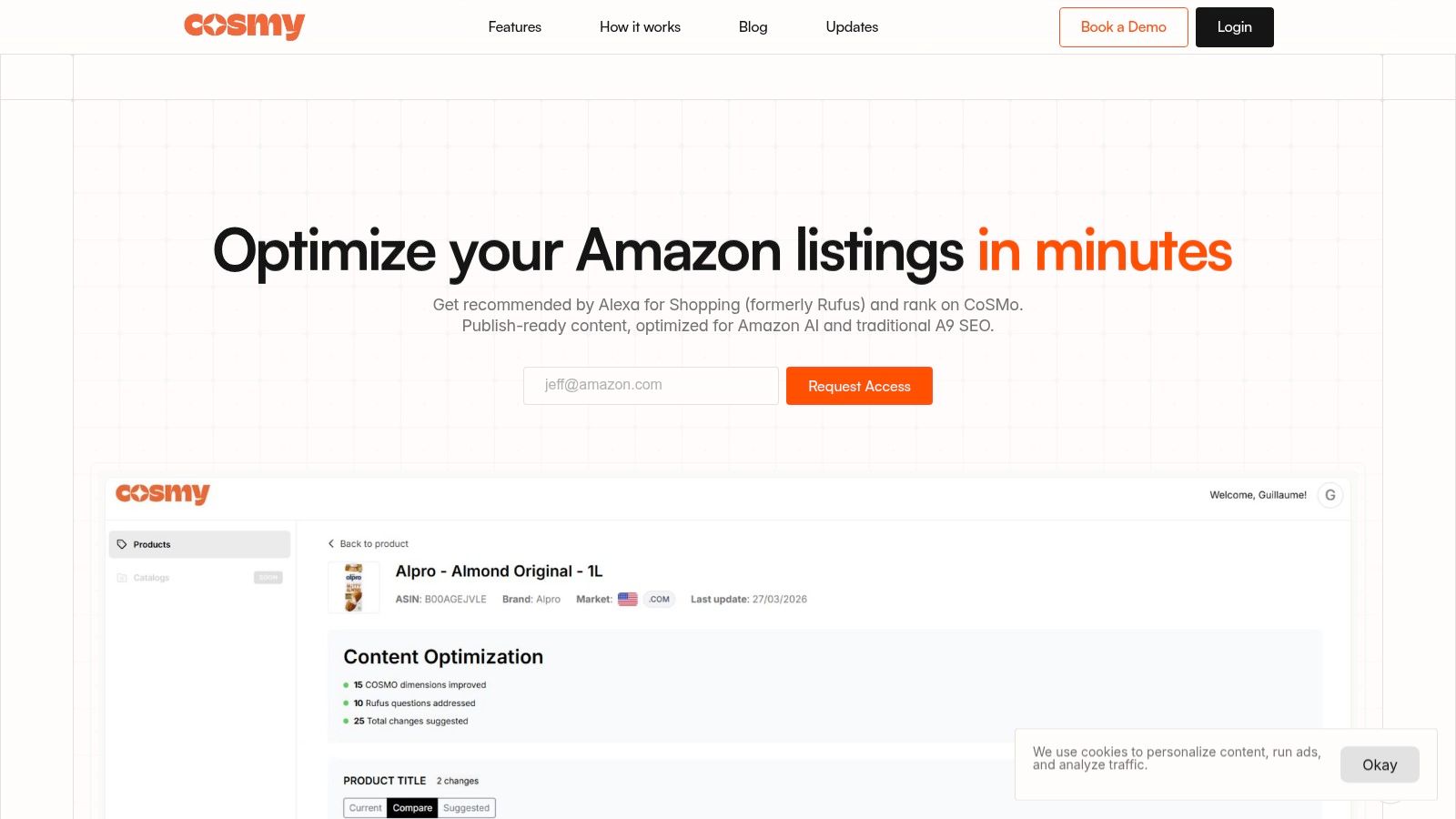
One example is Cosmy, which audits Amazon listings against AI-oriented signals, maps shopper questions to listing gaps, and helps teams prioritise which content updates to tackle first. That's different from a basic keyword export because the goal isn't just term coverage. It's understanding how the system may be interpreting the page.
Align the team around one workflow
Tooling only helps if the team uses it the same way.
A simple operating model works better than a complicated one:
Content manager owns the audit
This person reviews listing quality, image clarity, and message gaps.Growth marketer validates opportunity
They look at traffic patterns, paid support, and strike-zone potential.Ecommerce lead approves sequencing
They decide which ASINs matter most commercially.Designer or creative team handles asset updates
Images and A+ usually need changes, not just copy.Weekly check-in reviews movement
Focus on what changed, what improved, and what still looks blocked.
If content, media, and ecommerce teams work from different priorities, the listing gets edited in fragments. That usually produces a page that is technically fuller, but strategically weaker.
Don't overinvest in net-new content
A lot of brands still assume the answer is more pages, more launch assets, more copy production. Often the better move is to refresh what already exists and remove ambiguity from the listings that already have traction.
That's less glamorous than a full rebuild, but it's usually more defensible. In an AI-shaped marketplace, clarity beats volume.
Making Your Content Strategy a Continuous System
The weakest Amazon content strategy is the one that treats optimisation as a one-off project.
Listings drift. Shopper questions change. Competitors improve images, tighten positioning, and answer objections better. If your team only revisits content when sales dip, you're already late.
A sustainable system is simpler than often assumed. It runs on a repeating loop:
Audit the listings that matter most
Prioritise based on readiness and likely impact
Optimise the content and assets
Measure what changed in discoverability and conversion
Repeat before the listing goes stale
The habits that hold up over time
A durable process usually includes a few basic rules:
Quarterly listing reviews: Don't wait for obvious decline.
Clear KPI ownership: One person should own the reporting view for each major ASIN group.
Customer question feedback loops: Reviews and Q&A should feed the next round of edits.
Refresh discipline: Update older listings that already have momentum instead of chasing only new launches.
This matters for Amazon sellers, but it matters even more for larger catalogues. Once you manage dozens or hundreds of ASINs, inconsistency becomes the primary cost.
Strong content teams don't ask whether they've “finished” optimisation. They build a process that keeps weak signals from accumulating.
If your organisation also sells into more complex channels or wholesale relationships, this Market Edge B2B strategy for Amazon is a useful reminder that marketplace execution works best when content, retail conditions, and commercial planning stay connected.
A modern Amazon content strategy isn't just better copy. It's a managed system for keeping products understandable, discoverable, and persuasive in an environment where AI now helps decide what gets surfaced.
If you want to see how your listings may be interpreted inside Amazon's AI-driven search environment, Cosmy gives teams a practical way to audit product pages, spot visibility gaps, and prioritise content fixes using AI-oriented signals rather than keyword lists alone.