Amazon Monthly Payments: A Guide to Boosting Sales


A shopper adds a higher-priced product to the basket, gets all the way to checkout, then pauses. The product still looks right. The reviews still hold up. What stops the purchase is the total on the screen.
That moment matters more than most brand teams admit. You can improve images, tighten copy, and defend margin, but if the customer feels the upfront cost too sharply, the sale slips. On Amazon, that lost sale often goes to a competing listing that feels easier to buy, not necessarily one with the better product.
That’s where amazon monthly payments becomes more than a payment feature. It becomes a conversion tool. It reduces the sting of a larger basket, gives shoppers a simpler path to yes, and lets brands keep the product positioned at full value instead of racing to discount.
This also changes how you should think about product content. Monthly payment visibility now affects not only the customer at checkout, but also how Amazon’s AI surfaces products to shoppers who ask affordability-led questions. If your listing doesn’t make payment options clear, you can lose both the click and the sale.
A lot of teams still treat this as a passive Amazon feature. That’s a mistake. You should treat it like any other lever tied to conversion, average order value, and discoverability. If you already monitor pricing pressure, content quality, and retail readiness, payment messaging belongs in the same operating rhythm. It sits right beside other commercial signals, including how shoppers compare prices with Amazon before they decide whether to buy now or leave.
Introduction Why Payment Options Matter More Than Ever
Customers don’t always reject the product. Often, they reject the way they’re asked to pay for it.
That distinction matters. A shopper looking at a webcam, Echo device, or another considered purchase may already be convinced on utility. The friction appears at the final step, where the full amount has to be justified in one go. When that happens, monthly payments can bridge the gap between interest and action.
Why this matters on Amazon
Amazon has trained shoppers to expect convenience. Fast delivery is part of that. Easy payment is part of it too. If one listing lets a customer spread the cost and another forces an all-at-once decision, the first listing usually has the advantage, even before product detail copy does its work.
For brand managers, the commercial question is simple. Do you want the customer comparing your value over time, or rejecting your price in a single moment?
Practical rule: When customers hesitate on price, don’t answer only with a discount. First ask whether the payment framing is doing enough.
Where brands usually get this wrong
Sellers often rely on Amazon to show the offer wherever Amazon chooses. That leaves too much to chance. If the listing copy, bullets, and A+ Content don’t reinforce affordability, the customer may not notice the option early enough to care.
Common misses include:
Weak price framing: The listing talks only about total cost, not manageable monthly cost.
No benefit explanation: Customers see a payment option but don’t understand how simple it is.
Poor content alignment: Titles, bullets, and visual modules focus on features but ignore buying friction.
Late discovery: The customer only notices instalments near checkout, when doubt is already high.
The better approach is straightforward. Make affordability part of the product story without making the listing feel pushy. That’s how monthly payments moves from background feature to active sales lever.
How Amazon Monthly Payments Work for Customers
From the customer’s side, the appeal is simple. They get the product now and spread the cost over a short, fixed schedule instead of paying the full amount upfront.
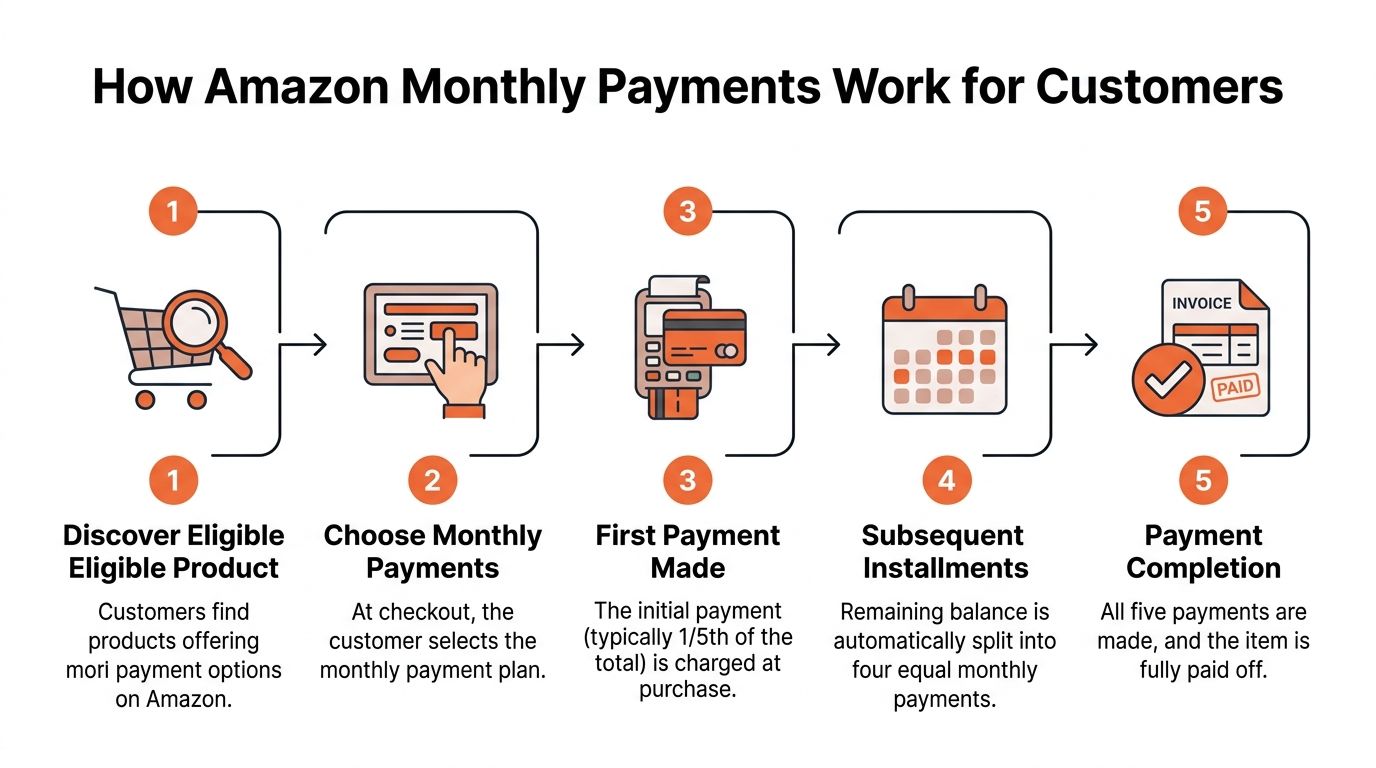
Amazon Monthly Payments uses a 5-payment structure, with an initial 20% down payment on shipment and four equal monthly charges after that. The model is described as zero-interest, and the same source notes that it has boosted conversion rates by 15-25% on higher-ticket items by reducing sticker shock and cart abandonment, according to Android Authority’s breakdown of Amazon’s monthly payment plan.
What the customer actually experiences
This isn’t the same as applying for a traditional loan. Amazon determines eligibility using account-derived signals such as purchase history, linked payment methods, and prior plan performance. The customer doesn’t go through a standard credit-check flow.
In practical terms, the process usually feels like this:
The customer finds an eligible product and sees that monthly payments are available.
They choose the payment option during the purchase flow.
The first payment is charged when the item ships.
Future instalments are charged automatically on the set monthly schedule.
The plan can be managed inside Amazon, including payment method changes or early payoff where available.
That simplicity is the point. The customer doesn’t have to leave Amazon, open a new account with another lender, or work through a more complicated approval journey.
Why customers like it more than third-party BNPL in some cases
The main advantage is familiarity. The payment option sits inside the Amazon experience the shopper already trusts. It feels like part of the purchase, not a separate financing event.
For teams that also manage subscriptions or repeat billing elsewhere, it can help to understand the broader mechanics of automated billing. This guide on how to set up recurring payments is useful background because it explains the operational side of stored payment methods and scheduled charges in plain English.
The less a customer has to figure out at checkout, the more likely they are to finish the order.
What it’s commonly used for
Amazon Monthly Payments has been closely associated with Amazon devices and tech-led purchases. That makes sense. Products with a higher perceived upfront cost, but clear everyday utility, are often the best fit for instalment messaging.
Think in categories like:
Connected devices: Echo hardware and similar products where the total price can create pause.
Consumer electronics: Webcams and other tech accessories where the utility is obvious but the basket value still needs easing.
Giftable premium items: Products shoppers want now but prefer to spread over a few months.
For a brand manager, the takeaway is clear. If your item sits in a category where shoppers often hesitate at price, amazon monthly payments should be treated as part of the buying journey, not a footnote.
The Impact of Monthly Payments on Your Business
From the merchant side, the first question is usually cash flow. Brands want to know whether instalments delay payout or create extra collection risk.
With Amazon’s monthly payment structure, the seller receives the full merchant payout upfront while Amazon defers the buyer’s payments over time. That’s a meaningful commercial distinction because it gives you the conversion benefit without turning your business into a lender.
Why the business case is stronger than many teams assume
In the United States, Amazon Pay’s monthly sales reached $30.8 billion as of 2026, and 78% of US Prime members had used the service. The same data set puts the average transaction size at $130, which shows both scale and buyer trust in these payment options, according to CoinLaw’s Amazon Pay statistics.
That matters for two reasons. First, customer behaviour is already there. You’re not trying to teach the market a new habit. Second, payment flexibility sits inside a system shoppers already use at volume.
Where brands see the upside
The strongest gains tend to show up in a few places:
Conversion on considered purchases: When a customer can frame the cost month by month, the product feels easier to justify.
Average order value: Customers are often more comfortable choosing the better model or adding complementary products when the overall spend feels manageable.
Margin protection: A payment option can solve the affordability problem without defaulting straight to promotions.
If you want a broader commercial framework for evaluating financing offers across products, this guide on how to master monthly installment plans is a useful reference point. It’s especially relevant for teams deciding when instalments should support pricing strategy rather than replace it.
The trade-offs that deserve a proper review
Not every market behaves the same way. Payment services under the wider Amazon umbrella vary by region, and local seller realities can be less tidy than the headline “0%” language suggests. In India and Turkey, for example, underbanked sellers and smaller brands can face accessibility issues, bank-partnership constraints, or added processing friction in related payment programmes, based on Inc42’s reporting on Amazon Pay’s fintech expansion.
So the practical advice is boring but important. Read the programme terms that apply in your market. Don’t assume that what works smoothly in one region will map neatly to another.
One more point matters operationally. If monthly payments helps conversion but your listing loses the Buy Box, the benefit won’t show up consistently. That’s why payment readiness should be reviewed alongside core retail mechanics such as winning the Buy Box on Amazon.
Optimising Your Product Content for Monthly Payments
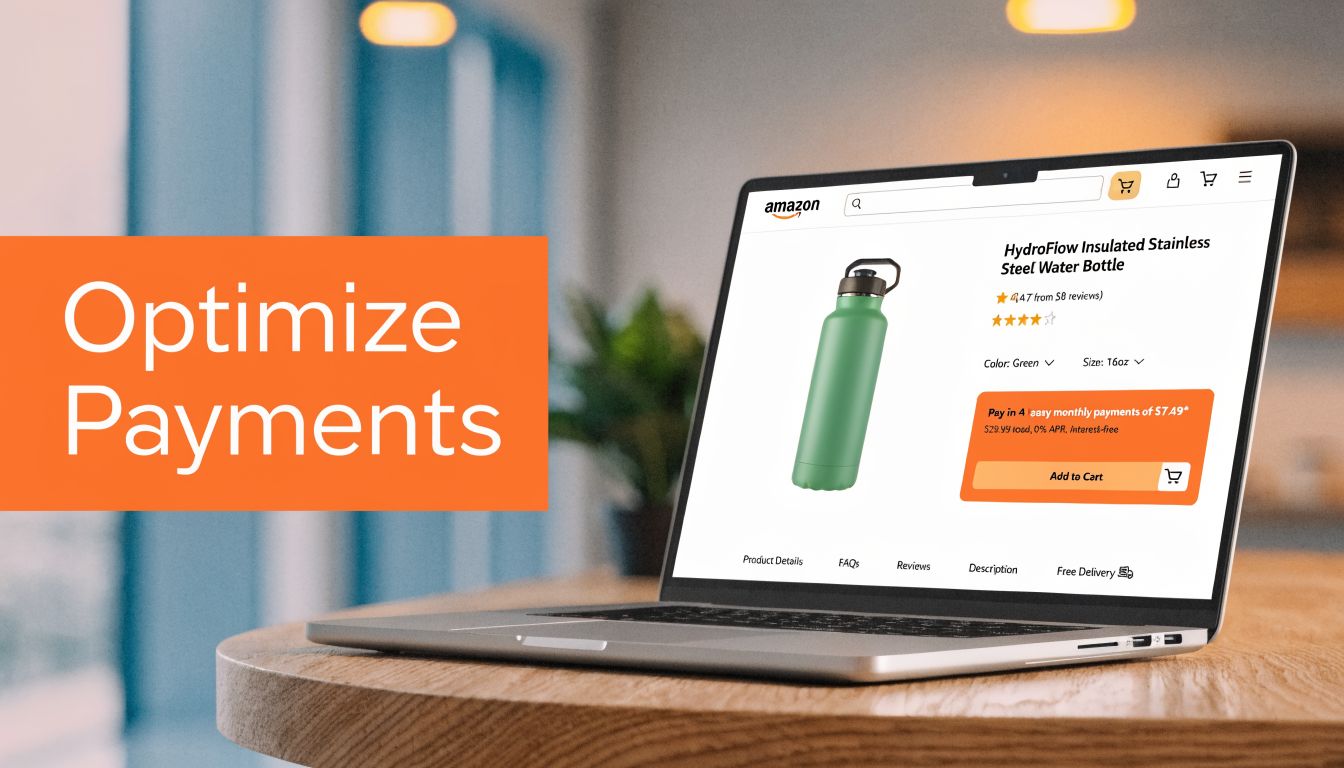
Most brands underuse monthly payments because they leave the message buried in Amazon’s interface. If the affordability cue appears only where Amazon places it, you’re depending on the customer to spot it at exactly the right moment.
A better listing brings the payment story forward. It doesn’t replace product benefits. It supports them. The point is to help the shopper translate “I want this” into “I can buy this now”.
Put affordability into the parts customers scan first
Shoppers don’t read listings in a tidy top-to-bottom sequence. They skim. That means payment messaging should appear where scanning happens first.
Use these placements deliberately:
Title support where appropriate: Don’t stuff the title with finance language, but where format allows, use copy that normalises manageable cost.
Bullets: Add one bullet that explains the availability and convenience of paying monthly in plain language.
A+ Content: Show the payment flow visually so the offer feels easy, not abstract.
Brand Store and comparison modules: Reinforce which products are most suitable for budget-conscious shoppers.
Here’s the difference in practice.
Weak bullet
Premium webcam with high-definition video, dual microphones, and compact mount.
Stronger bullet
Premium webcam with high-definition video and dual microphones, plus eligible monthly payment options that make the purchase easier to budget.
The second version does more commercial work. It still sells the product, but it also answers the question many shoppers won’t ask out loud: “Can I afford this right now?”
Keep the language plain
Payment copy works best when it sounds operational, not promotional.
Use language that is:
Clear: “Pay monthly” is better than vague finance wording.
Specific: Explain that charges are split across a fixed schedule when the product is eligible.
Low-friction: Reassure the customer that the process happens inside Amazon.
Avoid two common mistakes. The first is making the copy sound like a bank advert. The second is overpromising details the customer will expect Amazon to confirm.
A useful filter: If the wording would confuse someone skimming on mobile, rewrite it.
Build one visual module that answers the affordability question
A+ Content is the most underused place for this message. Brands often fill every module with feature education and lifestyle imagery, then leave buying friction untouched.
A simple payment module can do more than another feature block. It can show the customer that the purchase fits their budget process.
A practical module might include:
A short headline: “Available with monthly payments on eligible purchases”
A simple visual sequence: order, first payment, automatic monthly charges
One reassurance line: payment happens within the Amazon purchase flow
You don’t need heavy design. You need clarity.
Match copy to the queries shoppers actually use
Customers don’t always search like marketers write. They use practical wording. “Best webcam with monthly payments” is more realistic than polished internal brand language.
That’s why content teams should review the phrases shoppers use around price, affordability, and budgeting. If your listing only reflects technical features and never reflects buying intent, you leave discoverability on the table. This matters not just for classic search, but also for the AI-led product understanding Amazon is building around natural language. A useful starting point is tightening your Amazon product keywords so affordability-led intent sits alongside your feature and category terms.
A Seller's Audit Checklist for Payment Messaging
Instead of another theory deck, what's often needed is a quick way to look at a listing and decide whether payment messaging is doing its job.
This checklist is built for that. Use it during listing refreshes, seasonal pushes, premium product launches, or content clean-up across a catalogue. Keep the process simple. If too many answers come back “No”, that SKU probably isn’t presenting amazon monthly payments strongly enough.
Monthly Payment Messaging Audit Checklist
Content Area | Optimisation Check | Status (Yes/No) |
|---|---|---|
Product title | Does the title support affordability positioning where appropriate without becoming cluttered? | Yes/No |
Main image set | Do any secondary images help explain ease of purchase or budgeting? | Yes/No |
Bullet points | Is there a dedicated bullet that mentions monthly payment availability in plain English? | Yes/No |
Product description | Does the description remove friction by explaining the option clearly and simply? | Yes/No |
A+ Content | Is there a visual module that shows how the payment flow works? | Yes/No |
Brand Store | Are premium or higher-priced products grouped in a way that supports budget-conscious browsing? | Yes/No |
Mobile readability | Can a mobile shopper understand the payment benefit without expanding every section? | Yes/No |
Tone of voice | Does the copy sound helpful and factual rather than salesy or vague? | Yes/No |
Compliance review | Have you avoided claims Amazon itself should confirm at checkout? | Yes/No |
Portfolio priority | Have you identified which SKUs would benefit most from stronger payment messaging? | Yes/No |
How to use the checklist properly
Don’t apply this evenly across every product. Prioritise the listings where payment friction is most likely to block purchase.
Start with:
Higher-priced hero SKUs: These usually have the biggest conversion upside.
Products with strong traffic but weaker conversion: Price hesitation is often part of the problem.
Bundles or premium variants: These benefit when shoppers can justify the step-up more easily.
What a good audit usually uncovers
In most catalogues, the issue isn’t that payment messaging is totally absent. It’s fragmented. One SKU has a bullet mention, another has a visual cue, a third has nothing, and none of it follows a standard.
That inconsistency creates avoidable leakage. A clean audit gives the team a repeatable rule set. Once that’s in place, content updates stop being random acts of improvement and start behaving like a system.
The AI Connection How Rufus Sees Your Payment Options
Amazon’s AI layer changes the stakes. Payment messaging is no longer only for human shoppers scanning a page. It’s also a signal for the systems interpreting your listing and deciding when it answers a shopper’s question.
That matters when someone asks a query framed around affordability, such as a product they can pay for monthly. If your listing hints at the option but never states it clearly, the AI has less usable material to work with.
Why vague content underperforms
Emerging data shows that unoptimised listings can see visibility drops of 25-40% in AI-driven recommendations. The same research notes that in markets where Amazon has rolled out AI payment nudges, only brands with clearly structured instalment information in their listings benefit from 12% higher payment success rates, according to Analyzer’s review of unserved demand and AI visibility gaps on Amazon.
The practical lesson is straightforward. If payment information is buried, inconsistent, or written in fuzzy marketing language, the listing can become less visible in AI-led shopping experiences.
What Rufus is likely looking for
You don’t need to reverse-engineer every signal to improve performance. You do need to make the listing easier for a machine to interpret.
Focus on content that is:
Explicit: Say the product is eligible for monthly payments where appropriate.
Consistent: Align the message across bullets, description, and visual content.
Structured: Present the information in predictable places instead of scattered references.
Aligned with shopper language: Use the terms real customers would ask, not internal shorthand.
If you want a broader view of how AI systems tailor discovery and recommendations, this explainer on artificial intelligence personalization is worth reading. It’s useful context for understanding why clean, interpretable product content performs better than clever but ambiguous copy.
A listing can be persuasive to a human and still be unclear to an AI system. On Amazon now, you need both.
The shift brand teams need to make
Treat payment content as discoverability content. That’s the shift.
Once you do that, the work changes. You’re no longer adding a finance note at the edge of the page. You’re improving a signal that can influence whether your product appears when a shopper asks Amazon a buying question in natural language.
Using AI Audits to Find and Fix Visibility Gaps
Manual review breaks down fast once the catalogue grows. One or two hero products are manageable. Dozens of parent listings and child variations are not. Teams miss inconsistencies, forget mobile context, and rarely assess content the way an AI system interprets it.
That’s why AI audits are becoming practical, not optional. They let teams check listings systematically for missing payment cues, weak wording, and gaps between shopper questions and on-page content.

What a useful audit should surface
A good audit doesn’t just tell you that payment messaging is weak. It shows where it is weak and which fixes matter first.
Look for an audit process that can flag:
Missing affordability language on premium or higher-consideration SKUs
Inconsistent signals across title, bullets, description, and A+ Content
Poor alignment with shopper questions around paying monthly or budgeting purchases
Portfolio-level patterns where entire product groups understate payment flexibility
This becomes especially valuable when multiple teams touch the listing. Brand, content, retail, and performance can all believe someone else has covered the issue. An audit removes that ambiguity.
Why this matters at scale
The cost of weak payment messaging isn’t one bad page. It’s portfolio-wide underperformance that nobody spots because each listing looks acceptable in isolation.
That’s where AI-led review has an edge over ad hoc copy checks. It can apply the same lens across the full catalogue, prioritise which pages need attention, and give teams a cleaner workflow for implementation.
In practice, the strongest process usually follows three steps:
Audit the current state across your most commercially important SKUs.
Prioritise fixes where payment visibility and affordability framing are weakest.
Roll changes into a repeatable content standard so the same problem doesn’t return next quarter.
The brands that move fastest here usually aren’t writing more content. They’re writing clearer content, on the right SKUs, with better consistency.
If you want a faster way to spot where amazon monthly payments is helping or hurting your visibility, Cosmy is built for that job. It audits how Amazon’s AI perceives your listings, highlights missing payment and affordability signals, and shows your team which fixes are most likely to improve discoverability and conversion. Paste in your product links, review the audit, and act on the gaps with a clear priority list instead of guesswork.


