Beauty Score Calculator Guide for eCommerce Product Images


You've got the shoot scheduled, the catalog is ready, and the team is still arguing over which hero image will pull its weight on Amazon, Walmart, and everywhere else your shoppers compare options. That's the core problem with product imagery now, it's no longer enough for a thumbnail to look polished in a deck. It has to survive marketplace compression, AI-assisted discovery, and the split-second judgment of a shopper who's scanning half a shelf at once.
A beauty score calculator started life in the consumer selfie world, but the underlying idea is useful for eCommerce teams for a different reason. It forces a conversation about visual quality in measurable terms, which is a lot more useful than debating taste in a meeting after the assets are already live. If you're trying to decide which image to keep, which one to retake, and which one is dragging a listing down, that kind of triage matters.
Table of Contents
The Thumbnail Problem Most Brands Discover Too Late
A mid-market beauty brand can ship 200 SKUs into a Prime Day push and still not know which hero images are helping and which ones are getting ignored. The photos all cleared internal review, the creative director signed off, and the catalog looked consistent in the asset folder. Then the listings go live, and the only signal that matters is what shoppers do with the thumbnail.
That's where a beauty score calculator becomes more than a consumer novelty. Used correctly, it works as a triage layer, a fast way to sort out which images deserve a second look before media spend gets behind them. If you're trying to find ecommerce AI solutions here, the useful question isn't whether a tool can produce a nice-looking score. It's whether it helps your team make faster decisions on image quality at catalog scale.
Why the catalog problem hides in plain sight
Only a handful of flagship SKUs are typically inspected. That works until the assortment expands, the marketplace rules get stricter, and the same creative process has to cover dozens of variants, bundles, and product families. At that point, the weak link is usually not the main brand shot. It's the image that looked fine in Figma but gets muddy when compressed, cropped, or displayed in a crowded search result.
A beauty scoring approach is useful because it turns image review into a repeatable audit instead of a subjective debate. It doesn't tell you that a product is desirable. It tells you whether the visual presentation is strong enough to earn attention in the first place. That distinction is the difference between a creative asset and a performance asset.
Practical rule: if your team can't explain why one hero image should outperform another, you're probably choosing by instinct instead of by signal.
That matters even more when the brand is about to push spend into sponsored placements. The same image has to do the work of attracting clicks, communicating the product, and fitting the marketplace's visual standards. If it fails at the thumbnail stage, the rest of the listing rarely gets a fair shot.
What a Beauty Score Calculator Measures
A beauty score calculator usually returns a 0 to 100 score and breaks that number into smaller components. In consumer face-analysis tools, the result often reflects symmetry, proportions, skin quality, and facial balance, sometimes as a composite score rather than a simple label. One workflow described in the verified data checks symmetry, proportion ratios such as facial thirds and facial fifths, and skin texture before returning the score, while other tools frame the output as a percentage-based or 100-point result. That pattern is exactly why the category is more useful than a vague “good image” judgment.

The pipeline behind the number
Under the hood, the tool is usually doing facial-landmark geometry, not magic. The verified data describes current calculators that detect hundreds of facial landmarks, compare key proportions against the golden ratio, and return a harmony score in the browser. Another implementation documents a larger landmark set and combines symmetry, facial thirds, facial fifths, and the golden ratio into a 0–100 score with weighted inputs. A different tool says its analysis can run in as little as 5 seconds or “instantly,” which shows how quickly this category has moved from manual comparison to real-time machine review. lower ACoS with better photography becomes more realistic when teams can identify which images need a reshoot before ad dollars are wasted.
For eCommerce, the important takeaway isn't the face-specific output. It's the logic. Landmark detection, proportion checks, and a weighted composite can be repurposed conceptually for product packaging, apparel flats, and hero crops, because the goal is the same, a measurable visual read that can be compared across assets. That is why teams that track eCommerce KPI frameworks often pair image quality review with conversion and listing performance, rather than treating it as a design-only exercise.
Why the decomposition matters more than the score
A single score is useful for sorting. The sub-scores are what help a team fix the problem. If a product image looks weak because framing is off, that calls for a different correction than an image that fails because the surface looks noisy or the lighting is uneven.
Bottom line: the score is the headline, but the sub-scores are the work order.
That breakdown matters for marketplace images. It separates retouching from cropping, and it separates a reshoot from a simple adjustment. It also keeps the conversation grounded in the asset itself, instead of drifting into vague opinions about whether the image “feels premium.”
The Core Metrics Behind Every Beauty Score
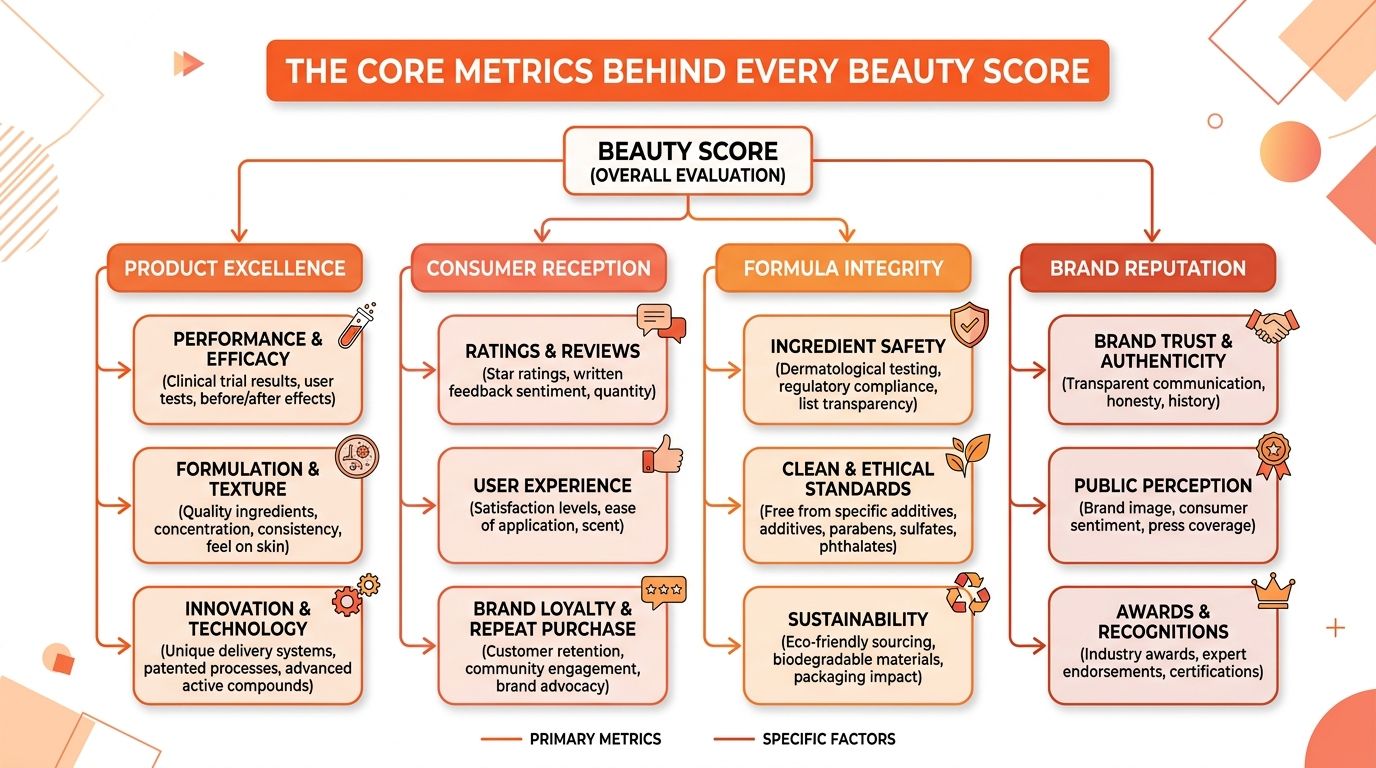
The most useful beauty scoring systems don't act like black boxes. They surface the underlying dimensions, then combine them into a composite result that's easier to compare across assets. In practice, the core ideas are usually symmetry, proportions, surface quality, feature balance, and overall harmony. Those terms come from face-analysis products, but the logic maps cleanly to marketplace imagery when you're judging whether a thumbnail reads clearly at a glance.
What each metric means in a catalog workflow
Symmetry is a proxy for compositional balance. In face tools, it measures whether the left and right sides align cleanly. In product imagery, the useful version is simpler, does the image feel centered, stable, and intentional, or does it look like it was rushed into frame.
Proportions are about relative fit. The golden ratio of 1.618 shows up in beauty tools as an idealized proportion target, and the broader lesson for eCommerce is framing discipline. If the product is too small in the crop, too close to the edge, or awkwardly staged, the image can feel off even when it's technically sharp.
Skin quality in consumer tools often means surface clarity, texture, and smoothness. For product photography, think of it as image cleanliness, sharpness, and the absence of distracting artifacts. Dust, compression, and muddy gradients all live here.
Feature balance is the equivalent of focal hierarchy. The viewer should know what the product is at thumbnail size without hunting for it. If props, labels, shadows, or reflections compete with the product, the image fails this test.
How to read a low sub-score
That's where a reference like Grumspot's search optimization advice is useful, because the same principle applies, relevance isn't a single label, it's a cluster of signals that has to line up. A low score in one area doesn't always mean the whole image is bad. It usually means one part of the composition is undermining the listing.
For an eCommerce manager, the value is diagnostic. If symmetry is weak, retest the crop. If surface quality is weak, inspect resolution and retouching. If harmony is weak, the issue may be less about the image itself and more about how the image reads in context on the marketplace page.
For a broader KPI view, teams often tie visual quality back to their internal reporting, including content health and discoverability metrics like those tracked in an eCommerce KPI framework.
Where Beauty Scoring Quietly Breaks Down
The biggest flaw in consumer beauty tools is not that they're wrong all the time. It's that they can be unstable in ways users don't see. The verified data is clear that these systems often expect a front-facing photo and may tell users to try multiple photos or use natural light for better results. That alone should make anyone cautious about treating a single score as a final truth.
Why reproducibility is the real issue
A beauty score can change because the photo changed, not because the subject changed. Angle, lighting, and image quality can all move the result, which means the tool may be reacting to capture conditions as much as to the thing it's measuring. Several consumer tools present the output as objective or scientific while still relying on proxies like symmetry, facial proportions, and golden-ratio comparisons, so the score may reflect geometric alignment more than actual human attractiveness.
That's the key limitation for eCommerce teams. Product imagery is shot under controlled conditions, but that doesn't mean the score is automatically trustworthy. It just means the failure mode shifts. Instead of selfie angle bias, you get white-background inconsistency, edge softness, compression blur, and thumbnail legibility problems that can disappear inside a single composite number.
The bias problem is not just theoretical
A tool trained on narrow visual patterns can reward some images more than others for reasons that have nothing to do with commercial performance. That matters whether the subject is a face or a product. If the scoring model favors one kind of framing or surface presentation, it may call that “better” even when shoppers would respond differently.
A beauty score is directional, not a verdict.
That's the safest way to use it. For a brand team, the honest workflow is to compare multiple captures, check whether the score is stable, and treat sudden swings as a signal to investigate the image, not as a final ranking of the product itself.
The bottom line is simple. If a tool can't explain why the score changed, or it only works on idealized inputs, it's better as a learning aid than as a production decision layer.
Why AI Shopping Assistants Now Care About Image Quality
Amazon's current AI shopping assistant is Alexa for Shopping, and Amazon has publicly repositioned it around conversational product discovery. That matters because it marks a real shift from keyword matching to AI-assisted product discovery, where listing content has to be understandable to the system, not just stuffed with search terms. In that environment, image quality stops being a cosmetic issue and becomes part of discoverability.

What AI discovery is really judging
When a shopper asks for help conversationally, the system has to decide which listings are easy to interpret and worth surfacing. That decision isn't based only on title wording. Visual presentation helps determine whether the product looks credible, complete, and relevant enough to recommend.
That's why content quality models like CoSMo matter in the broader marketplace conversation. A listing that has a weak main image, unclear packaging, or a thumbnail that fails at small size is not just aesthetically weaker. It is harder for AI-driven systems to read as a good match for the shopper's intent.
The same logic shows up in platform guidance around content quality. If the image doesn't communicate fast, the listing loses before the shopper even gets to bullets or A+ content. That's not a trick to game the algorithm. It's just a better answer to the shopper's question.
Why this changes the job of the content team
There's still a temptation to treat image optimization as separate from search optimization. That split doesn't hold up anymore. If the assistant is parsing product discovery conversationally, then copy and image quality work together. A strong title with a confusing hero shot is still a weak listing, and a strong image with vague content can still fail to convert.
For teams managing large catalogs, the practical move is to treat thumbnail quality as a discoverability input. A beauty scoring lens is useful because it gives the content team a shared way to spot where the hero image is underperforming before it gets buried in a live assortment. Cosmy's ecommerce SEO strategies fit that same operating logic, content has to be readable by people and systems at the same time.
The conclusion is straightforward. As AI assistants take a bigger role in shopping, the image has to do more than look good. It has to communicate product relevance instantly.
Consumer Selfie Tools Versus ECommerce-Ready Scoring
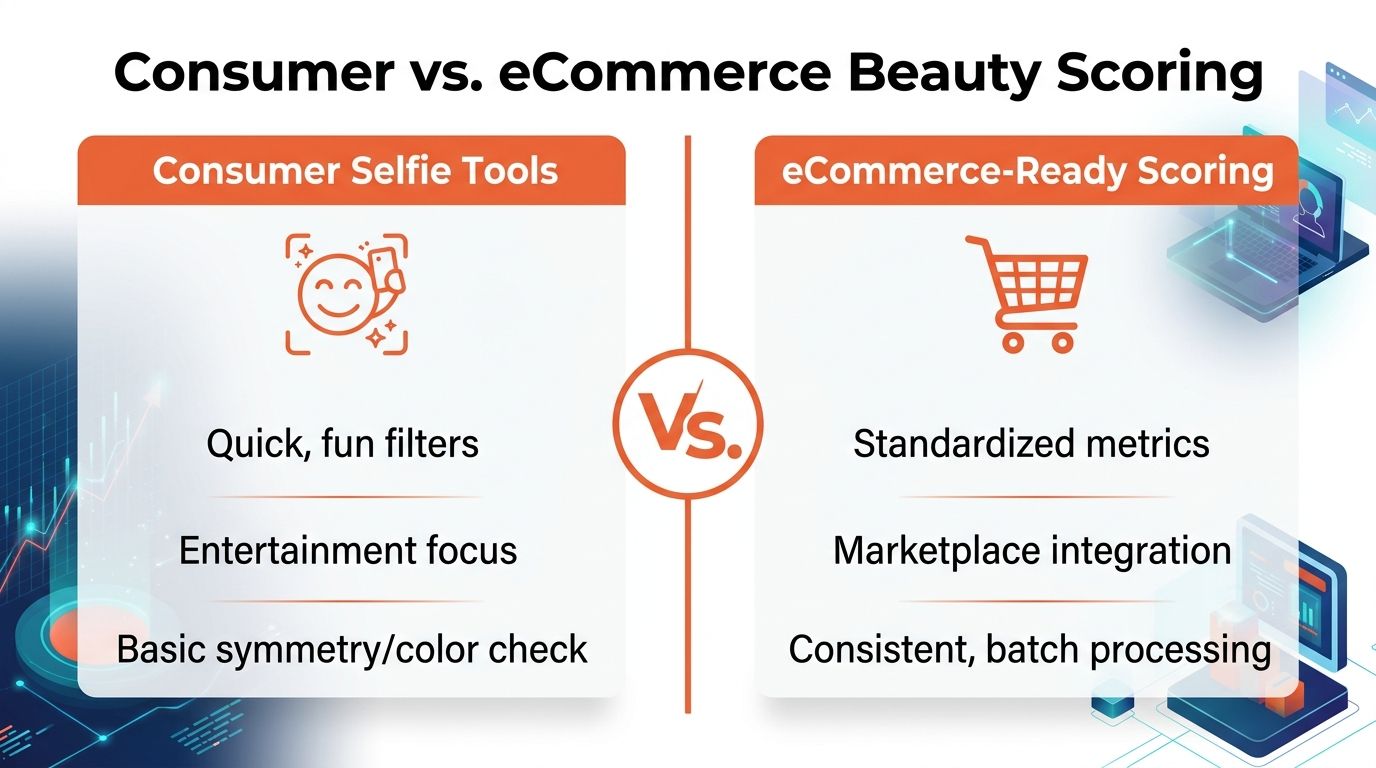
Consumer beauty tools are fine for learning the mechanics, but they're a poor fit for production catalog work. They're built for uploaded selfies, quick feedback, and entertainment. That makes them useful if a team wants to understand how geometry-based scoring works, but not if the goal is to audit hundreds of SKUs, compare variants, or plug results into a listing workflow.
What to look for before you adopt a tool
Consumer tools usually optimize for novelty. They may give a single vanity score, a simple breakdown, or a fast browser-based result. That's fine for education, but weak for operations.
ECommerce-ready scoring needs a different checklist:
Input format: Can it handle catalog images, not just selfie uploads?
Throughput: Can it process a batch instead of one file at a time?
Workflow fit: Does it connect to ASIN-level or SKU-level review?
Actionability: Does it show which dimension failed, or only a composite score?
Marketplace alignment: Does it reflect listing standards and content quality needs?
Those questions matter because the output has to be usable by the people who own the catalog. A creative lead needs to know which image to retake. A marketplace manager needs to know which listing to fix first. An agency needs something that can be repeated across clients without reinterpreting the score every time.
When a consumer tool still has value
A selfie calculator can still be useful as a teaching tool. It helps non-technical stakeholders understand that a score is usually built from measurable visual components, not taste alone. That can make internal conversations better, especially when a merchandiser or brand manager needs to explain why a hero image feels off.
But for production use, the bar is higher. If a platform can't support catalog-scale review, it's not built for the work most eCommerce teams need done.
Cosmy is one example of a tool in this category, since it audits and rewrites product listings for Amazon-style discoverability rather than face attractiveness. That's the right direction for teams that need visual scoring tied to content decisions, not just curiosity.
Turning a Beauty Score Into Listing Decisions
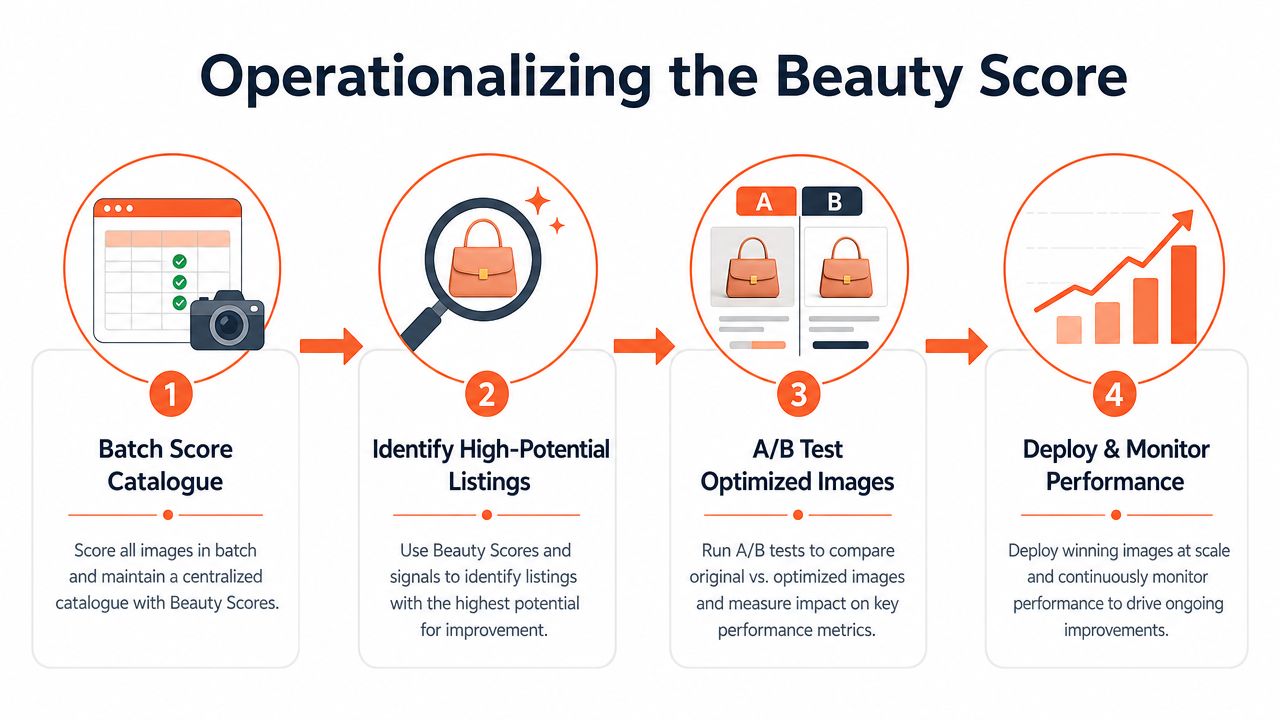
The only reason to score images is to change what goes live. A useful workflow starts with the catalog, not with a single hero SKU. Batch-score the assortment, isolate the weakest images, and look for patterns in the sub-scores. The goal is to find the listings that are visually underperforming before they absorb traffic and spend.
A practical operating loop
Batch score the catalog. Sort the full image set and pull the underperformers to the top of the review queue.
Inspect the weakest sub-scores. Decide whether the fix is framing, clarity, crop, or a full reshoot.
Prioritize by business impact. Fix the listings that matter most to revenue, not the ones that look cosmetically imperfect.
Deploy and watch the result. Roll the better image into the listing, then monitor how the asset performs against your other creative.
That sounds basic, but many teams don't run this loop consistently. They review creative in batches, launch on deadlines, and only come back after performance slips. A scoring layer changes that by making image quality a standing part of the content review process.
The same logic should apply to copy. If the image is weak but the text is strong, the listing still fails to communicate cleanly in AI-assisted search. If the image is strong but the copy is vague, the system still has incomplete context. That's why marketplace content teams need image and copy optimization to sit together, not in separate handoffs.
For teams that want to connect the workflow to broader listing operations, Amazon SEO optimization guidance belongs in the same playbook. The best results come when the thumbnail, bullets, and description all support the same shopper intent.
Start by scoring your top 50 or 100 listings, then compare the worst images against the strongest ones and document what changed. That gives your team a reusable standard instead of another subjective debate. If you're ready to turn visual scoring into a catalog workflow, review Cosmy and test it against a few live listings before your next launch cycle.
A CTA for Cosmy.