AliExpress Best Selling Items: Find & Validate Winners 2026


Most advice on AliExpress research stops at the easiest number on the page, the order count. That's a bad habit if you're trying to build a resale business, because a big lifetime number can hide a product that already peaked, slowed down, or became unreliable to source. AliExpress best selling items only become useful research inputs when you separate historic popularity from current momentum, supplier quality, and whether the item can survive a move into Amazon or another retail channel.
The operators who win usually look past the headline ranking and ask a harder question, which products are still moving, still ship cleanly, and still make sense after fees, defects, and ad spend. That filter matters even more now that marketplace discovery is moving from keyword matching toward AI comprehension. Amazon, Walmart, and other retail platforms are all leaning harder on content quality and relevance, so the item you choose and the way you describe it now matter together.
Table of Contents
Why Order Counts Alone Mislead Product Researchers
A high order count looks persuasive until you ask what it represents. A listing with tens of thousands of lifetime orders may have built that number over years, while a newer product with a smaller total can be accelerating right now. For resellers, that difference is everything, because you don't need the most famous item, you need the one that still has room to move through a clean supply chain.
Lifetime popularity and current momentum are not the same thing
AliExpress itself lets you sort products by Orders on search results, and that's useful as a first pass, not a final answer. The better interpretation is simple, the number tells you that buyers once trusted the listing, but it does not tell you whether the current supplier, shipping method, or product version still deserves that trust AliExpress search sorting by Orders.
Practical rule: treat order counts as a starting signal, then check whether recent reviews, seller activity, and shipping options still support the story the ranking is telling.
That's especially important on platforms where demand shifts fast. A product can look like a winner in a curated “best sellers” page and still be a poor resale choice if the supplier has become slow, inconsistent, or hard to reach. Recent guidance on AliExpress research makes the same point, because order counts alone can hide whether a listing has current momentum or just a long sales history Sell The Trend on AliExpress trending products.
What to look at instead of one big number
The better filter is a small bundle of signals. Recent reviews show whether buyers are still arriving. Supplier history tells you whether the store has stayed active long enough to avoid one-off spikes. Shipping availability tells you whether the item can be delivered in the markets you care about.
If you've ever sourced from AliExpress and later sold on Amazon, you already know the pain point. The product looked hot, the first batch sold, and then the second order took longer, looked different, or triggered complaints. That's why order count needs to sit beside recency and operational fit, not above them.

The key question is not “what sold most?” It's “what still sells, ships, and fits a repeatable resale model?” Once you shift to that frame, the search process gets much cleaner, and your shortlist gets much smaller.
Where AliExpress Demand Actually Concentrates
AliExpress demand clusters around practical categories, not just impulse buys. Analysts at Alibaba's best-selling category review found Electronics at 35.2% of revenue share with $102.7B in total data coverage, while Home & Garden held 16.4% and Automotive 10.9%. The same source reported growth rates of 12.8% for Electronics, 15.1% for Home & Garden, and 18.6% for Automotive, which points to durable, utility-driven demand rather than random hype AliExpress category analysis.
Product-level winners tend to be functional and broadly compatible
Inside Electronics, smart home accessories were singled out as the leading subcategory with an average order value of $28.50. That matters because it shows a useful pattern, mid-priced utility items can outperform ultra-cheap accessories when they solve a clear problem and work across devices or households.
A product mix built around phones, charging, home organization, and small automotive accessories makes sense for a reason. Those categories travel well, don't depend on local sizing rules as much as apparel, and usually fit a broad range of buyers. AliExpress has long produced scalable winners in small-ticket products that can accumulate massive unit volume even when each item stays under about $30 AliExpress product ranking data.
The unit-volume pattern tells a clearer story than trend chatter
The strongest product-level movers in a 2025 to 2026 ranking were not flashy gadgets for a tiny niche. They were practical items with obvious use cases, including magnetic phone rings (3-pack) at 8.7 million units, silicone stretch lids (10-pack) at 6.2 million, rechargeable LED nail lamps at 5.9 million, adjustable laptop stands at 5.1 million, and 3-in-1 pet grooming kits at 4.9 million AliExpress product ranking data.
Product | Units Sold | YoY Growth |
|---|---|---|
Magnetic phone rings (3-pack) | 8.7 million | not provided |
Silicone stretch lids (10-pack) | 6.2 million | not provided |
Rechargeable LED nail lamps | 5.9 million | not provided |
Adjustable laptop stands | 5.1 million | not provided |
3-in-1 pet grooming kits | 4.9 million | not provided |
Wireless earbuds | 14.7 million orders | 32.1% |
Car phone mounts | 18.5 million orders | 21.3% |
The same snapshot showed wireless earbuds at 14.7 million orders with 32.1% year-over-year growth, and car phone mounts at 18.5 million orders with 21.3% growth. That combination of scale and growth is exactly why these items get attention from Amazon and resale operators. They solve everyday needs, they fit international shipping patterns, and they can keep moving when the market is not in a fad cycle.
How to Find and Filter Best Sellers on AliExpress
Sorting by Orders is a starting point, not a verdict. If you treat the top row as a shortlist without checking recency, shipping, and seller consistency, you end up chasing old volume that may not translate into a clean Amazon resell. The AliExpress search interface does let you sort by Orders, and that makes it easier to surface products with proven demand, but the filter pass matters just as much.
Start broad, then narrow with relevance
Begin with a category browse instead of drilling straight into a keyword that may be too narrow. That gives you a better read on which product families dominate the niche, not just which exact phrase happens to be overused in listings. After that, sort by Orders and look for listings with enough activity to justify a second pass.
Then tighten the filters. Price has to leave room for Amazon fees, packaging, and promotion. Ship-from matters because a product that looks attractive on paper can still fail if delivery timing is too slow for your target market. A listing that cannot reach the buyer reliably is not a usable winner, even if the order count looks strong.
Check whether the demand is still alive
Order volume shows historical movement. Recent reviews and buyer photos show whether demand is still active. If reviews are still coming in and the user photos look current, the listing is more likely to be supported by ongoing sales rather than a one-time spike.
A good shortlist usually has the same shape, a clear use case, visible review activity, and shipping options that fit the market you are targeting.
Operators who need a repeatable workflow often export titles, prices, ratings, and order history instead of copying everything by hand. A browser tool can make that easier, and this chrome extensions web scraper guide is a practical reference for setting up that kind of extraction without turning research into manual data entry.
The final decision still comes down to judgment. If a listing looks hot but the photos feel stale, the shipping window is too wide, or the reviews point to inconsistency, pass on it. Curated “top sellers” pages only help when you still validate that the product fits your resale model and does not rely on a temporary burst of attention.
Supplier Vetting and Quality Risk Assessment
A good product from a bad supplier is still a bad sourcing decision. On AliExpress, the supplier determines whether the item arrives on time, matches the listing photos, and stays consistent when you reorder it. That's why product research and supplier vetting have to happen together, especially if you're planning to resell on Amazon where defect rates and account health matter more than they do in casual dropshipping.
Use store history and communication patterns as quality filters
Start with the store itself. Look for a supplier that has been active long enough to show stability, not just a handful of random listings. Then check how the store communicates, whether replies are timely, whether product questions get real answers, and whether the seller is evasive about shipping methods or packaging.
A practical way to think about this is the same way you'd choose a niche for search content. You want a topic, or in this case a supplier, with enough depth to support repeat work. The logic behind how to choose a niche for SEO applies here, because shallow options look tempting at first and then collapse under operational scrutiny.
Look at real proof, not polished listings
Product photos are not enough. Ask for samples when the margin justifies it, then compare the sample to the listing images and buyer-uploaded photos. If the supplier won't show consistency before you commit to scale, that's a warning sign.
The most useful operational benchmark comes from a 2026 ranking that required products to score at least 8.2/10 across order velocity, buyer retention, and logistics stability, with on-time delivery and low dispute frequency under 2.1% across EU, US, and ANZ markets AliExpress 2026 best-selling items data-backed guide. That doesn't mean every product needs that exact profile, but it does show what the market rewards, stable fulfillment and low friction.
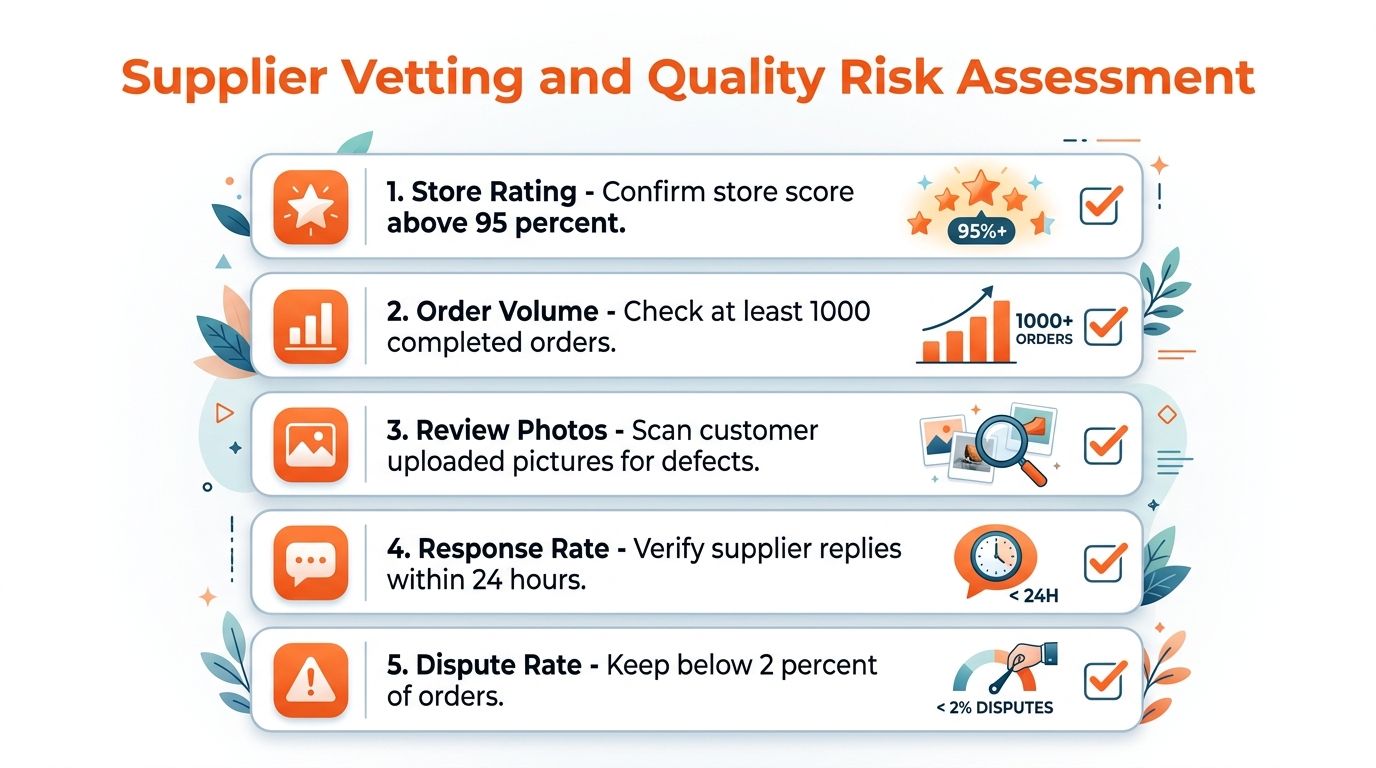
If a supplier is slow to answer, vague about shipping, or inconsistent across listings, move on. The cheapest unit price in the world won't save a product that creates disputes, and one bad supplier can poison an entire catalog when you're selling through a marketplace account.
Validating Cross-Market Demand Beyond AliExpress
AliExpress data shows what moves on AliExpress. It does not prove the same item will sell in the US, EU, or any other Amazon market. That gap causes a lot of product research to fail, because sellers read marketplace-native demand as if it were cross-market demand, then wonder why the listing stalls after launch.
Cross-check the product against external demand signals
Start with search behavior outside AliExpress. If a product has real potential, it should surface in Google Trends, TikTok, Instagram, YouTube Shorts, or Pinterest, depending on the category. The point is not to chase every mention, it is to see whether the idea has moved beyond one marketplace and into broader consumer awareness.
That matters because recent AliExpress-oriented trend coverage keeps emphasizing fast-moving electronics, smart home devices, and portable power products, but those lists often do not say whether demand is concentrated in emerging regions or spread across major Amazon markets AliExpress best items overview. For brands, that distinction changes the next move. A product with strong demand in one region may need localization, different imagery, or a different price point before it works elsewhere.
Use the market target to decide what happens next
If the product shows broad, repeated interest across channels, keep it in play. If it is hot only on AliExpress and nowhere else, treat it as a warning that the trend may be regional or temporary. If demand exists but the wording differs by market, reposition the listing language instead of changing the item itself.
Practical rule: a product that trends in one marketplace but stays invisible everywhere else usually needs a different angle, not a bigger ad budget.
That kind of validation also helps when you plan to expand beyond Amazon. A practical eBay launch guide like how to sell on eBay can give you a useful second read on whether the same product has enough buyer intent to justify a wider rollout.
Targeted validation saves time. If you are checking whether a product has traction on Amazon, do not just compare titles, compare the underlying shopper intent. A product that does well in one marketplace because of broad compatibility or utility often fails in another when the content is too generic or the use case is not obvious.
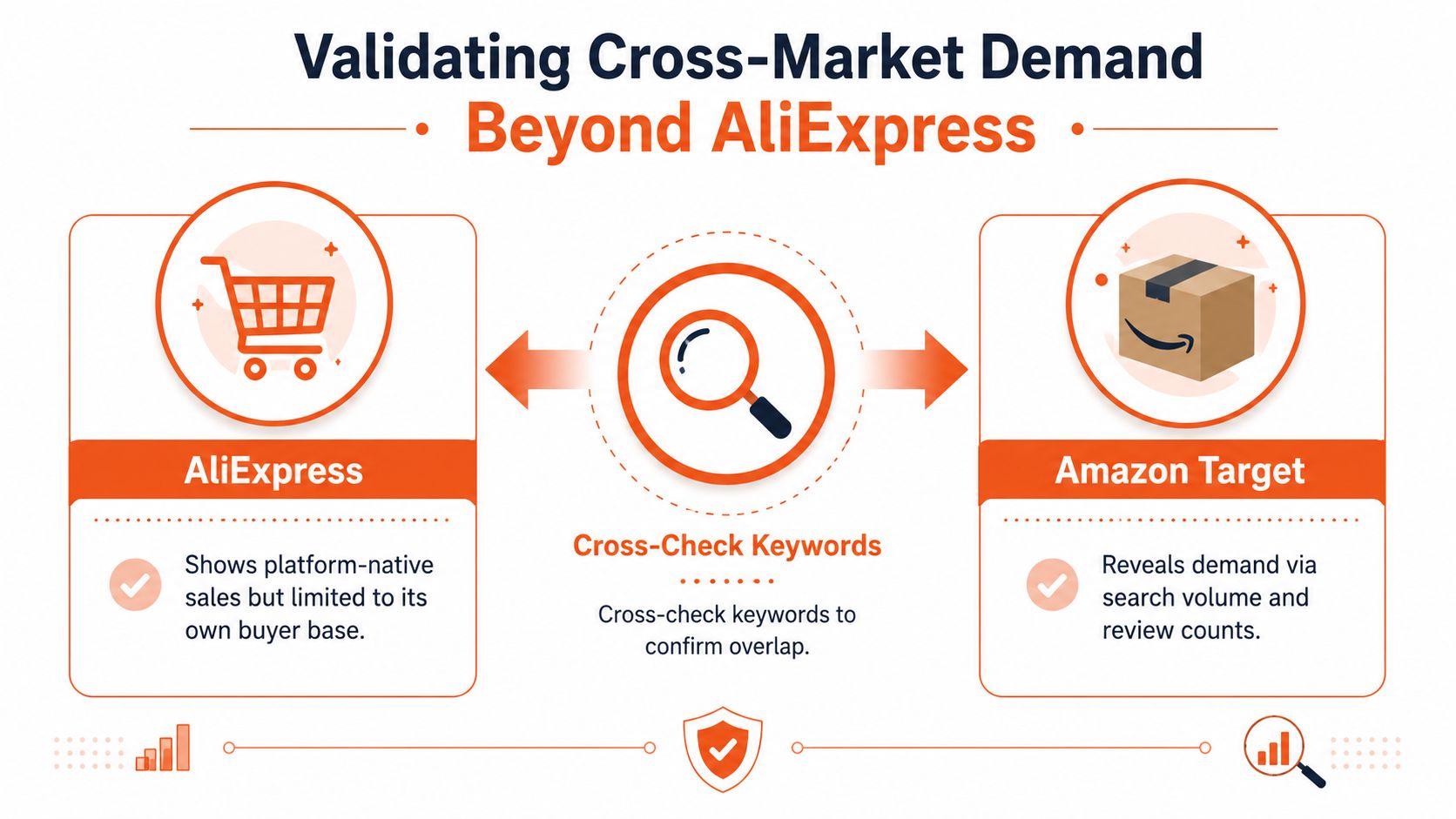
For teams selling across channels, that cross-check is where product selection becomes strategy. You are not just asking whether a product sells, you are asking where it sells, how it is described, and whether the same demand signal exists where you plan to compete. If you need a wider operating model for that part of the workflow, AdStellar AI agent solutions can help structure research across channels without turning it into manual spreadsheet work.
Translating Product Research into AI-Ready Amazon Listings
A strong AliExpress find can still fail on Amazon if the listing was written for old-school keyword stuffing instead of actual product understanding. Amazon's discovery layer now leans harder on AI comprehension, which means the page has to explain the product clearly enough for a shopping assistant to map intent, use case, and compatibility. That shift also shows why listing quality models like CoSMo matter, because the content has to work across multiple dimensions, not just keyword repetition.
Write for shopper intent, not keyword density
The best Amazon listings answer the question a buyer has. What does it do, who is it for, what devices does it work with, and why is this version worth choosing? That matters especially for products that show up strongly on AliExpress because they often win on utility and compatibility rather than brand prestige.
Multi-device products are a good example. One AliExpress-linked best-sellers page says multi-device wireless chargers account for 5.7% of all electronics category sales and that consumers own 3.2 devices on average AliExpress multi-device wireless charger data. That kind of signal justifies broad compatibility language in titles and bullets, because buyers are rarely shopping for one device in isolation.
Structure the listing so AI and humans read it cleanly
Titles should name the product plainly, then layer in the main compatibility or use-case signal. Bullets should separate features from benefits, so the listing reads like a useful summary instead of a pile of adjectives. Descriptions should give context, especially for small electronics and home items where a buyer needs to understand fit, size, and scenario fast.
If you're managing this at scale, tools like AdStellar AI agent solutions can help teams handle repetitive content operations without sacrificing clarity. For a deeper content workflow, the structure in Cosmy's Amazon content strategy guide is useful because it treats listing quality as a publish-ready process, not a keyword exercise.
The practical shift is simple. Product research tells you what buyers already want. AI-ready listing work tells the marketplace how to understand that demand, and that's what determines whether the item gets found at all.
Risk Factors and Logistics Realities to Plan For
A product can be popular, compatible, and easy to explain, and still fail because the logistics don't work. I've seen that happen with low-cost accessories that looked perfect on paper, then turned into margin drains once shipping, delays, and returns hit the account. The operational picture is what separates a useful AliExpress best seller from a costly experiment.
Delivery speed and returns shape the economics
The 2026 guide cited earlier is useful because it connects product type to fulfillment realities. Smart posture-correcting wearables were listed with 218,400 average monthly orders, $42.90 average order value, 14.2 days median delivery time, and 8.3% return rate AliExpress 2026 best-selling products guide. Those numbers show why product choice has to include delivery and return expectations, not just demand.
A higher-value item can tolerate more friction if the margin exists. A thin-margin product cannot. That's the part many sellers skip, then they discover Amazon fees, shipping costs, and ad spend erase the upside.
Build contingency into sourcing from day one
Shipping methods should match the target market, not the cheapest available option. Customs can slow things down, inventory can get stranded in transit, and a supplier can vanish just when a winning SKU starts to scale. That's why the logistics checklist has to include backup suppliers, sample testing, and enough lead time to avoid stockouts.
If you need a practical reference for the mechanics of moving goods across borders, the shipping logistics playbook is a useful companion because it keeps the discussion grounded in transport reality instead of theory. For AliExpress resellers, that kind of planning is what keeps a promising product from becoming a service headache.
The best-selling item on AliExpress is not automatically the best item to resell. The winner is the one that survives supply variation, fits your target market, and still leaves room after every fee is paid.
If you want to turn product research into listings that get found, visit Cosmy. It audits and rewrites Amazon content for the AI search era, so your listings are built around how buyers and marketplace assistants read them. For teams choosing between a trendy product and a sustainable one, that kind of clarity saves time and protects margin.