Amazon Browsing History and What It Means for Brands

Most brand teams are looking at Amazon the wrong way. They treat the shopping journey as a keyword problem, then wonder why strong listings still get inconsistent visibility, weak follow-up traffic, or strange recommendation behavior after a shopper clicks around for a few minutes.
Amazon browsing history is the missing layer. It sits between the first product view and the next recommendation, and it tells Amazon what a shopper was curious about, what they came back to, and what context should shape the next screen they see. For brands, that means content quality, clarity, and attribute structure matter just as much as keyword targeting, because browsing signals only help a listing if the product page gives Amazon something precise to read.
Table of Contents
The Shopper Moment Behind Every Click
A shopper opens Amazon to compare a pair of running shoes, taps one listing, scrolls away, then checks a similar pair ten minutes later. Later that evening, the homepage starts showing related options, and the shopper feels like Amazon is “remembering” what they were looking at.
That memory is not magic. It is Amazon browsing history, and it connects a casual visit to the next recommendation, the next search result, and the next merchandising surface. Amazon also gives shoppers direct controls for viewing and managing it, which makes the feature part of the customer-facing experience, not a hidden backend log, as described in Amazon's own help pages and history page (Amazon browsing history help, Amazon browsing history page).
For a brand team, the point is straightforward. A product view is not only a page session, it is a signal that can shape what happens next. If the listing is vague, hard to classify, or overloaded with soft copy, Amazon has less to work with when it links that view to future discovery.
A strong listing gives the system clearer cues. Title structure, bullet hierarchy, attribute completeness, and content relevance all help Amazon understand what the page is, who it is for, and what adjacent products should be shown beside it. That is also why teams that work from a structured SEO process, like the one outlined in ecommerce SEO strategies for Amazon brands, often find it easier to improve both discovery and page quality at the same time.
Practical rule: treat every product page as input to the next recommendation, not just a place to close the sale.
For AI-driven content models like CoSMo and Cosmy, these browsing signals matter because they help sort which listings need attention first. If a page gets viewed but does not lead anywhere useful, the model can prioritize fixes in the title, bullets, or attribute stack before the team spends time on lower-impact changes. That turns browse behavior into a content triage signal, which is more useful for brand teams than treating it only as a shopper privacy feature.
What Amazon Browsing History Is
A shopper clicks into a product, glances at the listing, and moves on. Amazon keeps that view in browsing history, which is the record of products a shopper has recently looked at and a control shoppers can manage from their account. On desktop, it lives under Accounts & Lists. On mobile, it appears in the profile or account area as Your Browsing History. Shoppers can remove individual items, clear items from view, or turn the feature off through the settings described on Amazon's help page.
For brand teams, that simple history page is a signal source, not just a privacy setting. It shows what a shopper considered before buying, which is different from what they searched for or what they eventually purchased. Search history captures the words they used. Purchase history captures the order they completed. Browsing history captures the products that stayed in play long enough to shape the next recommendation.
Signal | What it captures | Where shoppers see it | Brand implication |
|---|---|---|---|
Browsing History | Recently viewed products and related discovery actions | Accounts & Lists on desktop, Your Browsing History on mobile | Shapes recency-based discovery and recommendations |
Search History | Queries and intent phrases | Search surfaces and account-related views | Tells you how shoppers describe the need |
Purchase History | Completed orders | Orders and account records | Confirms conversion, repeat behavior, and replenishment patterns |
The visible history page is only the part shoppers can see. Behind it sits a wider personalization system that uses those views to decide what should show up next. That is why the strategic question is not only whether a shopper can clear the list. The better question is whether your listing is easy for Amazon to read back into discovery once that view becomes part of the next recommendation cycle.
Browsing history is useful because it sits closer to consideration than purchase. That makes it a strong clue about what a shopper may want next.
For a brand team, that means the page has to do more than look polished. Titles, bullets, images, and attributes need to make the item easy to classify. If those signals are muddy, browsing data has less value because Amazon has less confidence about where the product belongs in future discovery. That is also why teams that use a structured approach such as Amazon A10 listing tactics can often turn browse behavior into clearer listing priorities.
For AI-driven content models like CoSMo and Cosmy, browsing signals help rank which listings need attention first. A page that gets viewed but does not lead to the next useful action is a warning sign. The model can use that pattern to prioritize fixes in the title, bullets, or attribute stack before the team spends time on lower-impact changes. That makes browsing history a content triage signal, which is more useful for brand teams than treating it only as a shopper privacy feature.
How Amazon Turns Browsing Into Recommendations
Amazon has been unusually explicit about how its personalization stack uses shopping information. In its description of Alexa for Shopping, Amazon says product recommendations and dynamic product content draw on customer shopping information that includes search, browsing, and purchase history. Amazon also says one LLM selects which attributes matter most and an evaluator LLM checks and improves the result, which shows that browsing signals are being interpreted inside an AI workflow, not just stored for later use (Amazon generative AI for product search and descriptions).
That changes how listing content should be written. If a shopper viewed a blender, then moved to a related accessory, Amazon's systems are not just looking for the same keyword again. They're trying to understand what attribute pattern fits that browse path, then surface content that looks consistent with it. Weak titles and muddy attribute order make that harder.
What this means on the listing side
A title that leads with the wrong attribute can break the match between browse intent and product meaning. A bullet that hides the main use case can make the item harder to place in recommendation or comparison surfaces. A description that reads fine to a human but doesn't expose clear attributes can leave Amazon with less confidence when it assembles the next result.
If your team wants a deeper playbook for traditional marketplace structure, this is also where Amazon A10 listing tactics still help as a reference point, especially for aligning product content with how retail search engines interpret relevance.
Browsing history is not just a recall feature. It feeds ranking, recommendation, and AI-generated content decisions.
That's the strategic shift. Brands used to optimize for a search box. Now they need content that survives interpretation by systems that connect browse behavior to product meaning across multiple surfaces.
Why Recency Matters More Than Depth
Amazon-style recently viewed systems are built for speed. A common implementation pattern is event-driven. Each product view emits an event, the write path stores it in durable storage and an in-memory layer, and the read path serves the history from a fast key-value store such as Redis sorted sets. One described design keeps only the latest 100 events per user and retains roughly 6 months of views, which makes the feature behave like a recency index rather than a permanent archive (Amazon-style system design for recently viewed items).
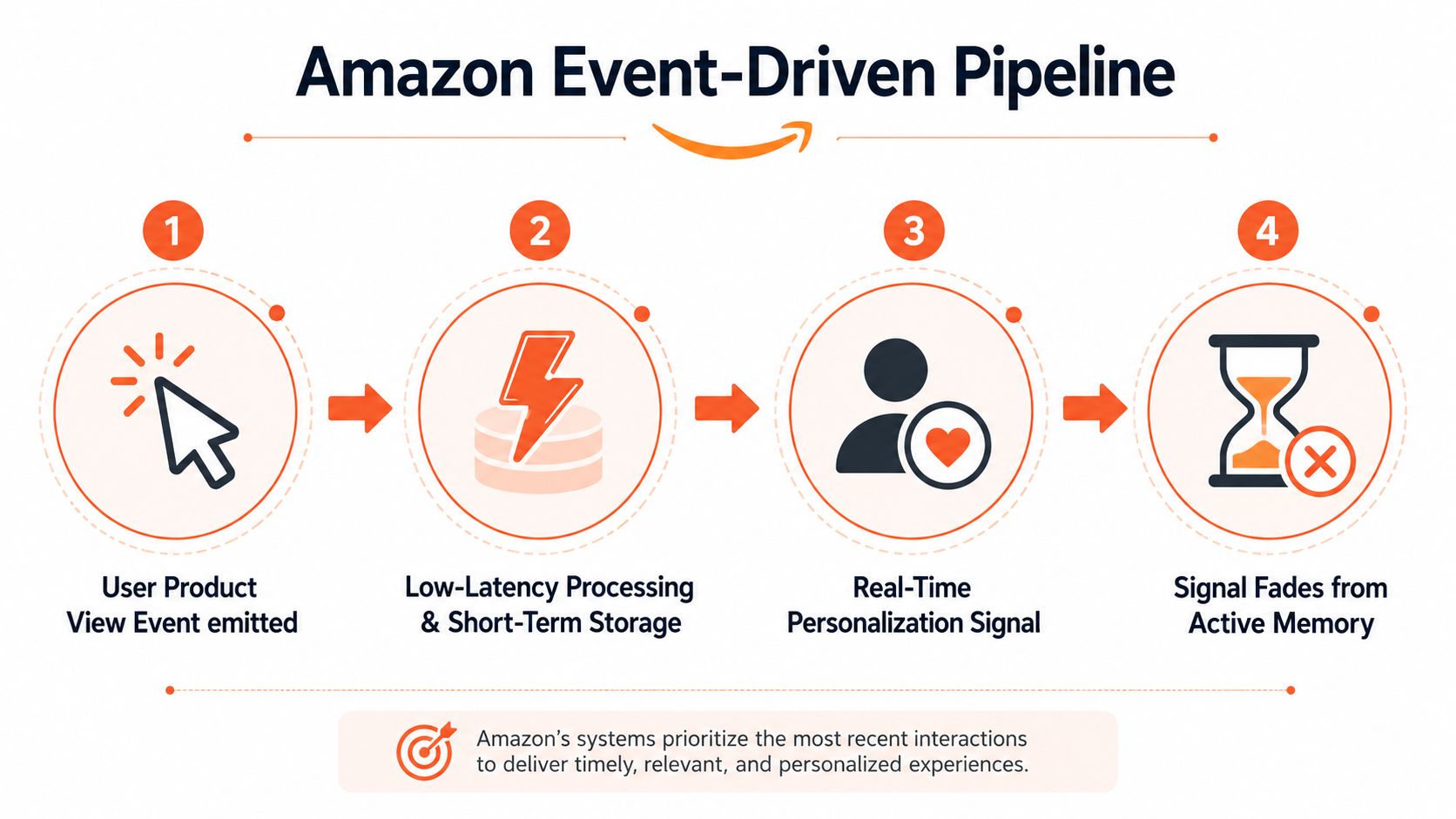
That design choice has a practical consequence for brands. Recent behavior matters more than old behavior because the active browsing set is bounded. If a shopper viewed your product yesterday, that signal is more likely to influence what they see next than a view from months ago. Retargeting windows, recommendation triggers, and follow-up merchandising should reflect that timing instead of assuming browse intent stays warm forever.
How to think about it operationally
If a shopper looks at a premium coffee maker, then browses filters and accessories the same week, those signals can work together. If they came back six months later, the active memory may no longer reflect that old path. Your content strategy should therefore support short-cycle discovery, especially around launches, seasonal demand, and replenishment categories.
The engineering lesson is useful even for nontechnical teams. Low-latency systems favor recent intent, so the page that the shopper sees right after browsing has outsized importance. That's where title clarity, image hierarchy, and bullet relevance need to do the most work.
What Data Amazon Retains Beyond the Visible Page
A shopper may only see the browsing carousel, but Amazon's internal view is wider. That matters for brands because personalization is built from more than a single screen. A 2024 Scientific Data paper released an Open e-commerce 1.0 dataset built from five years of U.S. Amazon purchase histories, covering 5,027 Amazon.com consumers and 1,850,717 total purchases from 2018 through 2022 (Scientific Data paper). The point for marketers is simple, Amazon sits on a large body of commerce behavior, and that makes browsing signals part of a much larger system of shopping intent.
The visible history page is only one window into that system. Consumer-security coverage indicates that Amazon can retain granular activity such as searches, clicks, cart actions, and metadata like timestamps and IP address in some exports or records (consumer-security coverage). That does not mean every shopper sees every field. It does show that the data behind personalization can be broader than the list of recently viewed items.
For brands, that wider view changes how you read browse behavior. A view may sit beside query intent, cart behavior, and order history, so on-page history controls are only part of the picture. If you are building a first-party strategy for a DTC brand, the useful habit is to treat behavior as a set of signals, not a single screen. The guide on first-party data tactics for DTC brands gives a practical way to frame that work.
The control point still matters
Amazon's help guidance gives shoppers ways to remove items or manage the browsing feature from view, so the visible interface stays editable. That control matters for the customer experience, but it does not erase the underlying signal. A shopper can clean up the surface while Amazon still uses broader behavioral context to shape what appears next.
For brands, that means the key question is not whether the history page is visible. The core question is whether your listing content supports the data Amazon is already collecting. A clean title, clear attribute order, and plain-benefit bullets help Amazon classify the product correctly, which is why teams often pair browse-signal analysis with Amazon SEO optimization work. AI-driven content tools like Cosmy can then sort listing issues by what those signals suggest matters most, so teams fix the pages that are most likely to affect discovery first.
From Browsing Signals to Content Quality Signals
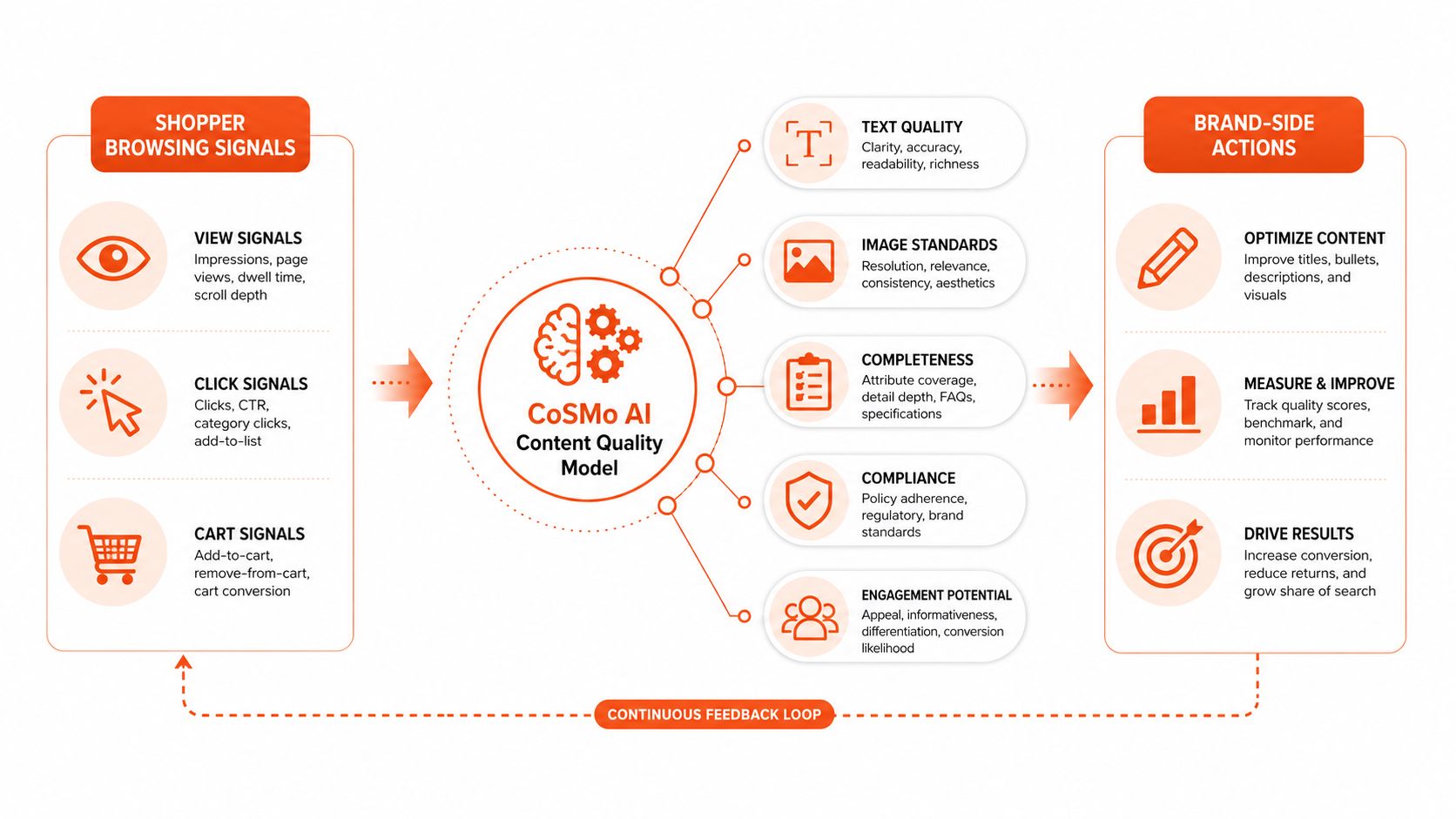
Amazon's internal CoSMo model is important because it shifts the conversation from keywords to content quality. CoSMo scores listings across multiple dimensions, which means Amazon is not just matching terms, it's judging whether the page is complete, readable, compliant, and useful to shoppers and its own AI systems. That's the bigger story behind browse intent. If Amazon can see what a shopper viewed, the listing still has to make sense when the system tries to classify it.
What good content looks like now
Titles need a clear attribute order. Bullets need to answer the shopper's immediate use case. Descriptions need structured context that an AI system can map back to the browsing path. That's why generic keyword stuffing stops working. It doesn't help Amazon understand what the product is, who it fits, or why it belongs in the next recommendation set.
The practical shift is simple. Write for machine comprehension first, then make it readable for humans. That means using clean product types, specific attributes, and plain-benefit language that mirrors how shoppers browse categories. If a customer is exploring “small-space storage,” your content should make the size, format, and use case obvious without making Amazon guess.
A useful reference on the video side of this same problem is how to sell more with product videos, because images and motion assets now support the same interpretability challenge that copy does. When content is clear across formats, the system has a better chance of mapping browsing signals to the right product.
Practical takeaway: the listing that wins is usually the one Amazon can understand fastest.
That's where CoSMo fits into the broader discoverability shift. It gives brands a way to measure quality the same way the marketplace increasingly does, which is why browse intent and content structure should be managed together.
Diagnostics and Fixes Brands Can Run This Week
Start with the title. Pull your top ASINs, then compare each title against the top listings in the same browse set. Ask one question, does the first half of the title make the product type and key attribute obvious enough for a shopper who just came from browsing, not searching? If not, the title is probably doing too much or too little.
Then check the bullets against real shopper intent. Use the questions your team already sees in reviews, customer service, or on-page search behavior, then ask whether each bullet answers one of those questions cleanly. If a bullet repeats the title or leans on vague claims, it isn't helping the browse-to-discovery path.
A simple content audit pattern
Title clarity: Does the title lead with the attribute Amazon is most likely to match to browse intent?
Bullet alignment: Do the bullets map to actual shopper questions, not internal feature lists?
Description depth: Does the description add structured context a generative shopping assistant could use?
Review language: Do customer phrases support the same attribute story the page is trying to tell?
If you want a single workflow that collapses this work into something manageable, Cosmy combines Alexa for Shopping analysis, CoSMo scoring, Voice of Customer review analysis, and Jungle Scout keyword intelligence into one process that turns content gaps into prioritized fixes and publish-ready copy.
That matters because it removes the guesswork. Instead of arguing about whether the listing needs more keywords, your team can see where the page fails to support browsing-intent signals and then fix the right part first.
Turning Signals Into a Repeatable Content Workflow
The workflow is straightforward. Audit the ASIN through the lens of browsing intent, score the listing against content-quality dimensions, prioritize the fixes that will improve discoverability, regenerate the title, bullets, and description, then recheck the result against the current page. If you want a strategic reference for that process, the article on Amazon content strategy is a useful companion because it frames content as an operating system, not a one-time rewrite.
Most listings were written for an algorithm that no longer exists. Amazon now reads shopper behavior through browsing, recommends from recent intent, and evaluates content with AI-aware quality models. Brands that adapt to that reality will stop treating product pages like static assets and start treating them like signals.
A practical next step is simple. Pick one priority ASIN, run it through your current content workflow, and compare the live listing against a version built for browsing-aligned discovery. If the second version reads clearer to a shopper and cleaner to Amazon, you've found the gap.
If you want to see how your listings read against Amazon browsing behavior, start with one ASIN and audit it in Cosmy. It shows where your content is helping discovery and where it's holding the listing back. For brand teams managing Amazon at scale, that kind of signal-based review is the fastest way to turn browse data into better content.

