Ecommerce SEO Strategies: AI Visibility & Shopper Intent


The most common ecommerce SEO advice is also the least useful for a brand manager under pressure. Audit keywords. Fix metadata. Build backlinks. Wait. That playbook still matters, but it describes a search environment that shoppers increasingly bypass.
Product discovery now happens inside answer layers, rich results, marketplace recommendation systems, and AI shopping assistants that summarise options before a shopper ever opens a listing. If your team is still judging success by rank alone, you're measuring visibility too late.
That shift changes how strong ecommerce SEO strategies are built. The job is no longer just to help Google or Amazon find your page. The job is to help machines understand your product well enough to recommend it confidently, and to help shoppers see the right facts fast enough to choose it.
The New Audit Finding Your AI Visibility Gaps
A traditional SEO audit asks, “Where do we rank?” A useful audit now asks, “How is the product being interpreted?”
That's the gap many teams miss. In Italy, Google accounted for about 95.6% of desktop search visits in 2025 according to Google's ecommerce search guidance context. Yet many optimizers still optimise only for classic blue-link behaviour, even as AI-mediated discovery becomes a normal part of how shoppers evaluate products.

What an AI visibility audit looks for
On Amazon, this means checking whether a system like Rufus can answer obvious shopper questions from your listing alone. On DTC, it means checking whether your product page gives search engines enough clean, structured, explicit information to surface in rich results and answer-style experiences.
I'd break the audit into four checks:
Attribute clarity
Does the page state core facts plainly? Size, material, compatibility, use case, care instructions, pack count, safety notes, and intended buyer all need to be explicit. If a product is “travel friendly”, that's vague. “Fits under most airline seats” is usable.Question coverage
Look at your listing as if the shopper never clicks. Can someone learn the top buying facts from the title, bullets, schema, reviews, and first visible copy?Machine readability
Dense brand language hurts comprehension. Structured, specific phrasing helps. AI systems don't benefit from vague persuasion. They benefit from clean facts.Conflict detection
Many listings send mixed signals. The title says “water-resistant”. The bullets say “not for heavy rain”. The A+ content shows hiking in storms. That inconsistency causes weak matching and poor recommendations.
Practical rule: If two people on your team describe the product differently, an AI assistant probably will too.
Where most brands find the real gaps
The biggest problems are usually boring. Missing attributes. Thin bullets. Generic titles. Reused manufacturer copy. No clear answer to “who is this for?” Product pages often read like catalogue entries, not decision tools.
For Amazon teams, I also look for gaps between shopper phrasing and listing phrasing. Buyers ask “Will this fit a carry-on?” or “Is this safe for sensitive skin?” Brands often write “compact design” or “gentle formulation” and assume that's enough. It isn't.
A practical starting point is to compare your top listings against the kinds of intent patterns discussed in Cosmy's breakdown of how people search on Amazon. That helps surface whether your page is aligned to how shoppers phrase needs, not how internal teams describe products.
Build a baseline before rewriting anything
Before changing copy, capture a simple baseline:
Audit area | What to record |
|---|---|
Top shopper questions | Questions answered well, poorly, or not at all |
Listing fields | Title, bullets, description, images, A+ content, schema |
Attribute coverage | Missing specs, compatibility notes, usage context |
Answer quality | Whether a non-expert could choose confidently from the page |
If you also need a grounded explanation of how AI answer layers change organic visibility, The SEO Agent's guide to AI Overviews is worth reading because it frames optimisation around answer extraction, not just ranking position.
The main trade-off is simple. Teams that obsess over rankings often miss comprehension. Teams that fix comprehension usually improve the signals that rankings depend on anyway.
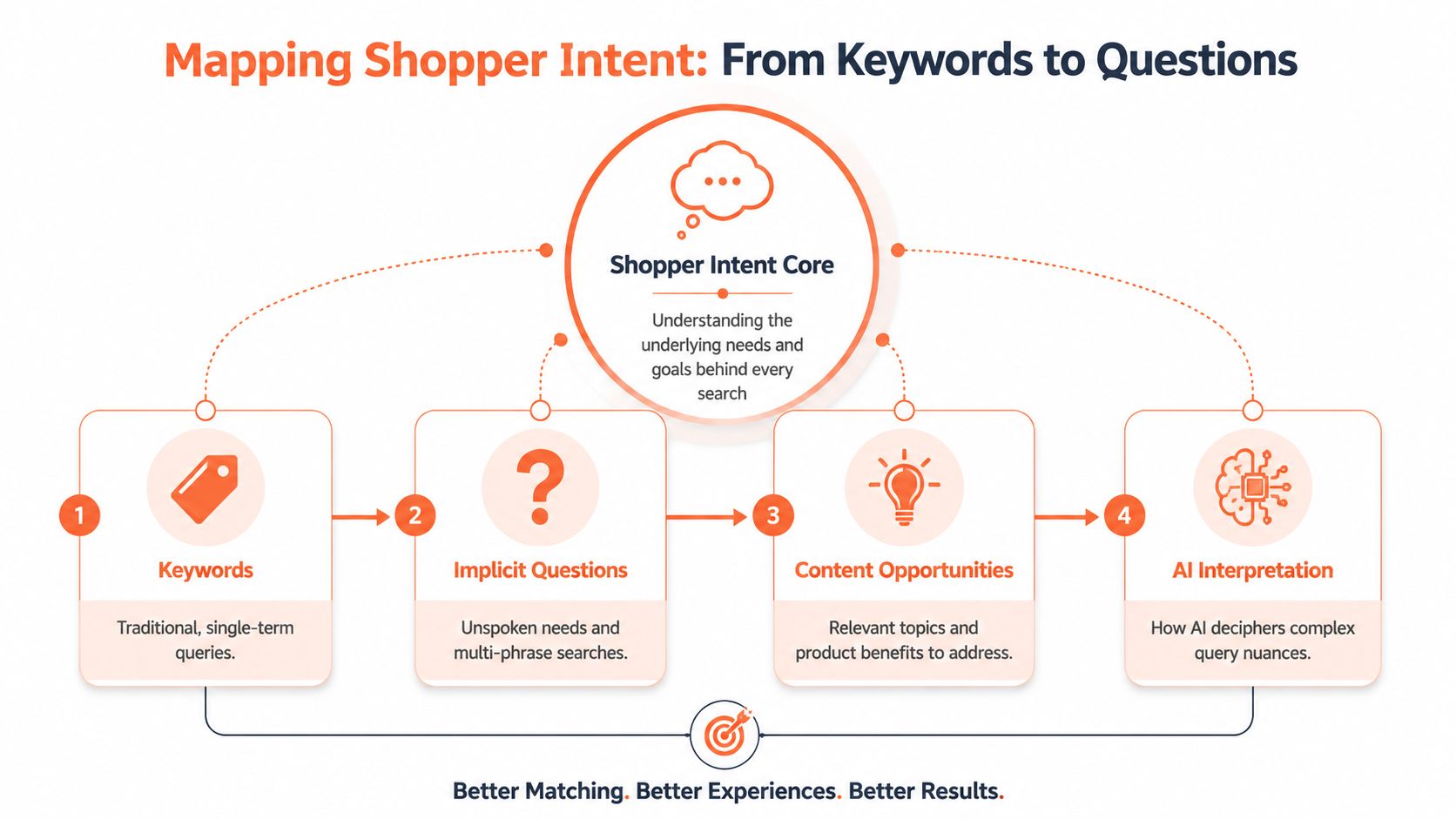
From Keywords to Questions Mapping Shopper Intent
Keyword lists are still useful. They're just not enough.
A search like “winter jacket” isn't one intent. It's a bundle of hidden questions. Is it for city commuting or hiking? Mild cold or deep winter? Lightweight packing or maximum insulation? Men's fit, women's fit, or unisex sizing? AI assistants try to resolve those hidden layers. Your content needs to do the same.
The pressure to answer directly is growing because 58–60% of Google searches now end without a click, and the breakdown cited by SEO Sherpa includes 61.5% of desktop searches ending with no click according to SEO statistics compiled by SEO Sherpa. If the answer surface matters this much, your page content has to map to real shopper questions, not just target terms.
Build a question map from real customer language
Skip the temptation to start with a spreadsheet of search volume alone. Start with the language customers already use when they are close to buying.
Use inputs like:
Reviews from your own catalogue and competitor listings
Support tickets that mention confusion before purchase
Amazon Q&A and product questions on marketplaces
Returns reasons that reveal mismatched expectations
Sales calls or chat logs if you sell considered products
If you sell skincare, the keyword “vitamin C serum” is only the shell. The decision happens inside questions like oxidation, skin sensitivity, layering with SPF, texture, and scent. If you sell luggage, “carry-on suitcase” breaks into airline fit, wheel durability, laptop compartment, weight, and overhead-bin practicality.
Sort questions by buying stage
Not every question belongs in the same place. That's where many ecommerce teams make pages bloated and confusing.
Use a simple three-part sort:
Question type | Example | Best home |
|---|---|---|
Eligibility | Is this compatible with iPhone 15? | Product title, bullets, specs |
Comparison | How is this different from hard-shell options? | Product description, comparison chart, category copy |
Reassurance | Is it easy to clean? | Bullets, reviews, FAQ content |
A lot of keyword strategy becomes practical merchandising. You're not just targeting language. You're removing hesitation.
The strongest product pages answer the question behind the query, not just the wording inside it.
Turn broad terms into content actions
A useful test is to take one broad query and force it into concrete sub-questions.
For example, “running backpack” may contain:
Fit concerns for long runs or commuting
Storage needs for shoes, laptop, or hydration
Comfort questions about straps and bounce
Travel questions about cabin use or compact packing
Those questions then become copy tasks:
Add exact dimensions and compartment use cases
Rewrite bullets around scenarios, not slogans
Show use-case images that match the top questions
Add supporting content for comparison and care
If your team needs a cleaner method for building product language around search behaviour, this guide on product keywords is a practical reference because it connects product terms to how buyers express needs.
The trade-off here is important. Broad category terms bring reach. Question-led content brings selection. Reach without selection is expensive content.
How to Optimize for AI Shopping Assistants
Once you've mapped shopper questions, the next job is formatting answers so machines can parse them cleanly. Many listings fail at this stage. They use persuasive language where precise language would perform better.
For AI shopping assistants, the winning product page is usually the one with the least ambiguity.
Write titles for retrieval, not just branding
Brand teams often overload titles with slogans or internal naming conventions. That hurts discoverability because the most useful terms get buried.
A stronger title does three things:
states the product type clearly
includes the most important differentiator
clarifies use case or compatibility where relevant
A weak title:
“AeroFlex Elite Everyday Performance Pack”
A stronger title:
“AeroFlex Lightweight Travel Backpack, 20L Carry-On Daypack with Laptop Sleeve”
The second version gives a machine clear product classification, capacity, and use context. It's easier to match to a shopper asking for a carry-on backpack with a laptop compartment.
Turn bullets into direct answers
Bullet points should work like mini-responses to likely questions.
Instead of:
“Premium comfort”
“Built for modern lifestyles”
“Designed with quality in mind”
Use:
All-day wear: Padded shoulder straps and breathable back panel for commuting or travel
Carry-on use: Compact size designed for day trips and short-haul travel
Device storage: Separate sleeve for a laptop and quick-access pocket for chargers and documents
That shift matters because AI systems often pull from concise, factual phrasing. So do shoppers scanning fast.

Make descriptions factual before they become persuasive
Descriptions still help conversion, but they now serve a second job. They support interpretation.
A good structure is:
What it is
Who it's for
When it works best
Key limits or constraints
Care, fit, or compatibility details
That last point matters. Pages that only sell benefits often leave important decision gaps. If a jacket is water-resistant but not built for prolonged heavy rain, say so. If a serum is fragrance-free, say it plainly. If a charger doesn't include a cable, state it early.
Working rule: Replace every vague benefit claim with one concrete, checkable fact.
Schema, reviews, and speed are not optional
For DTC stores, structured data is still one of the clearest ways to make product facts accessible to search systems. Product and review schema can surface price, availability, and ratings directly in search results, as outlined in Sigma Solve's ecommerce SEO guide. The same source notes that products with 50+ reviews convert 4.6x better than products without reviews, and that a 0.1-second page-speed improvement can lift retail conversion by 8.4%.
That creates a practical order of operations:
Fix the facts first
Ensure product type, specs, dimensions, ingredients, compatibility, and care details are explicit.Mark them up properly
Add product and review schema where your DTC platform supports it.Improve review usefulness
Ask for reviews that mention fit, usage, quality, and comparison context.Protect page speed
Don't bury a strong page under heavy scripts and oversized media.
For brands trying to think beyond classic search formatting, this guide on how to boost visibility in AI search is useful because it pushes teams to structure content for machine interpretation rather than old-style keyword stuffing.
One practical tool in this workflow is Cosmy, which audits Amazon listings against AI-driven interpretation signals so teams can see where content leaves gaps in product understanding. That's useful when a listing looks “optimised” by old standards but still isn't being selected confidently.
A Practical Framework for Prioritizing SEO Fixes
Most ecommerce teams don't have a strategy problem. They have a sequencing problem.
The backlog usually contains everything at once: duplicate copy, thin category pages, poor reviews, weak titles, broken internal links, mobile speed issues, messy filters, and underperforming hero SKUs. If every fix is urgent, nothing gets shipped properly.
In a market where ecommerce sales in Italy reached roughly €58.8 billion in 2024 according to Semrush's ecommerce SEO context, brands need a tighter way to decide what earns time first. The useful question isn't “What's wrong?” It's “Which fix improves discoverability soonest on pages that matter?”

Score fixes by business value, not SEO purity
I use a simple filter. Every task gets reviewed against three criteria:
Criteria | What to ask |
|---|---|
Impact | Will this affect a high-intent page or a product people already want? |
Effort | Can the team implement it without design, development, and legal delays? |
Urgency | Is the issue blocking crawlability, clarity, or conversion right now? |
This sounds basic, but it changes behaviour fast. A perfect taxonomy project can wait if your hero products still have generic titles and unanswered compatibility questions.
What should usually move first
For most brands, the first wave should include issues tied to pages with both traffic potential and purchase intent.
Good candidates:
Hero product pages that already rank but don't convert cleanly
Category pages with strong intent but weak copy or poor internal linking
Top marketplace listings where bullets don't answer common pre-purchase questions
Schema and review gaps on products with active demand
Navigation problems that hide important products too deep in the site
For large catalogues, site structure matters more than many teams admit. A practical benchmark is keeping architecture shallow enough that users can reach any product in 3–4 clicks, as discussed in Shawn the SEO Geek's ecommerce SEO strategies guide. The same source recommends mapping category and product keywords first, then building a category tree that mirrors intent, with related cross-links and technical hygiene such as compressed WebP images, lazy loading, minimised JavaScript and CSS, CDN delivery, and browser caching.
Don't let deep faceted navigation eat the budget that should go to commercially important pages.
A realistic example
Say you manage a brand with:
a few top-selling backpacks on Amazon
a mid-sized DTC store
dozens of low-volume accessories
several blog posts that barely influence revenue
You could spend weeks polishing blog metadata across the whole site. That feels productive, but it rarely changes much.
A stronger sequence would be:
Rewrite the top backpack listings so titles and bullets answer use-case and compatibility questions.
Fix the DTC category pages for travel and commuting so navigation and copy align with shopper intent.
Add schema and improve reviews on the highest-value SKUs.
Clean internal links from guides and comparison pages into those priority products.
Leave low-value accessories and vanity content for later.
What doesn't deserve priority
Some tasks are valid but shouldn't go first:
minor wording tweaks on low-demand pages
blog content with no path to product selection
large-scale rewrites before you've tested one template
backlink campaigns for pages that still have weak conversion information
A lot of SEO waste comes from improving the wrong page type. Product pages close choice. Category pages shape discovery. Support content reduces uncertainty. Treat them differently.
Measuring What Matters and Scaling Success
The hardest part of modern ecommerce SEO isn't finding ideas. It's proving which changes deserve to scale.
Rankings and sessions still belong in the report, but they no longer tell the whole story. If you've changed your content to serve AI-mediated discovery, you need measurement that reflects comprehension, selection, and conversion quality.
Use a tighter scorecard
A practical scorecard should include a mix of visibility and commercial signals:
Question-based query performance
Track whether pages built around explicit shopper questions start attracting stronger search demand and better downstream behaviour.Rich result presence
Check whether product pages are surfacing with stronger search-result information where schema and review signals are in place.Product-page conversion quality
Watch how traffic behaves after content changes. Better-fit traffic matters more than broader traffic.AI answer inclusion
On marketplace listings, manually test important shopping questions and record whether your product is mentioned, compared accurately, or excluded.
At this point, teams often get sloppy. They change ten things at once, then can't explain what worked.
Test small changes on pages that matter
Industry testing summarised by Analyzify's ecommerce SEO strategies guide shows how much small edits can matter. Adding “best” to a title tag produced an 11% increase in organic traffic, while adding “pros and cons” sections to product pages drove a 50% increase in organic traffic. The same set of tests also found gains from capitalising keywords in title tags, placing the main keyword in the H1, and increasing related internal links from 2 to 4 on content pages.
That doesn't mean you should copy every tactic blindly. It means the right mindset is test, isolate, measure.
A sensible testing sequence looks like this:
Test area | Example change | What to watch |
|---|---|---|
Title | Add clearer use case or differentiator | Organic traffic quality |
Bullets | Rewrite around shopper questions | Conversion and reduced confusion |
Description | Add comparison or limits section | Better-fit sessions and fewer weak clicks |
Internal links | Link supporting content to priority products | Discovery of target pages |
The goal isn't more activity. It's fewer guesses.
Build a workflow people can actually use
The teams that scale this well don't treat SEO as a specialist side project. They treat it as a merchandising system shared across content, ecommerce, marketplace, and leadership.
A simple operating rhythm works better than a complex dashboard:
Pull one product or category template into review.
Identify missing answers and weak signals.
Ship a focused set of edits.
Review performance after enough time to see directional change.
Roll the winning pattern into the next template.
If you need a cleaner reporting structure, this guide to KPIs for ecommerce is useful because it helps teams separate vanity movement from metrics tied to commercial outcomes.
The practical benefit of this approach is alignment. Content managers know what to rewrite. Marketplace teams know what to test. Executives see why the fix matters. That's how optimisation stops being a list of disconnected tasks and becomes an operating system.
Putting It All Together Your Operational Plan
Most brands don't need a grand transformation. They need one disciplined pilot.
Start with a single product family or one priority category. Pick something commercially important, not something easy. If the page matters to revenue, the learning will matter too.
A workable first 30 to 60 days
Use this sequence:
Run an AI visibility audit
Review the current page and list the top unanswered shopper questions, missing attributes, and inconsistent claims.Choose one pilot page type
Pick either a hero Amazon listing, a high-intent DTC product page, or an important category page. Don't spread effort across all three at once.Map the top five shopper questions
Pull them from reviews, support tickets, Q&A, returns feedback, and competitor listings.Rewrite for clarity
Update the title, bullets, description, specs, and supporting content so each major question has a direct answer.Fix the technical basics around the page
Make sure internal links, structured data, review presentation, and mobile experience support the content.Set a baseline and review it consistently
Record current traffic quality, conversion behaviour, rich-result presence, and whether AI-led discovery surfaces the product accurately.
Keep the pilot narrow
Don't rewrite the whole catalogue. Don't rebuild the information architecture in week one. Don't launch content changes without a simple measurement plan.
A narrow pilot does something more useful than a broad initiative. It gives your team evidence. Once you can show that clearer, question-led, machine-readable content improves discoverability and selection, scaling gets easier.
The old playbook asked whether your page ranked. The current one asks whether your product can be understood, trusted, and chosen before the click.
Cosmy helps ecommerce teams analyse how Amazon's AI environment interprets product listings, spot question-level content gaps, and prioritise fixes on pages that matter most. If your team wants a clearer view of how products are being evaluated inside AI-led shopping discovery, you can explore Cosmy.