
Amazon SEO Optimization: A Guide for the AI Era


Most Amazon listings do not underperform because they lack keywords. They underperform because they were built for an older ranking system.
Amazon now processes over 4 billion product searches every month, and more than 60% of consumers start their online shopping journey on Amazon rather than a major search engine, according to DataHawk's Amazon strategy guide. Amazon SEO optimization is no longer just about ranking. It is about giving Amazon enough context to understand relevance, quality, and buyer intent.
That is why old keyword-density tactics fail. Repeating "stainless steel water bottle" across the title, bullets, and description creates stiff copy, weaker conversion, and worse AI comprehension. For a broader view of how eCommerce SEO is shifting, Keyword Kick's e-commerce SEO definitive guide is a useful companion read.
Amazon is not alone. Walmart, other marketplaces, and shopping assistants are moving toward AI-driven discovery. Cleaner product data, stronger context, and more useful copy beat blunt keyword repetition.
Why Your Old Amazon SEO Strategy Is Failing

The biggest mistake is treating Amazon like a simpler version of Google. It is not. Amazon SEO optimization now sits at the intersection of discoverability, conversion, operations, and shopper satisfaction.
Many teams still audit listings by counting phrases. They check whether the main keyword appears in the title, bullets, description, and backend fields, then wonder why rank stalls. Amazon is trying to decide whether the listing is useful, specific, and trustworthy.
What stopped working
Outdated listing tactics usually show the same symptoms:
Repetitive copy: The title and bullets repeat the same point.
Thin context: The listing names the product but does not explain who it is for, where it is used, or when it fits.
Feature dumping: Specs appear without a shopper outcome.
Search-first wording: The copy sounds engineered, which hurts readability and conversion.
Keyword density optimizes for a search engine that no longer exists in the same form.
What works now
Modern Amazon SEO optimization is closer to merchandising than old-school SEO. The key question is not "Did we include enough keywords?" It is "Did we give Amazon enough context to understand the product and give shoppers a reason to buy?"
That means stronger titles, clearer bullets, better images, complete attributes, and fewer gaps between what shoppers ask and what the listing answers.
Meet the AIs That Control Your Ranking
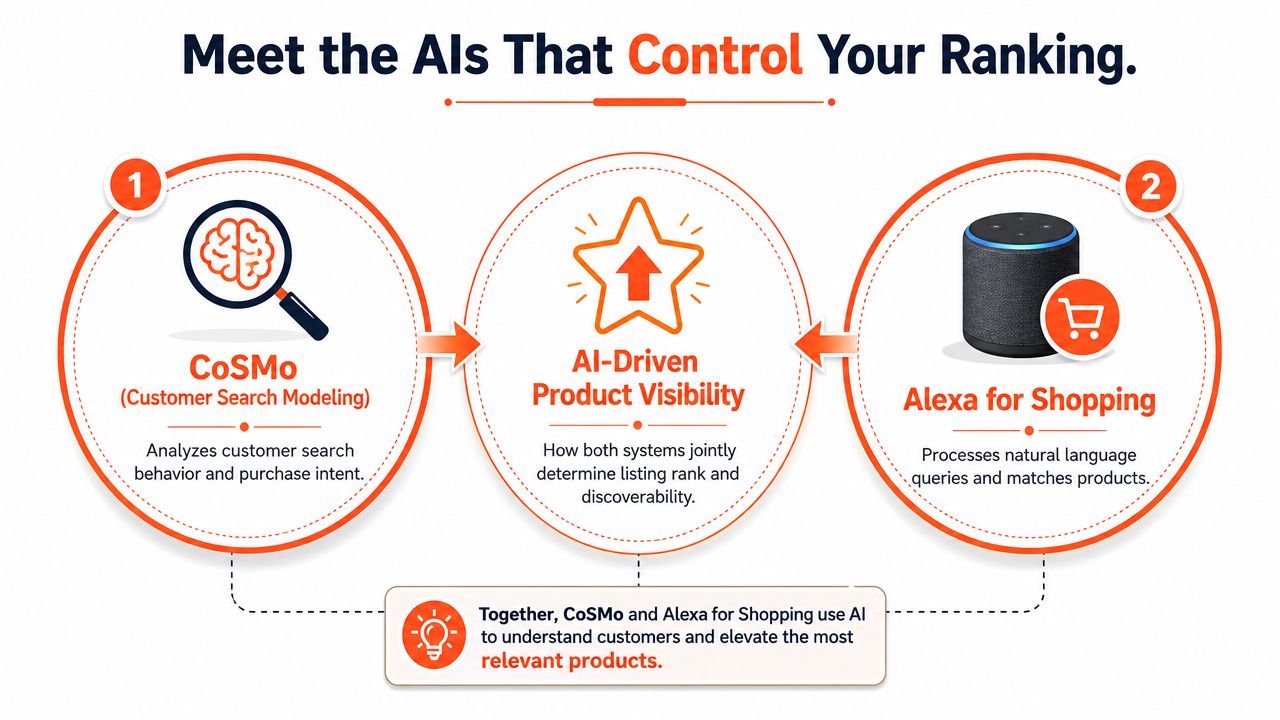
Two systems matter most in Amazon discoverability.
CoSMo is Amazon's internal content quality model. It scores content across 15 dimensions including relevance, clarity, and consumer focus, as outlined in Pattern's overview of Amazon SEO best practices. If CoSMo reads a listing as weak, visibility problems start upstream.
CoSMo decides whether the foundation is sound
CoSMo does not just check whether a term appears. It asks whether the content makes sense for the product and buyer.
That is why some listings look optimized on a checklist but still feel incomplete. They mention size, color, and materials, yet skip context that helps interpretation, such as usage location, routine, occasion, and shopper need.
A humidifier listing might say "ultrasonic, quiet, compact." A stronger version adds context such as bedroom, nursery, office desk, dry winter air, or nighttime routine.
Alexa for Shopping handles the shopper-facing layer
Alexa for Shopping officially replaced Rufus by combining Rufus's product expertise with Alexa+ capabilities into a single assistant, and it uses reviews, ratings, and customer sentiment to compare products and recommend items to shoppers, as described in Amplifyy's explanation of Alexa for Shopping. If you want a deeper look at how that interface works, Cosmy has a practical breakdown of Alexa for Shopping.
System | Main job | What it means for your listing |
|---|---|---|
CoSMo | Scores content quality and structural usefulness | Weak content gets suppressed before shopper-facing AI can help |
Alexa for Shopping | Interprets natural-language shopping queries | Strong listings are more likely to surface for conversational discovery |
Fix CoSMo first. Alexa for Shopping can improve visibility for real shopper questions, but it cannot rescue a structurally weak listing.
How to Audit Your Listings for AI Readiness

An AI-ready audit starts with structure, not keywords. Amazon's 2025 best practices require sellers to use the full 249-byte title space, while account health metrics such as ODR below 1% and Late Shipment Rate under 4% influence rankings, according to inriver's Amazon product SEO guidance.
Start with the non-negotiables
Check title construction
Use the title for core product identity, meaningful differentiators, and buyer-relevant attributes.Review duplication across fields
If the same phrase keeps appearing, you are wasting space that could add new context.Audit operational signals
Late shipping, cancellation issues, slow response times, and stock problems can hurt visibility.Look for missing life-context
Many listings describe the item, but not its practical use.
For teams that want a useful companion process for term selection after the audit, this guide to a data-driven Amazon keyword strategy is worth bookmarking.
The hidden gaps CoSMo tends to expose
The most common misses are context gaps:
Occasions and events: gift, travel, back-to-school, seasonal use
Usage location: kitchen, nursery, gym bag, car, patio, dorm
Consumer focus: why the feature matters, not just that it exists
Clarity: whether a shopper can skim and understand the listing fast
A basic example helps. A manual audit might approve "lightweight throw blanket, soft microfiber, machine washable." A stronger audit asks what is missing: couch, guest room, movie night, cold office, kids' room, holiday gifting.
Later in the workflow, speed matters too. If your team is trying to reduce rewrite cycles and shorten content approval, this look at time to market for listing updates is relevant.
A walkthrough helps when you are standardizing this process across a catalog:
Practical rule: If a listing tells me what the product is, but not when, where, or for whom it matters, I treat it as incomplete.
Writing Content for Shoppers and Algorithms
Most listing rewrites fail because they improve indexing language, not understanding.
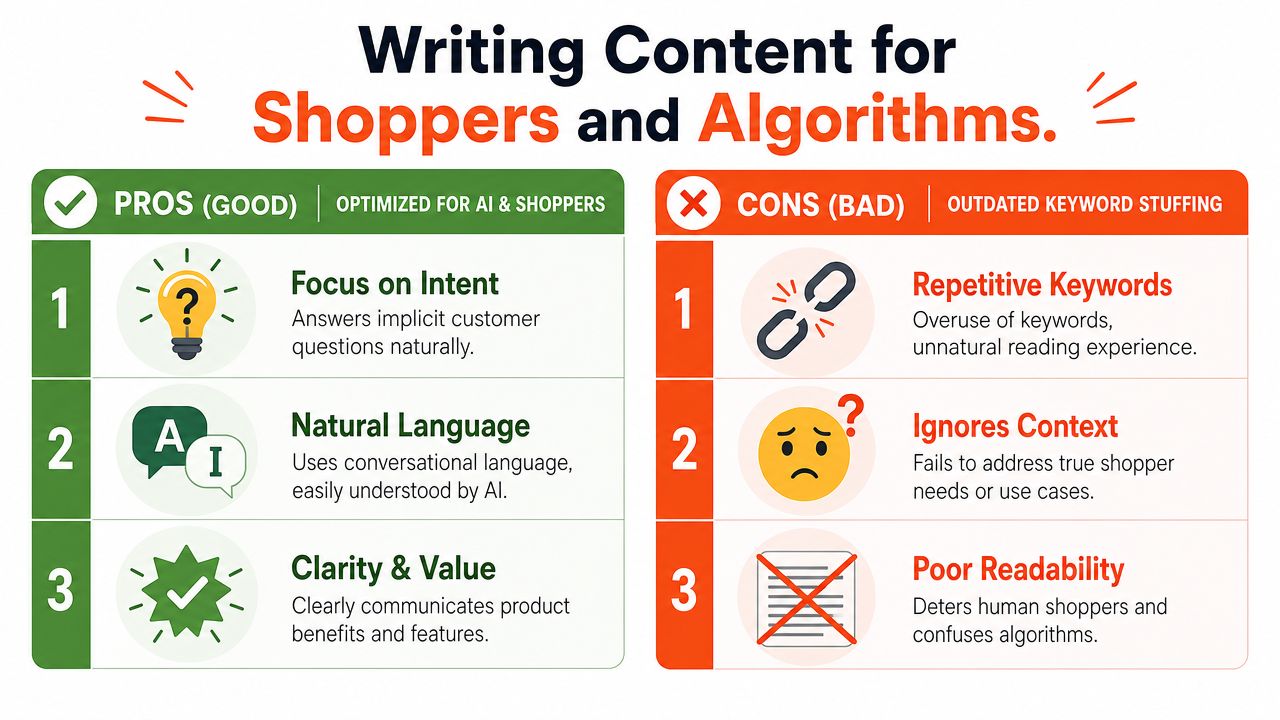
The strongest shift is moving from feature-led bullets to benefit-first bullets that answer conversational questions. The gap in most Amazon SEO advice is bullet optimization for voice-style and FAQ-driven discovery. Structuring bullets to answer conversational questions is a key dimension of CoSMo's 15-point scoring system, and starting each point with a benefit such as "Gentle on Sensitive Skin" improves AI comprehension, as explained in Mobius Services' 2025 listing optimization article.
Before and after the rewrite
Take a common beauty listing bullet.
Before
"Contains oat extract, ceramides, and fragrance-free formula for daily use."
After
Calms Sensitive Skin with a fragrance-free daily formula made with oat extract and ceramides, ideal for morning and evening routines when skin feels dry or reactive.
The second version leads with the benefit, supports it with ingredients, and adds routine context.
What a stronger bullet set looks like
Across all five bullets, cover broad shopper intent:
Open with a benefit: "Reduces morning puffiness" is stronger than "stainless steel roller head."
Add a use case: Mention bathroom routine, travel bag, office lunch, nursery shelf, weekend hiking, or guest room.
Include buyer language naturally: Fold the phrase into a readable sentence.
Cover unstated questions: Is it easy to clean? Suitable for gifting? Useful in small spaces? Good for daily use?
A short example for a portable blender shows the difference:
Weak bullet | Better bullet |
|---|---|
USB rechargeable with compact motor | Blends Smoothies on the Go with a compact rechargeable design that fits gym bags, office desks, and travel routines |
BPA-free cup and stainless blades | Safer Daily Use with a BPA-free cup and stainless blades for shakes, protein drinks, and quick single-serve blends |
Good Amazon copy does not just describe the product. It answers the question behind the search.
If your team is using AI tools to accelerate copy production, quality control matters. This piece on high-converting AI product descriptions is useful because it keeps the focus on clarity and conversion, not content volume.
Advanced Tactics for Discoverability and Conversion
Advanced gains do not come from adding more keywords. They come from making the listing easier for Amazon's AI systems to classify, retrieve, and trust.

The levers that compound
Attributes and filters
Size, material, color, compatibility, age range, and similar fields help Amazon place the product into the right browse paths and filter sets.Backend search fields
Use backend fields for synonym coverage, alternate naming, abbreviations, and phrasing that would make front-end copy awkward.Structured testing
Test the assets that change click-through and conversion, especially the main image, title framing, A+ modules, and offer presentation.
A practical optimization loop
Find gaps in catalog data, indexing coverage, and conversion friction.
Complete attributes and backend fields with clear, non-duplicative inputs.
Support the listing with Sponsored Products to generate query and conversion data.
Review search term reports, conversion rate trends, and competitor shifts.
Retest the weakest asset first, usually the image stack, title angle, or price-pack architecture.
Cosmy fits into this stage because it audits and rewrites listings through CoSMo and Alexa for Shopping, which is useful for teams that need publish-ready content tied to Amazon's internal AI logic, not another static checklist. If your team also tracks momentum through sales velocity signals, this guide to Amazon bestseller rankings gives the right context for how BSR relates to listing performance.
The Future of Amazon Discoverability
Amazon no longer ranks listings on keyword presence alone. It ranks them on how well its systems can interpret the product, predict buyer intent, and trust the page to satisfy the click.
Strong Amazon SEO optimization now looks closer to catalog engineering than old-school copywriting. The best listings give Amazon clean signals across titles, bullets, attributes, images, reviews, and behavioral data.
The goal is not to mention more terms than the competitor. The goal is to reduce ambiguity better than the competitor.
Cosmy is useful in that environment because it evaluates listings through CoSMo and Alexa for Shopping, then helps teams rewrite content in a format Amazon's internal AI can interpret more cleanly. That matters if your workflow still relies on static SEO templates built for an older version of Amazon search.
Amazon SEO optimization now means helping Amazon's AI understand your product better than competing listings do. That is how discoverability works now.
If your team needs a faster way to audit and rewrite listings for the AI search era, Cosmy helps brands and agencies evaluate product pages through CoSMo and Alexa for Shopping, then generate publish-ready listing content built for Amazon and other marketplaces.