Alexa for Shopping: A Guide to AI-Driven Discoverability


Amazon product copy now has two jobs. It still needs to index, but it also needs to explain.
That changes how teams should write listings for Alexa for Shopping. The old habit of repeating category terms in titles and bullets is no longer enough. The system has to understand what the product is, who it fits, and which shopper question it answers. If your copy is vague, inconsistent, or overloaded with keyword variants, AI-generated recommendations have less usable evidence to work with.
The practical shift is bigger than Amazon. Walmart is pushing AI-assisted shopping with Sparky, and other retail platforms are building similar layers on top of search. The common rule is simple. Retail search is becoming a comprehension problem, not just a retrieval problem.
For brand managers, that means auditing listings with a different standard. Start by sorting your content into three buckets: core product facts, use-case claims, and proof. Then rewrite with one bullet, one intent, so each line answers a clear shopper question without mixing benefits, ingredients, and compliance language. That structure makes weak listings easier to spot and easier to fix.
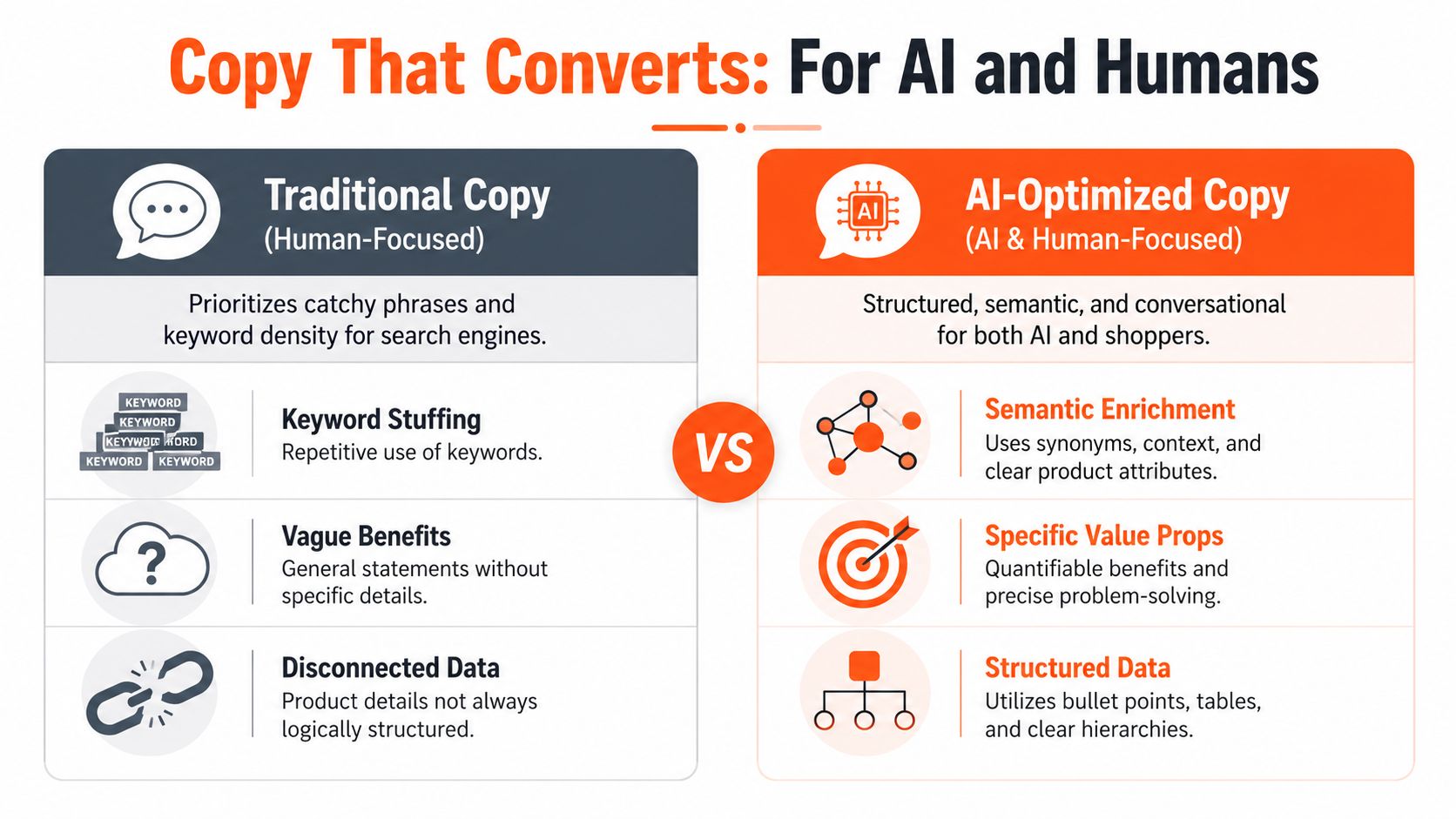
A Greek yogurt listing is a good example. If one bullet tries to cover protein content, texture, flavor, breakfast occasions, and dietary claims at the same time, an AI system has to guess what matters. A cleaner version separates those ideas into distinct units. The same issue shows up in baby formula, where unclear feeding stage details or buried ingredient differences can block the product from matching high-intent questions. Teams using modern eCommerce SEO strategies for AI-driven retail search need to write for that level of clarity.
Why Your Amazon SEO Strategy Is Obsolete
Amazon SEO now rewards product understanding, not keyword density.
For years, brand teams could get acceptable results with a familiar checklist: exact-match phrases in the title, repeated category terms in bullets, backend search terms packed with variants, and paid traffic used to reinforce rank. Those tactics still help with basic indexing. They no longer decide which products an AI shopping assistant can explain, compare, and recommend with confidence.
As noted earlier, Rufus and Alexa for Shopping have changed the shape of discovery on Amazon. Shoppers ask full questions now. They ask for the best option for a small apartment, a toddler with sensitivities, or a post-workout routine. A listing built around term repetition gives weak input to that kind of system.

What changed in practice
The ranking problem is no longer just retrieval. It is comprehension.
A legacy listing strategy assumes Amazon will connect a product to demand if the right terms appear often enough. The current system asks a harder question: can Amazon tell what the product is, who it fits, what need it serves, and when it should be excluded? If the copy is vague, overloaded, or structurally messy, the system has less usable evidence.
This is why many "optimized" listings now stall. The title is stuffed. The bullets mix ingredients, benefits, certifications, and audience in a single line. The description repeats claims without adding context. For a human shopper, that is annoying. For AI, it creates ambiguity.
A simple test works well here. Read the title and bullets out loud as if they were answers to shopper questions. If the wording sounds evasive, bloated, or hard to parse, the listing was built for an older ranking model.
What breaks first
The first failure point is usually intent matching.
Take Greek yogurt. A weak bullet often tries to say everything at once: protein content, texture, flavor, breakfast use, digestive benefits, and diet fit. That gives an AI system a pile of attributes, but no clear answer to a specific question. A cleaner listing separates those ideas so each line serves one intent. That is the "one bullet, one intent" rule in practice.
The same pattern shows up in baby formula. If stage fit, ingredient differences, or feeding context are buried inside generic marketing copy, the listing becomes harder to match to high-intent questions from parents. In regulated or high-consideration categories, that gap matters fast.
Teams working through modern eCommerce SEO strategies for AI-driven retail search need to audit listings for clarity at the sentence level, not just keyword coverage.
What brand teams should stop doing
Several habits now reduce performance:
Keyword stacking in titles makes listings harder to interpret and easier for AI systems to flatten into generic results.
Mixed-intent bullets force one line to answer five questions poorly instead of one question clearly.
Thin descriptions leave missing context around use case, fit, and comparison.
Blind syndication across channels ignores the fact that each retailer is building its own AI layer and its own interpretation rules.
The broader shift is already visible across retail. Brands investing in leveraging AI for voice commerce are adapting to a model where product data has to support spoken questions, guided recommendations, and conversational comparisons.
The practical takeaway is straightforward. Stop treating listing optimization as a keyword placement exercise. Treat it as relevance engineering. Audit the listing in three buckets: core product facts, use-case claims, and proof. Then rewrite so each bullet carries one intent, one clear claim, and one piece of usable context. That is the standard Alexa for Shopping can work with.
Understanding CoSMo and Alexa for Shopping
If you want to understand why one listing gets surfaced and another gets ignored, you need to separate the two systems that matter most on Amazon.
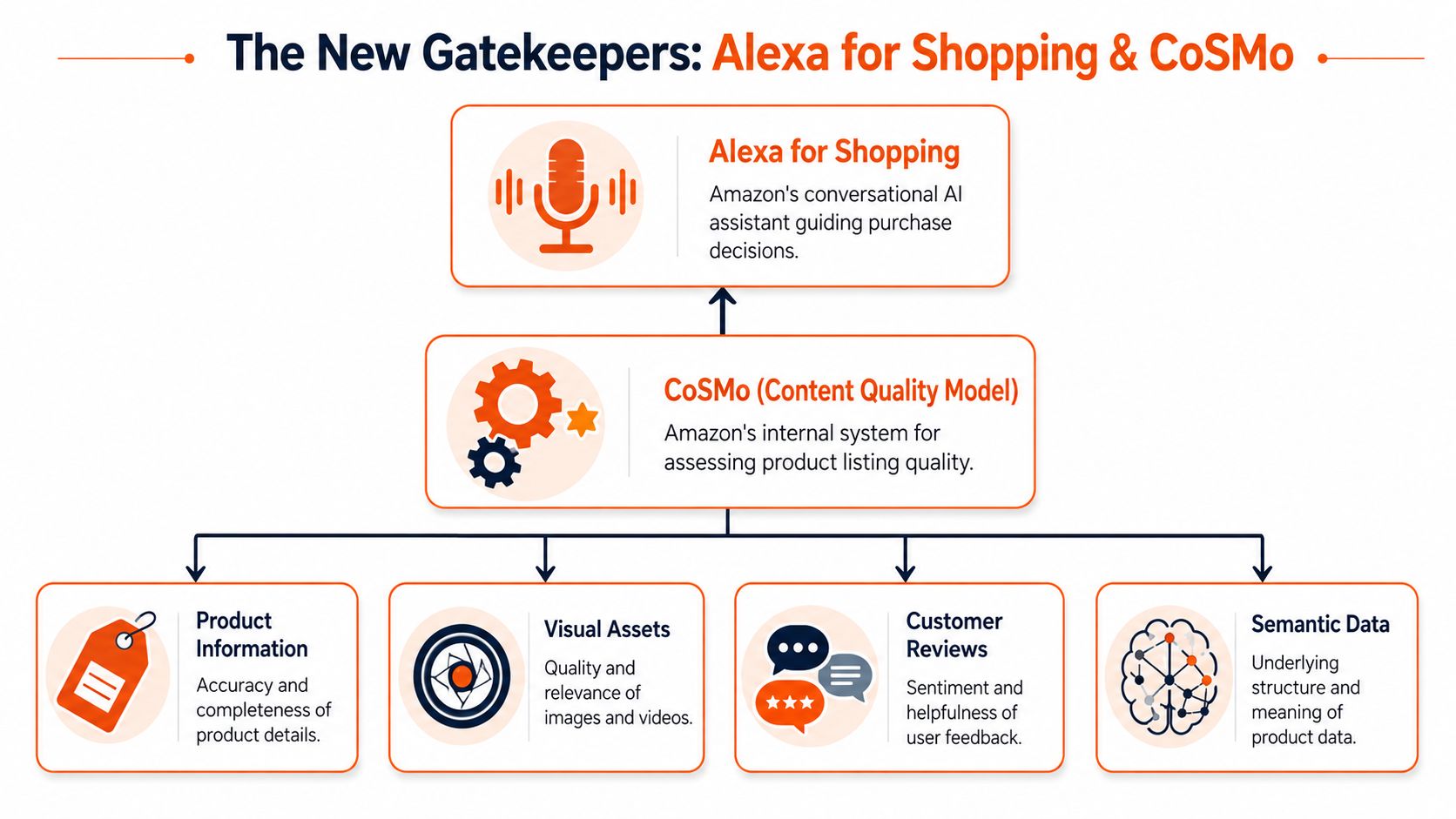
CoSMo is the internal content quality model. Alexa for Shopping is the shopper-facing assistant that turns that understanding into recommendations, comparisons, and answers. One evaluates whether your listing is semantically complete. The other uses that information during the shopping conversation.
What CoSMo is actually judging
Amazon's content quality model CoSMo evaluates product listings across 15 explicitly named relationship types, including audience, function, use-context, and complementary products (ZonGuru). That's the important part. It's not just looking for isolated terms. It's checking whether the listing captures the product's relationships to real shopping intent.
A good listing doesn't just say what the item is. It tells Amazon who it's for, what problem it solves, where it's used, what it works with, and how it compares.
A weak listing often fails on those relationships even when it contains the “right” keywords.
System | Role | What it cares about |
|---|---|---|
CoSMo | Evaluates listing quality for semantic coverage | Audience, function, use-context, complementary products, attributes |
Alexa for Shopping | Answers shopper questions and recommends products | Whether it can explain product fit clearly and confidently |
How Alexa for Shopping uses that foundation
Alexa for Shopping is where shoppers feel the change. They ask a question in natural language. The system interprets the request, retrieves evidence from the live catalog, reviews, and Q&A, then generates an answer. If the listing doesn't give it enough usable material, your product may not make the cut.
That's why AI discoverability isn't a copy trick. It's a content operations issue.
Teams that want a broader view of how voice interfaces are changing purchase journeys should look at Bridge Global's piece on leveraging AI for voice commerce. The useful takeaway for marketplace managers is that voice and conversational commerce reward clarity, specificity, and structured product data, not clever phrasing.
A listing can be visible in traditional search and still be weak in Alexa for Shopping if it doesn't answer intent-rich questions directly.
For brands selling through Amazon today, the practical sequence is straightforward. First, make the listing legible to CoSMo. Then make it useful to Alexa for Shopping. If you're managing both seller and vendor workflows, this is part of the broader discipline of selling on Amazon well in an AI-first environment.
How to Audit Your Listings for AI Readiness
Most listing audits still start with keywords, indexing, and conversion elements. That misses the question that matters in Alexa for Shopping: can the listing answer real shopper queries on its own?
The cleanest way to audit an ASIN is to simulate how an AI shopping assistant reads it.

The three-bucket audit
The workflow I use is simple and repeatable.
Start with the full listing: title, bullets, description, and A+ content.
Generate shopper-style queries for that product category.
Test whether the listing answers each query clearly.
Sort every query into one of three buckets.
Those three buckets are the ones that matter:
Answered by the listing
The title, bullets, description, or A+ content gives a complete and accurate answer.Answered by reviews
The listing doesn't cover it, but reviews provide enough evidence for the system to respond.Partial or no answer
The content is vague, mixed, incomplete, or silent.
That ratio tells you more about AI readiness than a keyword rank snapshot. If too many answers come from reviews, you've handed product positioning to customers. If too many fall into the third bucket, the AI has no reason to surface you confidently.
For teams that already run broader DTC e-commerce audits, this is the missing marketplace layer. It moves the audit from page quality into AI answer quality.
What to check first
Don't start by rewriting. Start by spotting coverage gaps.
I usually review the buckets in this order:
First, listing-answered queries
These show what your current content already communicates well.Second, review-answered queries
These are often your biggest upside. The demand exists, but your listing isn't owning the message.Third, partial and no-answer queries
These become the rewrite brief.
One useful pattern appears quickly. AI systems surface phrasing that classic keyword tools often miss. Parents ask whether something is “gentle on sensitive stomachs.” Fitness shoppers ask whether a product is “good for a post-workout snack.” Those are intent-rich questions, and they often don't appear in legacy SEO workflows.
Here's a walkthrough that shows the category of analysis you should be doing inside a live optimization process:
One useful tool choice
If you want to operationalize this at scale, use a tool that simulates AI shopper queries against the actual ASIN content. One option is Amazon content strategy workflows, especially when paired with a platform that fetches the listing and scores query coverage across the three buckets. Cosmy does that by pulling the ASIN content, generating category-relevant queries, and identifying which answers come from listing copy versus reviews.
Your audit is finished when you can point to the exact shopper questions your listing fails to answer. Until then, you're still looking at symptoms.
Rewriting Copy for AI and Human Shoppers
The best AI-ready copy doesn't sound robotic. It sounds like a competent brand team finally answered the customer's actual questions.
That's the shift many listings still haven't made. They describe features in merchant language instead of explaining outcomes in shopper language. Alexa for Shopping favors conversational answers, and a 2025 Jungle Scout study found that 68% of shoppers using AI assistants prefer products described in plain language over keyword-stuffed titles (Amplifyy).
The Greek yogurt example
One beta listing made the problem obvious.
The product was a Greek yogurt item optimized around terms like “high protein yogurt.” That language wasn't wrong. It was just incomplete. Alexa for Shopping kept pulling answers from reviews for shopper questions like whether it was good for a post-workout snack or usable as a meal replacement.
The listing implied those use cases, but it never said them directly.
After the rewrite, the bullets addressed:
fitness recovery
on-the-go nutrition
meal replacement scenarios
The language got more specific and more conversational. Instead of listing a nutrition attribute and hoping the shopper made the leap, the bullets answered the intent directly.
The result wasn't magic. It was clarity. Once the listing started stating those use cases explicitly, the product began surfacing for intent-driven queries it had previously missed.
The baby nutrition example
Baby nutrition is another category where old keyword workflows break down fast.
Review analysis surfaced phrases like:
“will this help with colic”
“is this gentle on sensitive stomachs”
Those questions rarely come from keyword tools because they're not just search terms. They're concerns. They reflect how a parent talks when trying to solve a problem.
The rewrite approach was to place those phrases into bullets as explicit benefit statements, not cram them into a title. That distinction matters. AI systems don't just scan for token matches. They look for a direct answer they can cite with confidence.
If Alexa for Shopping can't find the answer in your listing text, it will either pull from reviews or skip the product.
What good rewrites usually look like
A practical structure works well:
Weak copy | Better copy |
|---|---|
High protein yogurt | Good for post-workout recovery and quick on-the-go nutrition |
Gentle formula | Designed for babies with sensitive stomachs |
Waterproof design | Built for wet weather use during hikes, travel, or daily commuting |
If your team needs help producing this at scale across a large catalog, the challenge isn't generating more words. It's generating better answer-led copy consistently. That's where workflows for scaling content with generative AI can help, as long as the output is grounded in real shopper questions and product truth.
Optimizing Backend Data The Unseen Engine
Many teams spend hours debating title structure and bullet phrasing, then leave half the backend attributes untouched.
That's backwards.
CoSMo can't build semantic relationships from fields you never filled in. For Alexa for Shopping, blank attributes aren't harmless omissions. They remove context the system needs to understand what the product is for, what it works with, and when it should appear.

What needs attention in Seller Central
To optimize for Alexa for Shopping, sellers need to fill every backend attribute field in Seller Central, including item type keyword, intended use, material, size, weight, compatibility, and care instructions. Blank fields act as liabilities because they prevent CoSMo from processing semantic relationships, and updated attributes need a 7 to 14 day processing window to be reindexed (Perpetua).
That changes how I prioritize listing work.
Before rewriting front-end copy, I check whether the backend tells Amazon enough about:
what the product is
who it's for
what it's compatible with
how it should be used
what constraints matter
A cast iron skillet with no oven-safe context is incomplete. A supplement with no intended-use detail is incomplete. A charger with missing compatibility attributes is incomplete.
The operational trade-off
Backend cleanup is less visible than copy refreshes, so teams often delay it. But it usually has a bigger impact on AI comprehension because it sharpens the product's semantic frame before the assistant ever tries to answer a shopper question.
The trade-off is patience. You won't see the effect instantly.
Watch for timing: if you update attributes today and test tomorrow, you may conclude nothing changed when the system simply hasn't reprocessed the listing yet.
A simple backend checklist
Use this for priority ASINs first:
Item type keyword
Make sure the product is classified precisely, not broadly.Intended use
State the use case directly. Don't assume the title covers it.Material and composition
Especially important in apparel, cookware, furniture, baby, and beauty.Size and weight
These often influence fit queries and comparison logic.Compatibility
Essential for electronics, accessories, home improvement, and replacement parts.Care instructions
Useful for lifestyle, home, apparel, and repeat-purchase categories.
A lot of Amazon optimization work still treats backend attributes like admin cleanup. In AI-driven discovery, they're part of the retrieval layer.
The One Rule for High-ROI Optimization
The highest-ROI change an organization can make is also the simplest.
One bullet, one intent, one clear answer.
That rule works because Alexa for Shopping isn't reading your listing the way a search crawler does. It's interpreting each shopper request against a structured intent model. Amazon's query planner parses requests across seven dimensions, including use case and intent node, and only recommends products it can explain with high confidence (Andrew Bell on LinkedIn).
That means buried information often gets treated like missing information.
What fails
Many bullets still look like this:
premium ingredients
durable construction
easy to use
compact design
great for everyday use
None of those are false. They're just weak. They don't answer a shopper question directly, and they don't give an AI system much to work with.
A bullet that says “compact design” may not help with a query about apartment storage, travel, or a small kitchen. A bullet that says “fits easily in dorm rooms, studio apartments, and office kitchens” gives the system a usable answer.
What works
A better bullet structure is direct:
the outcome first
the feature that enables it
the use case that clarifies fit
That creates cleaner alignment between shopper intent and listing language.
For example:
Feature-list bullet | Intent-led bullet |
|---|---|
Long battery life | Runs through long workdays and travel days on a single charge |
Gentle formula | Suitable for sensitive stomachs and everyday feeding routines |
Easy storage | Fits small apartments, dorm rooms, and tight pantry spaces |
This is usually the fastest way to improve AI readability without rewriting the entire page.
Where to focus first
Don't spread effort evenly across the whole catalog.
Start with:
products already converting well in traditional search
listings where reviews are carrying important use-case answers
ASINs in crowded categories where shopper questions are more nuanced
products with strong inventory position and stable pricing
That last point matters because availability still shapes visibility. If a listing isn't consistently purchasable, it's much harder to build durable discoverability through an AI assistant.
The teams getting the best results aren't writing more. They're removing ambiguity.
Amazon is the clearest example today, but the same operating principle is showing up across major marketplaces, including Walmart and other retail platforms building AI shopping layers. The winners will be the brands that treat content quality as product infrastructure, not merchandising decoration.
If you want a faster way to audit and rewrite listings for this shift, Cosmy helps brand teams evaluate ASINs through the lens of Alexa for Shopping and CoSMo, identify unanswered shopper queries, and turn those gaps into publish-ready listing copy.