Amazon Growth Strategy: A 30-Day Playbook


The popular Amazon growth strategy is still built around a simple formula: add more products, add more keywords, and spend more on advertising. That formula made sense when ranking depended heavily on matching search terms. It breaks down when Amazon has to interpret conversational questions, compare products by use case, and decide whether a listing gives shoppers enough reliable information to buy.
The bigger change is structural. Amazon's marketplace reached an estimated $830 billion in global GMV in 2025, while active sellers fell to 1.65 million and new seller registrations reached a decade low of 165,000, according to Marketplace Pulse's analysis of Amazon's 2025 GMV. Growth is concentrating among sellers with strong assortment economics, clear product content, dependable operations, and enough conversion data to keep earning visibility.
That makes the modern Amazon growth strategy less about occupying every possible shelf and more about improving the few ASINs that can capture disproportionate demand. The practical question is no longer, “How many keywords can we add?” It's, “Can Amazon's systems and the shopper both understand why this product belongs in the consideration set?”
Table of Contents
Why Most Amazon Growth Strategies Fail in 2026
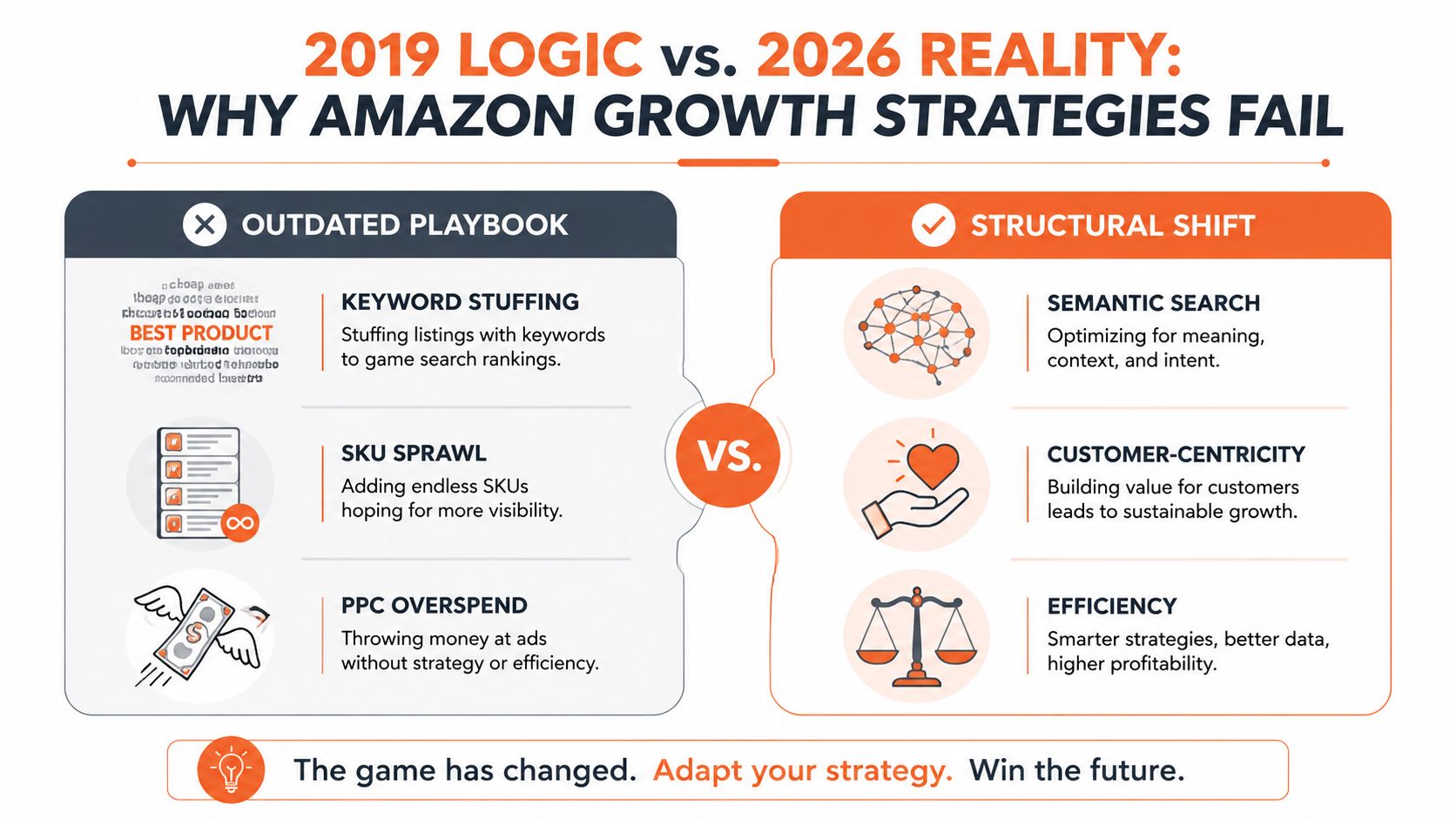
Most marketplace playbooks still use 2019 logic. They treat keyword volume as the primary growth lever, assume a larger catalog automatically creates more opportunity, and use PPC to compensate for weak product pages. Those tactics can create activity without creating durable demand. More impressions don't help much when shoppers reach the detail page and find unclear images, generic bullets, weak proof, or a price that doesn't match the perceived value.
The marketplace itself shows why broad expansion isn't enough. Third-party sellers were estimated to represent 69% of Amazon's total GMV in 2025, about $575 billion of roughly $830 billion, up from 60% in 2019. They also represented about 61% of items sold in 2025. Yet fewer than 8,000 sellers, around 1.6% of the active U.S. seller base, were estimated to generate half of Amazon's roughly $300 billion in U.S. third-party GMV as of February 2026. These figures come from Amazon marketplace statistics for 2026.
The implication is uncomfortable for teams managing large catalogs. SKU sprawl can hide underperformance, and a rising advertising budget can mask a listing problem rather than solve it.
Why keyword stuffing loses value
Keyword stuffing creates a page that may contain relevant terms but lacks a coherent explanation. Amazon's newer discovery experiences need to interpret attributes, use cases, trade-offs, and shopper questions. A title that repeats variants of “insulated water bottle” says less than a title that clarifies capacity, material, leak resistance, and the setting in which the product is useful.
Amazon's own launch research supports a broader view of content quality. Top-performing ASINs were 2.2 times more likely than lower-performing ASINs to have content without image defects, as reported in Amazon's study of new product launches. That doesn't prove one image fix guarantees a ranking lift. It does show that listing integrity is tied to launch performance and deserves attention before teams buy more traffic.
Amazon's AI shopping assistant, Alexa for Shopping, is available to U.S. customers in the Amazon Shopping app and on Amazon.com. Amazon says it combines Rufus and Alexa to recommend products, compare options, surface historical pricing, set price alerts, and support Auto Buy when an item reaches a target price, as described in Amazon's seller guidance for Alexa for Shopping. Content written only for exact-match indexing gives these systems less useful material to interpret.
Practical rule: If a shopper can ask a question about your product, the detail page should answer it in plain language.
A useful overview of broader e-commerce growth strategies for 2025 can provide channel context, but Amazon teams still need to make decisions at ASIN level. The winning approach is selective: improve conversion readiness, strengthen semantic coverage, and spend behind products that can turn relevance into profitable sales.
The Diagnostic Framework for Catalog Growth
Before changing a title or moving a bid, place every ASIN on two axes:
Discoverability potential, based on demand, category position, query coverage, and how clearly the content explains the product.
Conversion readiness, based on image quality, content completeness, pricing, review sentiment, and the shopper's ability to understand the offer quickly.
This creates four operating zones. The point isn't to assign a permanent label. It's to stop treating every ASIN as if it deserves the same creative, media, and inventory investment.
Catalog Diagnostic Quadrant Matrix
Quadrant | Discoverability | Conversion Readiness | Primary Action | Resource Allocation |
|---|---|---|---|---|
Scale | Strong | Strong | Increase qualified traffic, expand useful query coverage, and protect profitable placements | Highest priority for media and creative resources |
Fix | Strong | Weak | Repair images, copy, pricing, proof, and offer clarity before adding traffic | Concentrated content and merchandising effort |
Defend | Weak or narrowing | Strong | Protect the listing, investigate lost query coverage, and monitor competitors | Targeted research and controlled advertising |
Sunset | Weak | Weak | Reduce investment, consolidate variants, or remove the ASIN from active growth plans | Minimal maintenance unless strategic value exists |
The Scale quadrant contains products that already convert and have room to reach more relevant shoppers. The mistake here is changing too much at once. Preserve the elements that work, then widen coverage through adjacent use cases, comparison language, and carefully structured campaigns.
Fix is often the most valuable zone. These ASINs have demand potential, but paid traffic exposes the page's weaknesses. Review the main image first, then secondary image coverage, title clarity, bullets, description, A+ Content, price, and variation structure. Amazon's image-defect research makes this sequence practical, because content integrity can affect performance before additional traffic has a chance to help.
Defend requires a different mindset. A strong converter with declining visibility may have lost indexing coverage, category relevance, inventory continuity, or a key placement to a competitor. Don't rewrite the entire page immediately. Compare historical query performance, retail readiness, and recent catalog changes first.
For the Sunset group, discipline matters more than optimism. A product with poor discoverability and weak conversion readiness can consume design time, ad budget, and operational attention without improving the portfolio. Keep only the ASINs that serve a strategic role, such as completing an assortment or supporting a profitable bundle.
Pull the evidence from Brand Analytics, Search Query Performance reports, and Business Reports. Use sessions, ordered units, conversion, query-level impressions, clicks, cart activity, and purchase share to separate a traffic problem from a page problem. Tools such as Cosmy's Amazon content strategy workflow can add an AI-oriented review of semantic gaps and content completeness, but the output should still be checked against commercial realities such as margin, stock, and category competition.
Prioritized Actions That Actually Move Revenue
Order matters because traffic amplifies whatever is already on the page. If the listing is unclear, increasing PPC can make the weakness more expensive. A practical 30-day sequence starts with conversion readiness, moves into discoverability, and only then reallocates media.
Start with the page shoppers see
Main image and title come first. The main image needs to make the product recognizable at thumbnail size and show the correct pack, format, and variant. The title should identify the product, its defining attribute, and its primary use without reading like a keyword list.
A weak title might say: “Kitchen Organizer Cabinet Storage Rack Counter Shelf Home.” A stronger version would explain the product's form and purpose, such as a countertop organizer designed for spices and small cooking tools. The second version gives shoppers and AI systems a clearer product entity, even if it uses fewer repeated terms.
Then audit the secondary image stack. Use images to answer practical objections: dimensions, fit, materials, included components, setup, care, and the difference between variants. Independent research reported that moving from five to ten images increased conversion by 48%, while adding a sixth bullet reduced conversion by 43.5%, according to the listing content research summarized by Zigpoll. Treat that finding as a design constraint, not a mandate to add images or bullets blindly. More visual proof can help. More copy can hurt when it creates repetition.
Repair proof and offer clarity
A+ Content should demonstrate the product in context, compare variants objectively, and reinforce reasons to choose the brand. It shouldn't repeat the bullets in decorative panels. Pricing should be reviewed against direct alternatives, pack size, included accessories, and the promise made by the images.
The best before-and-after change is often not a dramatic rewrite. It's replacing a vague claim such as “premium quality for everyday use” with specific, verifiable information about construction, compatibility, or intended use. Avoid claims the product can't support, because short-term click appeal isn't worth customer dissatisfaction or policy risk.
Build semantic coverage after conversion fixes
Once the page is coherent, restructure bullets around intent clusters. One bullet can address the primary use case, another can clarify fit or compatibility, and another can handle a common objection. Backend terms should cover legitimate language shoppers use but shouldn't duplicate the visible copy or become a dumping ground.
The product detail page should also keep attributes consistent across title, bullets, images, A+ modules, and structured fields. Conflicting information creates uncertainty for shoppers and makes interpretation harder for automated systems.
Rebuild advertising around the new page
Move proven, high-intent queries into focused Sponsored Products campaigns. Use discovery campaigns to find additional language, but separate them from campaigns designed to protect profitable terms. Sponsored Brands can support category defense when the brand has enough range and creative assets to make the click useful.
Don't raise bids because impressions are low. First check whether the listing is indexed, retail-ready, in stock, competitively priced, and converting. After the content changes have had time to generate clean data, calibrate bids to the revised conversion rate and contribution margin. A lower click price won't rescue an offer that shoppers don't understand.
Winning Discoverability in the AI Search Era
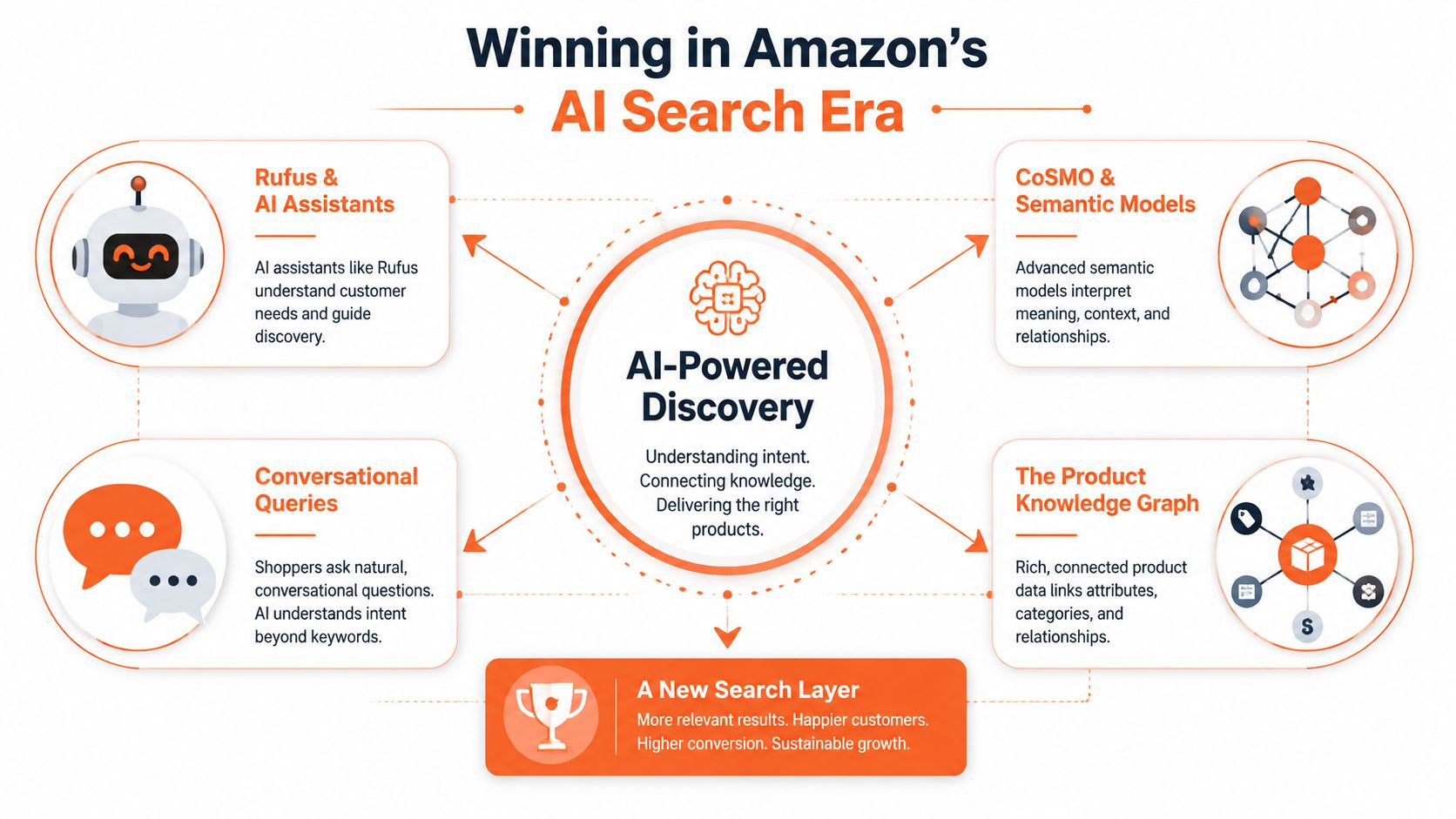
Keyword SEO still supports discovery, but Amazon is becoming a power-law marketplace where a smaller group of sellers captures more demand. Growth therefore depends on whether an assistant can understand a product, match it to a shopper's situation, and explain why it fits. A shopper may ask for a leakproof bottle for a long commute, compare alternatives, check cleaning requirements, and choose an option for a specific use. Your listing must answer that chain of questions with accurate attributes and natural language.
As introduced earlier, Alexa for Shopping combines Rufus and Alexa to recommend and compare products, surface historical pricing, set alerts, and support target-price purchasing. That capability changes the content brief. State who the product suits, which problem it solves, what constraints it has, and how it differs from alternatives. Use customer reviews and support tickets to identify the questions shoppers ask, rather than repeating legacy keyword formulas.
Write for questions, not keyword piles
Build an intent map with four groups:
Category intent, the name shoppers use for the product.
Use-case intent, where, when, and why they use it.
Comparison intent, the meaningful differences from common alternatives.
Objection intent, the concern that could stop the purchase.
Assign each answer to the format that proves it best. The title establishes identity. Bullets explain primary reasons to buy. Images demonstrate physical or functional details. A+ Content adds context and clarifies differences. Reviews expose language and use cases the brand may have missed.
CoSMo, Amazon's Contextual Shopping Model, is a useful content-quality lens, not another keyword field. Strong listings connect attributes to shopper needs. They make relationships clear, such as capacity for a specific routine, compatibility with a device, or a feature that addresses a known objection. Adding every related phrase to one paragraph weakens that explanation.
Extend the evidence beyond visible copy
Reviews, customer questions, video transcripts, and off-Amazon brand content can reveal how customers describe the product in real situations. Use those sources to find missing explanations. Do not copy negative comments into marketing claims or make promises the product cannot support.
The same operating principle applies across retail platforms. Walmart's Sparky is designed to find products, synthesize reviews, compare options, and provide personalized recommendations for signed-in U.S. customers, according to Walmart's Sparky help page. Walmart also describes Sparky as an agentic assistant that can help shoppers find and compare products, build lists, and plan occasions by synthesizing reviews and product data in its technology overview.
Content operations must support that shift. Maintain one reliable product knowledge base, then adapt the explanation for Amazon, Walmart, and other retail environments while preserving accurate attributes and use cases. Teams seeking specialist support can evaluate top ecommerce SEO specialists for broader marketplace content work.
For a practical view of Amazon-focused content workflows, Cosmy's e-commerce Amazon guide offers another reference. AI discoverability follows useful product understanding, not attempts to trick an assistant.
KPIs Timelines and Governance for Sustainable Growth
A 30-day sprint needs fast indicators, but it shouldn't confuse early movement with a finished growth outcome. Content indexing, query coverage, conversion, advertising efficiency, and organic position move on different timelines. The reporting system should reflect that.
Amazon Growth KPI Framework by Time Horizon
Time Horizon | KPI Category | Specific Metrics | Owner | Action Trigger |
|---|---|---|---|---|
Week one | Visibility health | Session share, impression velocity, indexing coverage | Catalog and content | Investigate missing coverage, suppressed content, or sudden visibility loss |
Month one | Commercial performance | Unit session percentage, add-to-cart rate, TACoS | Growth and paid media | Recheck page, offer, and campaign structure when traffic rises without efficient sales |
Quarter one | Structural growth | Market share, branded search volume, organic rank stability | eCommerce lead | Increase investment when gains persist across relevant queries and margin remains sound |
The first week is for diagnosis, not declaring victory. Confirm that revised content is live, attributes remain accurate, images render correctly, and indexing hasn't been disrupted. Session share and impression velocity can show whether visibility is changing, but they don't explain why.
Month-one metrics connect page quality to commercial results. Unit session percentage and add-to-cart behavior help distinguish weak traffic from weak merchandising. TACoS shows whether advertising is supporting the whole business or buying sales that would have happened anyway. Use contribution margin alongside TACoS, because an efficient-looking campaign can still be unprofitable if the offer economics are poor.
Quarter-one measurement should focus on durability. Organic rank stability, branded search volume, and market share matter because they indicate whether the ASIN is becoming a stronger part of the category rather than benefiting from a short-lived campaign adjustment. Avoid reacting to every daily fluctuation. Change one major variable at a time where possible, document the version, and give the system enough clean data to interpret the change.
A workable governance model assigns one owner to each decision:
Content owner: listing copy, images, A+ modules, attributes, and version control.
Paid media owner: campaign structure, search-term harvesting, bids, budgets, and placement reviews.
Catalog operations owner: inventory, variation integrity, suppression, compliance, and retail readiness.
eCommerce lead: prioritization, margin guardrails, approvals, and escalation.
Use Cosmy's e-commerce KPI framework as a starting point for aligning content diagnostics with commercial measurement. Escalate immediately when an ASIN is suppressed, a policy issue appears, inventory becomes unavailable, or a major content change creates a material mismatch. Let algorithmic learning run when the listing is live, the offer is healthy, and the early data is noisy but directionally consistent.
Executing the 30 to 45 Day Growth Playbook
A mid-size brand with a 50-ASIN catalog might begin with a problem common to many marketplace teams: plenty of reports, many active campaigns, and no shared agreement about which products deserve attention first. The team starts by placing each ASIN in the diagnostic matrix, checking listing integrity, query coverage, conversion readiness, pricing, reviews, inventory, and advertising structure.
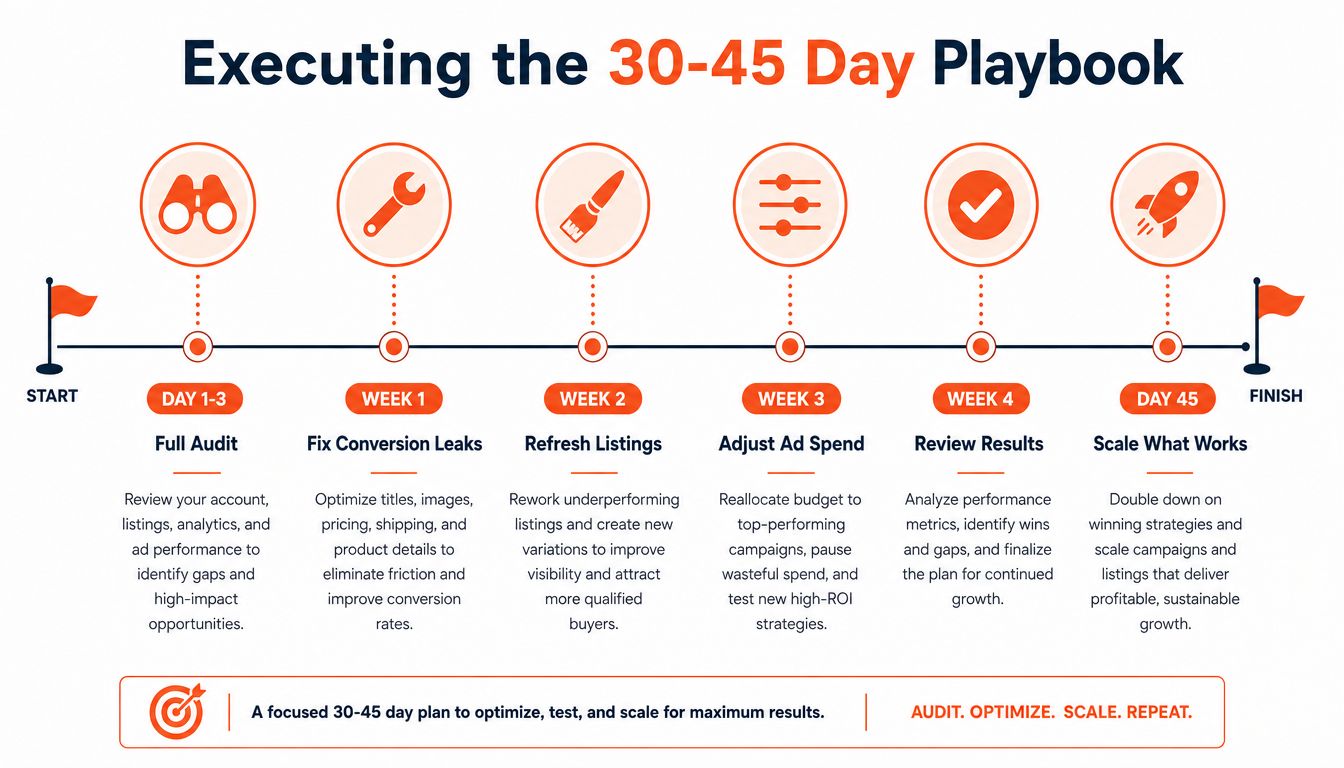
During Days 1 through 3, the team finds that several high-potential ASINs have incomplete image coverage, inconsistent attributes, and titles that lead with internal product names rather than shopper language. It also finds that some campaigns are sending traffic to products with weak contribution margins. The team doesn't rewrite every listing. It selects the ASINs in the Scale and Fix zones and documents the baseline before making changes.
In Week one, the content team repairs main images, removes unsupported claims, clarifies titles, and resolves indexing or suppression issues. A stakeholder objects to removing repeated keywords from a top-selling title, so the team compares the proposed wording against the product's attributes and customer questions rather than debating preference. The change is approved with version control and a rollback record.
Week two brings the larger listing refresh. Bullets are reorganized around use cases and objections, A+ Content fills proof gaps, and image requests move through a defined approval chain. Creative delays threaten the schedule, so the team publishes the compliant copy and existing approved assets first, then adds new visuals when ready. That prevents an unfinished asset pipeline from blocking the entire sprint.
In Week three, paid media is restructured around the revised pages. The team reduces spend on low-intent targets, protects relevant branded and category terms, and resists forcing an immediate ACOS improvement when the purpose of some campaigns is organic rank development. It pauses a campaign only when the data shows a real mismatch, such as sustained clicks without meaningful buying behavior, not because of a single weak day.
By Week four, the group reviews visibility, conversion, add-to-cart behavior, TACoS, and operational health together. One ASIN may show stronger relevance but need more pricing work. Another may convert well but require defensive advertising after losing important query coverage. The review determines which changes stay, which need another iteration, and which ASINs move into Sunset.
Between Day 30 and Day 45, the team shifts from sprint mode to an always-on operating rhythm. It keeps a change log, schedules recurring content audits, reviews search-term data, refreshes creative when customer objections change, and reserves larger investment for ASINs that demonstrate both demand potential and conversion readiness. That is the durable version of an Amazon growth strategy, fewer random edits, stronger evidence, and disciplined allocation of attention.
Cosmy audits Amazon listings for Alexa for Shopping and CoSMo-style content signals, analyzes customer language, and produces publish-ready titles, bullets, and descriptions for teams managing catalogs at scale. Visit Cosmy to assess which ASINs need conversion fixes, semantic coverage, or a clearer path to AI-driven discoverability.